
Last week, at Colgate University, former President Barack Obama shared his thoughts on President Trump’s decision to ban several news outlets from White House press briefings.
Obama posed an intriguing question. He asked what he would have done if he barred Fox News from the White House.
“It’s unimaginable,” he said.
He then spoke generally about Trump’s comments and how they impact the country as a whole. “If you have a certain cohort…30 to 35 percent of the country that is OK with that, then we haven’t built the knowledge of what democracy is all about and what it takes to sustain it,” said Obama.
“And we’ve gotta shore that back up.”
On September 18th, Colgate University invited Obama to speak on a variety of subjects, including his thoughts on citizenship, leadership and public service.
I keep coming back to one question.
Who are the 30 to 35 percent?
However, I am not interested in creating a negative peer group identity.
If Obama is correct about Americans being willfully ignorant of the tenets and institutions of American democracy and the rule of law, then we must investigate the beliefs of this demographic.
I don’t believe Trump voters are this 30 to 35 percent, but I may be wrong.
The problem is bigger than one political faction
Obama doesn't explicitly mention the segment of the population that accepts the behavior described above. However, in the context of his remarks, this group certainly exists.
Additionally, recent surveys show that the vast majority of people (77%) believe the First Amendment prevents government censorship. Other surveys also show that about 90% of the population does not believe the media should be censored by the government, and about 60% believe the government can censor the press if a story puts the country’s security at risk.
Democracy becomes harder when rules obstruct us.
Republicans and Democrats differ on those questions, sometimes substantially, but members of both parties become more willing to give government power over the press when they believe there is a sufficiently compelling reason.
That is the crux of the issue. Most Americans would probably say they favor democracy and believe in the importance of free and fair elections. I imagine most Americans also believe in an independent judiciary and, in general, the rule of law. The issues arise when we let our allegiance to a particular candidate or specific policy override our support for these values. Our allegiance to our side of the political aisle allows us to rationalize rules and standards that would otherwise constrain us.
Democracy is easiest when the rule helps us
A simple test that's not used often enough is this: would I give this power to the other side? If the answer is no, then that power should not be used. Using this test, should a Democratic president be able to exclude Fox News from the White House like a Republican president can exclude other news outlets? Should a Democratic Attorney General be able to open an investigation on a Republican candidate for president like a Republican Attorney General can investigate a Democratic candidate? If a ruling party can change election laws to its advantage, should the other party accept the same when it takes control?
The names should not determine the outcome of an election. Rules should.
Rules are meant to curb government power. Rules should also restrain the powerful when they lose control. We should use the strongest protection of individual freedoms when unpopular views become the most vocal. Protect individual freedoms when a president of the other party becomes unpopular. The same should apply to democratic checks and balances. The judiciary should be used when a president of the other party becomes unpopular and stops vote counts. A democracy should be practiced when the public becomes unpopular and gives checks and balances to the government.
There is evidence that partisanship changes what we see
This is not purely a theoretical issue. The team at Bright Line Watch has surveyed thousands of Americans to test their understanding and confidence in democratic principles. Their 2026 survey reported significant partisan differences on these issues. Americans’ confidence in the final vote count also diverged by party. Republican confidence dropped 12 percentage points, while Democratic confidence rose 11 points. The organization notes it is more important to study why this occurred. More relevant is the example this provides. Of course, we can and do teach the three branches of the federal government. However, it is also possible to deeply understand the three branches and conclude, for example, that the president and members of his party should not obstruct congressional oversight of the executive branch. Deep understanding is not the same as lack of knowledge. Deep understanding is also not the same as adherence to democracy’s principles and procedures. Many appear to support the rule of law until it negatively impacts them. I would like to think this is not true.
So how do we shore up democracy?
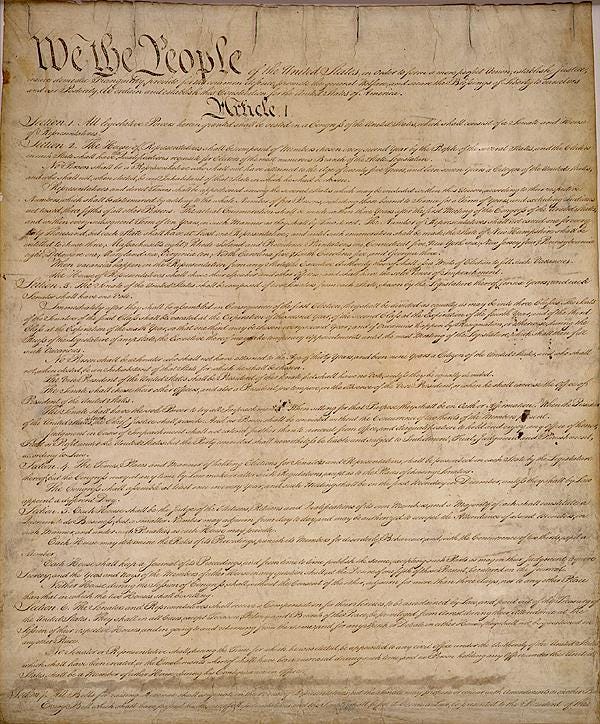
Another lecture on the Constitution won’t cut it. Students need to learn how the various checks and balances embedded within our political system work in practice.
One way to do this is to identify a real-world situation and analyze the power being exercised. Next, determine what restrains that power. Who or what are the institutions? Now consider the situation with different people in those roles. Is it something that we would accept? This type of exercise helps us to think about institutions differently.
When dealing with Congress, for example, rather than thinking of Congress as “gridlock,” think about what could restrain a member of Congress from acting to impose a particular policy on the country.
One way to think about the judiciary is to consider what gives a court the authority to review a law and determine whether it is constitutional.
A free press means the government cannot control what reporters write or decide who can question it. Rather, the government must allow reporters to question it.
Due process means the government must slow down and consider the potential effects of its policies. The same is true for an opposition political party. Rather than seeing an opposition party as a failure of the current political system, see it as a positive contribution to the political process.
Civic education may actually help
This work may not be futile. Results of a study published in 2025 in the British Journal of Political Science suggested that civic education can be effective. Researchers reported findings from an experiment that included 41,000 participants across 33 countries. The researchers’ general question was: to what extent would citizens, when faced with a choice between endorsing or voting for a candidate who opposes democratic principles and a party that supports them, choose democracy? The researchers used brief messages to explain some advantages of democracy compared with autocracy. The messages also included some disadvantages of autocracy. For the purposes of the study, participants’ political polarization influenced how likely they were to support an anti-democratic candidate from a political party of which the participant was a member. Based on the results, civic education messages reduced participants’ support for an anti-democratic candidate from a participant’s preferred party by 22 percent compared to the control group. The researchers said the civic education messages did not change polarization. Given the current political situation, the study’s key significance is to determine the extent to which politically polarized citizens are willing to put democratic principles over party politics. The worst-case scenario, based on Obama’s results, is to conclude that a significant number of citizens are politically lost.
If persuasion and education fail to engage the public, ultimately we will have to win the contest against anti-democratic movements through elections. This is the nature of our system.
But Obama came to a different conclusion before reaching that point: “We’ve gotta shore that back up.”
He is right to raise the question. But what, exactly, needs shoring up?
Understanding the Constitution will not help. Knowing the limits of government and the reasoning and justifications for those limits is essential.
That means learning to distinguish between what we want government to do and what government should have the power to do.
There are powers we should not give government at all, even when we trust the people currently exercising them.
Some rights should not depend on whether a majority approves of the people asserting them. And limits matter most when they protect people who are unpopular, powerless, or standing in the way of what the majority wants.
That is not a weakness of democracy.
It is one of democracy’s essential safeguards.
Majority rule matters. But democracy is not simply majority rule. It is majority rule constrained by rights, law, independent institutions, and the recognition that every political majority is temporary.
The test, then, is not whether we defend democracy when it gives us the result we want.
The test is whether we defend it when it doesn’t.
Teaching citizens to do that may be one of the greatest challenges of self-government.
It may also be the work democracy requires of us now.