
This is Part 3 of a five-part Dispatches from Kentucky series examining the decisions, political forces, and institutional failures that weakened American democracy.
On February 13, 2021, Kentucky Senator Mitch McConnell stood on the Senate floor and delivered a remarkable condemnation of Donald Trump.
The Senate had just concluded Trump’s second impeachment trial, concerning his responsibility for the January 6 attack on the U.S. Capitol.
McConnell placed responsibility squarely on the former president.
He said Trump was “practically and morally responsible for provoking the events of the day.”
He accused Trump of feeding his supporters false claims about an election he had lost and described his actions before the attack as a serious failure of presidential responsibility.
Yet McConnell had voted to acquit him.
The Senate voted 57–43 to convict, with seven Republicans joining Democrats and independents. But impeachment convictions require a two-thirds majority, and the Senate acquitted Trump.
McConnell explained that he believed the Constitution did not permit the Senate to convict a former president who had already left office. Other senators disagreed with that interpretation.
The distinction between McConnell’s words and his vote illustrated a difficult question about American democratic accountability.
What happens when elected officials recognize serious misconduct but the political and institutional system does not impose the consequences those demanding accountability seek?
And what happens when elected officials face greater political risks for challenging a leader of their own party than for supporting him?
Those questions became central after the 2020 election.
They also help explain an important cause of American democratic backsliding.
Congress has the power to hold presidents accountable
The Constitution gives Congress significant authority to investigate and constrain the executive branch.
Congress can conduct investigations, subpoena witnesses and documents, examine federal spending, enact legislation, and, in extraordinary circumstances, impeach and remove presidents and other federal officials.
These powers are not supposed to disappear when the president and congressional leaders belong to the same political party.
But Congress is a political institution.
Its members compete in elections. They depend on voters, campaign organizations, political donors, and their parties for support. Congressional leaders also influence committee assignments, legislative priorities, and opportunities for advancement.
Those relationships shape how Congress exercises authority.
Political scientists Douglas Kriner and Eric Schickler examined congressional investigations across decades of American history.
Their research found that the political relationship between Congress and the presidency influenced investigative activity. Congressional committees were more likely to scrutinize a president when the opposing party controlled the relevant legislative institution.
That pattern is understandable. Members of Congress have political incentives to investigate an opposing administration and defend an administration led by their own party.
But it creates an institutional vulnerability.
A president’s accountability becomes partly dependent on whether members of Congress are willing to investigate and challenge a leader of their own political party.
Donald Trump did not create that vulnerability.
It has appeared in different forms across American history, under presidents of both parties.
The events following the 2020 election, however, provide unusually clear evidence of how partisan incentives affected the exercise of congressional authority.
The decision to investigate January 6
After the attack on the Capitol, Congress faced several questions.
How had a crowd breached the building and interrupted the electoral count?
What had federal officials known about the threats?
What role had Trump’s efforts to overturn the election played in the events leading to the violence?
And what changes were necessary to prevent another attack on Congress’s constitutional proceedings?
Some answers could emerge from criminal investigations. Others required examining government decisions, institutional failures, and the responsibilities of public officials.
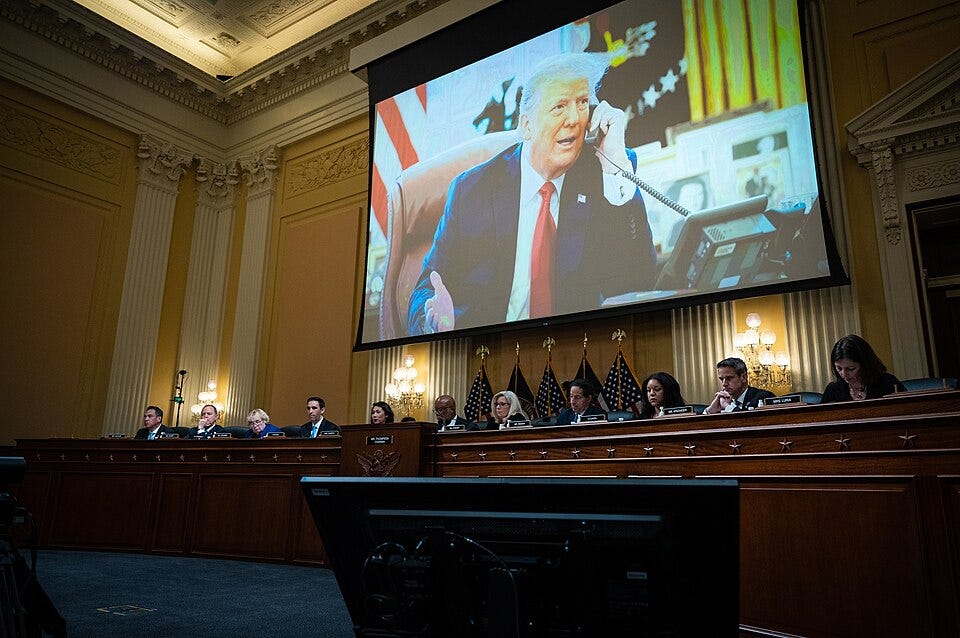
In May 2021, the House considered legislation establishing an independent commission to investigate the attack.
The proposal emerged from negotiations between Democratic Representative Bennie Thompson and Republican Representative John Katko, leaders of the House Homeland Security Committee.
The proposed commission would have included five members appointed by Democrats and five appointed by Republicans. It was intended to investigate the circumstances surrounding the attack and recommend institutional changes.
On May 19, the House approved the legislation by a vote of 252–175.
All 217 Democrats who voted supported it.
Thirty-five Republicans joined them.
But 175 House Republicans opposed the commission.
Republican congressional leaders argued that existing criminal investigations and congressional inquiries were sufficient. They also questioned whether the proposed commission would operate fairly or become a vehicle for partisan attacks.
Senate Republican leader Mitch McConnell announced his opposition.
He called the commission unnecessary and criticized what he described as an unbalanced proposal.
On May 28, the Senate voted 54–35 to advance the legislation, with 11 senators not voting.
Six Republican senators joined Democrats in supporting the procedural motion.
Because the motion required 60 votes, it failed.
The independent commission was never established.
This does not mean Congress conducted no investigation.
The Senate had already begun examining security and intelligence failures. The Justice Department continued investigating crimes committed during the attack.
And on June 30, 2021, the House established its own select committee by a vote of 222–190.
Only two Republicans, Liz Cheney of Wyoming and Adam Kinzinger of Illinois, voted with Democrats to establish that committee.
The committee subsequently gathered extensive testimony and documents, held public hearings, and published its findings in December 2022.
Congress therefore exercised significant investigative authority.
But the sequence reveals something important.
The decision about how to investigate an attack on Congress became deeply entangled with partisan disagreement over the investigation itself.
An independent commission failed to win sufficient support in the Senate. A House committee proceeded without the broad bipartisan participation it had originally envisioned.
Public accountability depends not only on establishing facts but also on whether elected officials are willing to accept and act on them.
The political consequences of challenging Trump
While Congress debated investigations, another development was unfolding inside the Republican Party.
Liz Cheney had served as chair of the House Republican Conference, the third-ranking Republican leadership position in the House.
She was a staunch conservative with a long history in Republican politics.
But after January 6, she became one of Trump’s most prominent Republican critics.
Cheney voted to impeach him and repeatedly rejected his unsupported claim that the 2020 election had been stolen.
She insisted that Republicans should acknowledge the election outcome and Trump’s responsibility for his conduct.
Her position created an increasingly serious conflict with other Republican leaders.
On May 12, 2021, House Republicans removed Cheney from her leadership position.
The vote occurred behind closed doors.
Republican leaders argued that the conference needed unified leadership and a consistent political message. Cheney’s repeated criticism of Trump had become a source of division.
Cheney continued speaking out.
She later served as vice chair of the House January 6 committee, participating in the investigation of Trump’s efforts to reverse the election.
Then came the 2022 election.
Cheney sought another term representing Wyoming in Congress.
Trump endorsed Harriet Hageman, who challenged Cheney in the Republican primary.
On August 16, Hageman defeated Cheney decisively, receiving approximately 66% of the vote to Cheney’s 29%.
The results do not establish that every Wyoming Republican voted against Cheney because of her position on January 6. Candidates are evaluated for many reasons.
But the political sequence is clear.
Cheney opposed Trump’s election claims, lost her Republican leadership position, participated in the investigation of his conduct, and was subsequently defeated by a Trump-backed primary challenger.
She was not the only Republican who experienced political consequences for opposing Trump.
Of the ten House Republicans who voted to impeach him in January 2021, four did not seek reelection in 2022. Of the six who ran, four lost their Republican primaries.
Some retirements also stemmed from redistricting and other political circumstances. Those decisions cannot all be attributed to a single cause.
Nevertheless, the consequences were significant.
Republican lawmakers who publicly challenged Trump faced substantial political difficulties within their own party.
What happened to the lawmakers who supported him?
The evidence from the 2022 elections
Political scientists Larry Bartels and Nicholas Carnes examined that question.
Their 2023 study, published in the Proceedings of the National Academy of Sciences, investigated the electoral consequences for Republican House members who supported Trump’s efforts following the 2020 election.
The researchers examined three congressional decisions:
Whether lawmakers supported objections to certified electoral votes.
Whether they opposed Trump’s second impeachment.
Whether they opposed establishing an independent January 6 commission.
They then examined what happened to those lawmakers in the 2022 elections.
The results were revealing.
In contested general elections, Republican lawmakers who had supported Trump did not perform significantly better or worse than other Republican candidates.
But within Republican politics, the researchers found a different pattern.
Lawmakers who supported Trump were less likely to lose primary elections, more likely to run unopposed in general elections, more likely to seek higher office, and less likely to retire.
The researchers concluded that supporting Trump’s efforts carried little measurable electoral cost and was associated with some political advantages.
That finding requires a distinction.
The study identifies patterns in actual electoral outcomes. It does not establish why every voter made a particular choice or prove that individual lawmakers acted solely out of political self-interest.
But it establishes the political consequences.
Republican House members who supported Trump’s post-election efforts did not face consistent electoral punishment in 2022. Some experienced measurable political advantages.
At the same time, several Republican lawmakers who opposed Trump suffered significant setbacks in their own party’s primaries.
Those outcomes help explain why institutional accountability became difficult.
The political system did not consistently impose greater costs on officials who supported attempts to challenge a certified election than on officials who opposed those attempts.
In some circumstances, the incentives ran in the opposite direction.
Why voters sometimes tolerate violations of democratic principles
The problem extends beyond congressional leaders.
Elected officials ultimately depend on voters. If voters consistently penalize candidates who violate democratic rules, politicians face a powerful incentive to respect those rules.
But what happens when voters strongly prefer a candidate’s political party or policies?
Political scientists Matthew Graham and Milan Svolik investigated this question in research published in the American Political Science Review in 2020.
Their study examined how Americans responded to hypothetical candidates who supported actions violating important democratic principles.
Participants evaluated candidates who differed in party affiliation, policy positions, and willingness to respect democratic rules.
The researchers found that violations of democratic principles did produce electoral penalties.
But those penalties weakened substantially when voters chose between a candidate who shared their political preferences but violated democratic norms and a candidate whose policies they strongly opposed.
In other words, some voters were willing to tolerate violations of democratic principles to avoid electing a political opponent.
This does not mean those voters rejected democracy as a general principle.
Many Americans support democratic government while disagreeing strongly about which leaders and policies should govern the country.
The problem arises when those political preferences take precedence over holding elected officials accountable for conduct that undermines democratic rules.
The study provides experimental evidence of that willingness to make trade-offs.
It does not establish that every Republican or Democratic voter behaves this way, or that partisan hostility alone caused American democratic backsliding.
In fact, a 2024 review by political scientists James Druckman, Donald Green, and Shanto Iyengar found limited direct evidence that hostility toward opposing-party voters independently caused democratic deterioration.
That is an important qualification.
The established problem is not simply that Americans disagree or dislike the opposing political party. It is that partisan and policy preferences sometimes reduce the political consequences of violations of democratic principles.
Political disagreement is normal in a democracy.
The failure to enforce democratic accountability is a different problem.
What Kentucky’s delegation reveals
Kentucky provides a particularly useful example because its Republican congressional delegation made different decisions at different points in the process.
During the January 6 and 7, 2021, electoral count, Kentucky Senators Mitch McConnell and Rand Paul voted against objections to the certified electoral votes from Arizona and Pennsylvania.
In the House, Republican Hal Rogers supported both objections.
Kentucky’s other Republican representatives, Andy Barr, James Comer, Brett Guthrie, and Thomas Massie, opposed them.
Democratic Representative John Yarmuth also opposed the objections.
These votes demonstrate that Republican officials did not respond uniformly to the attempt to challenge the electoral results.
But subsequent accountability decisions produced a different pattern.
On February 13, McConnell and Paul both voted to acquit Trump during his second impeachment trial.
McConnell’s explanation was constitutional. He argued that the Senate lacked authority to convict someone who was no longer president.
Other senators disputed that position, including seven Republicans who voted to convict.
McConnell’s statement condemning Trump’s conduct was unmistakable. His vote nevertheless contributed to an acquittal.
Then, in May, both Kentucky senators opposed advancing the proposed independent January 6 commission.
McConnell argued that existing investigations were sufficient and that the commission proposal was politically unbalanced.
Kentucky’s House delegation divided along party lines on the commission.
Yarmuth supported it.
All five Republican representatives opposed it.
This presents a more complicated picture than simply dividing Kentucky’s congressional delegation between officials who defended democracy and officials who did not.
Some officials rejected the effort to overturn electoral votes but opposed impeachment, conviction, or a particular investigation.
Others supported objections to certified results and later opposed the independent commission.
Those actions carry different constitutional and political implications.
A vote against a particular investigative proposal does not, by itself, establish opposition to accountability. A vote to acquit does not establish agreement with the president’s conduct.
The stated legal and institutional reasons deserve examination.
But the actual consequences matter, too.
Kentucky’s congressional delegation helped reject the attempt to overturn certified electoral votes. Its members later disagreed about the steps Congress should take to investigate and hold people accountable for what happened.
Those decisions illustrate why understanding democratic backsliding requires looking beyond public statements and examining how officials exercise their authority.
The difference between condemnation and accountability
This distinction recurs throughout this history.
An elected official may condemn misconduct without supporting specific legal consequences.
A legislature may investigate wrongdoing without enacting corrective measures.
A political party may acknowledge that one of its leaders violated democratic principles while continuing to support that leader’s political authority.
None of these circumstances automatically establishes bad faith.
Constitutional procedures, evidentiary requirements, and legitimate disagreements about institutional authority matter.
But democratic accountability ultimately depends on consequences, not merely expressions of concern.
Congress had the authority to investigate the events surrounding January 6.
It exercised some of that authority. The House select committee conducted a substantial investigation, while criminal investigations and other congressional inquiries proceeded.
But the proposal for an independent commission failed because it could not secure the Senate votes required to advance.
Trump was impeached, but the Senate did not convict him.
Republican lawmakers who supported his post-election efforts did not consistently suffer electoral penalties.
And Republicans who challenged him sometimes faced serious political consequences within their own party.
Those outcomes establish something about the incentives operating within American politics after the 2020 election.
Political accountability was not consistently aligned with the responsibility to protect democratic procedures.
That was not simply a matter of public attitudes. It showed up in congressional votes, party leadership decisions, primary elections, and the continued political influence of a president who had tried to reverse an electoral defeat.
What actually contributed to democratic backsliding?
The previous article in this series examined an effort to overturn the 2020 election.
This article addresses a different question: Why did political accountability fail to consistently constrain the officials involved?
The evidence supports several conclusions.
Congressional oversight was influenced by partisan control and political competition.
Republican leaders and lawmakers made different choices about whether to investigate, condemn, or impose consequences for Trump’s conduct.
Republican officials who opposed him faced political setbacks, including removal from leadership and primary defeats.
Research examining the 2022 elections found little electoral penalty and some political advantages for Republican House members who supported his post-election efforts.
Experimental research also found that some voters were willing to discount violations of democratic principles when the alternative was electing someone whose political positions they opposed.
These findings do not establish that every participant acted for the same reason.
Nor do they establish that party loyalty was the only cause of American democratic backsliding.
They do establish an important weakness in the systems intended to hold elected officials accountable.
Political parties and voters did not consistently penalize officials who supported efforts to challenge democratic procedures, while some officials who resisted those efforts experienced substantial political costs.
That weakened a key restraint on political power.
A constitutional system relies on laws, courts, elections, and the separation of powers.
But it also relies on political actors having sufficient incentives to respect those constraints.
When party loyalty and electoral advantage interfere with accountability, the institutions that limit government power face an additional obstacle.
The problem is not that political parties exist or that citizens disagree.
Political competition is essential to democratic government.
The problem is that the incentives governing political competition did not consistently reward defending democratic rules or penalize efforts to undermine them.
That is the third causal finding in this series.
And it helps explain why the next development in our investigation is so important.
Beginning in January 2025, Donald Trump returned to the presidency and undertook a series of actions that expanded presidential control over federal institutions.
The question was no longer whether officials would attempt to reverse an election they had lost.
It was how an elected president would exercise governmental power, and whether the institutions intended to constrain that power would do so effectively.
Next in the series: Part 4, The Expansion of Presidential Power.
Sources and documentation
This article draws on congressional voting records, statements by public officials, official election results, and peer-reviewed political science research.
Congressional accountability and January 6
U.S. Senate, February 13, 2021, Second Impeachment Trial Roll Call
Senator Mitch McConnell, February 13, 2021, Remarks Following Trump’s Acquittal
U.S. House Clerk, May 19, 2021, Vote on the January 6 Independent Commission
U.S. Senate, May 28, 2021, Vote on Advancing the Independent Commission
U.S. House Clerk, June 30, 2021, Establishment of the January 6 Select Committee
House Select Committee, Final Report on the January 6 Attack (2022)
Political consequences
Associated Press, House Republicans Remove Liz Cheney From Leadership, May 12, 2021
Wyoming Republican Congressional Primary, Certified 2022 Results
Larry M. Bartels and Nicholas Carnes, House Republicans Were Rewarded for Supporting Donald Trump’s ‘Stop the Steal’ Efforts, PNAS (2023)
Populism, Democracy, and the Post-2020 Republican Party in Congress, Political Science Quarterly (2023)
Political science research
Douglas L. Kriner and Eric Schickler, Investigating the President: Committee Probes and Presidential Approval, Journal of Politics (2014)
Matthew H. Graham and Milan W. Svolik, Democracy in America? Partisanship, Polarization, and the Robustness of Support for Democracy in the United States, American Political Science Review (2020)
James N. Druckman, Donald P. Green, and Shanto Iyengar, Does Affective Polarization Contribute to Democratic Backsliding in America? (2024)
Kentucky congressional voting records