
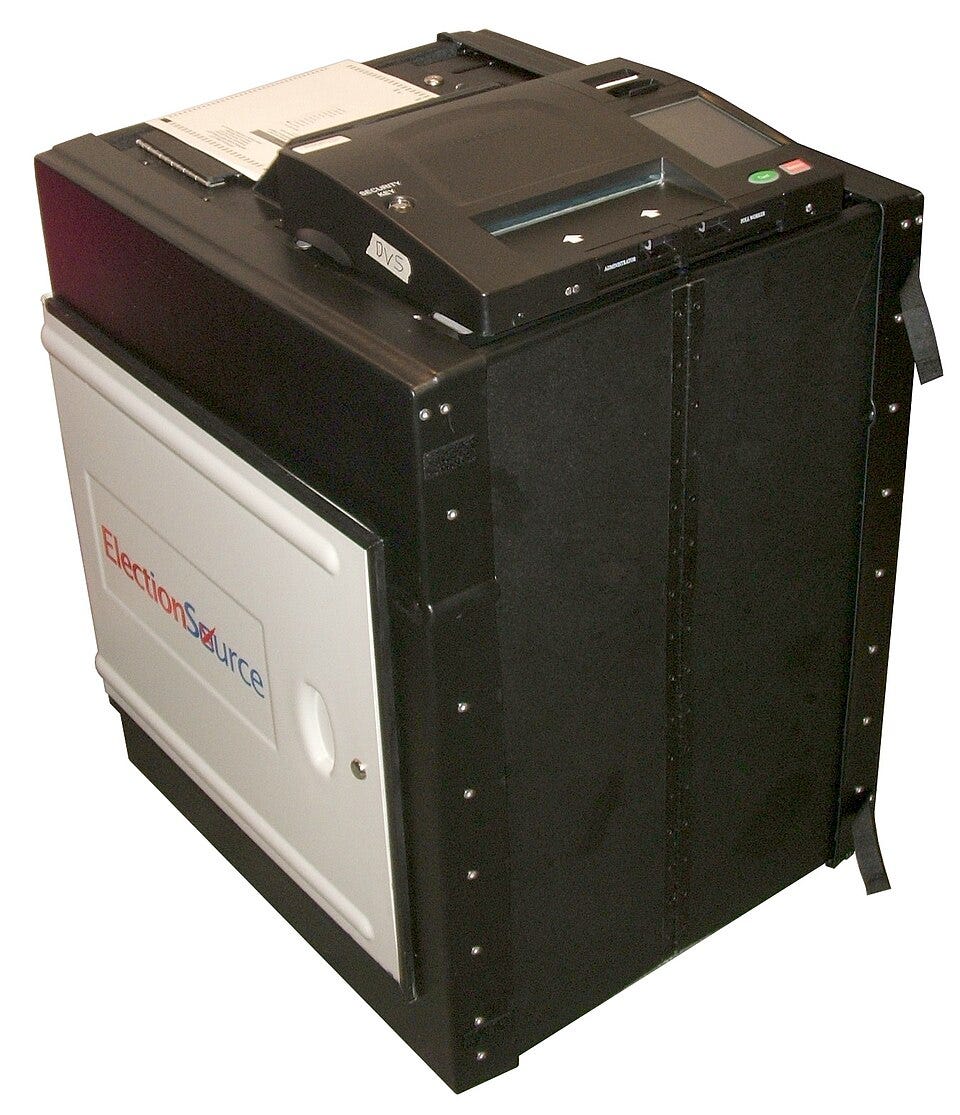
In June 2025, federal investigators examined a voting machine in Puerto Rico for evidence that foreign actors had manipulated elections. The search eventually reached the Office of the Director of National Intelligence, the Justice Department, the Department of Homeland Security, and the FBI. It found vulnerabilities in voting equipment, but no evidence that foreign actors had hacked the machines, altered votes, or changed the outcome of the 2020 presidential election.
The investigation did not begin with an unanswered question.
Five years earlier, federal agencies had already examined public claims that foreign governments controlled election infrastructure or manipulated vote counts in 2020. In March 2021, the Justice Department and Department of Homeland Security reported that those claims were “not credible” and that they had found no evidence that a foreign government manipulated election results.
The intelligence community reached the same basic conclusion. Its 2021 assessment said it had no indication that any foreign actor attempted to alter voter registration, ballots, vote tabulation, or reported results. The assessment did document foreign efforts to influence American opinion, including efforts by Russia and Iran, but distinguished those activities from altering votes or election machinery.
Yet by 2025, the theory that foreign actors had used voting machines to manipulate the 2020 election was again drawing federal attention.
Reuters reported on October 2 that attorney Kurt Olsen, who had spent years promoting claims that the 2020 election was stolen, became a central figure in the new effort. The investigation began with voting equipment in Puerto Rico and expanded into Georgia and Arizona, involving federal intelligence and law-enforcement agencies. Reuters reported that Olsen’s investigation ultimately found no evidence that foreign actors had infiltrated U.S. voting systems, manipulated machines, or changed the 2020 result.
The White House told Reuters that the Puerto Rico investigation began after election officials raised concerns about voting machines used there in 2024 and that it aimed to examine vulnerabilities, not revisit the 2020 election. Reuters found, however, that Olsen pushed the effort toward finding evidence of foreign manipulation of the 2020 vote.
That sequence provides a particularly clear example of one of the Patterns of Power: Flood the public with information and falsehoods.
How an old claim becomes a new question
Flooding the public with falsehoods does not depend on telling one lie and persuading everyone to believe it.
The mechanism works through repetition.
The voting-machine allegation did not disappear after federal agencies rejected it in 2021. It circulated through political speeches, lawsuits, activists, media coverage, and claims about Dominion Voting Systems and Smartmatic. Courts repeatedly rejected allegations connecting the companies to schemes to alter the 2020 result, according to Reuters.
Then the claim gained something it hadn’t before: new federal action.
Government specialists examined voting equipment. Intelligence officials became involved. Federal agents seized ballots and election records in Fulton County, Georgia. Federal officials obtained Arizona voter rolls, ballot images and signature-verification data that had previously been provided for a 2021 audit.
Those actions did not prove the underlying allegation.
But they created new facts.
Now there was another investigation to discuss, another federal agency involved, another set of records being examined, and another government action capable of generating headlines.
That changes the information environment, even when the evidence does not.
Government action can give a claim authority
There is nothing improper about government examining credible evidence of election vulnerabilities. Voting equipment is critical infrastructure, and security weaknesses should be identified and corrected.
The distinction in this case lies in what happened after investigators found weaknesses but no evidence that the machines had been used to change votes.
Reuters reported that the Puerto Rico examination identified vulnerabilities, including outdated software, that could be repaired. The investigators found no evidence of hacking or altered votes. An ODNI report likewise identified vulnerabilities but found no evidence that votes had been manipulated.
The absence of that evidence did not end the broader effort.
The investigation expanded.
In January 2026, FBI agents seized roughly 650 boxes containing 2020 ballots and election records from Fulton County, Georgia, after an investigation that Reuters reports began with an Olsen referral. In March, Olsen oversaw the Justice Department’s acquisition of records from Maricopa County, Arizona, including voter rolls, ballot images and signature-verification data. A Republican-backed Arizona audit in 2021 had already found no evidence that Donald Trump had been deprived of victory there.
The federal activity itself then becomes part of what the public sees.
A person encountering the claim for the first time may know little about the 2021 intelligence assessment, earlier government findings, or previous audits. In 2026, that person sees the FBI collecting ballots, intelligence agencies examining voting equipment, and federal officials seeking election records.
Official activity can make an unsupported claim appear newly unresolved.
The search can become evidence for the allegation
That creates a feedback loop.
A claim generates enough attention to produce an investigation. The investigation generates government action. The government action gives the subject greater visibility and apparent seriousness. That visibility can then be used to justify continuing attention to the original claim.
Evidence is no longer the only thing keeping the allegation alive.
The search for evidence begins doing some of that work.
Reuters reported a version of that dynamic in the Puerto Rico investigation. When the contractors examining the machines found no evidence of hacking, the effort did not conclude that the original allegation had been established. Instead, the investigation expanded to other jurisdictions.
Olsen later told colleagues that intelligence agencies and White House officials had hindered the investigation by withholding information, according to Reuters. That creates another way for a claim to survive an unsuccessful test: failure to find confirming evidence can itself become evidence that the inquiry was obstructed or incomplete.
The result is a claim that becomes increasingly difficult to resolve because each unsuccessful attempt to prove it can produce a reason to search again.
This is different from an election-security debate
Americans can legitimately disagree about voting machines, paper ballots, election audits, mail voting and the appropriate federal role in election security.
Those are policy disputes.
The Pattern appears elsewhere: when a factual claim that has repeatedly failed evidentiary tests continues to generate government action without new evidence supporting it.
The issue is not whether voting machines can have vulnerabilities. They can. Reuters notes that a 2022 review by the Cybersecurity and Infrastructure Security Agency identified vulnerabilities in some Dominion systems while finding no evidence those vulnerabilities had been exploited.
A vulnerability establishes what might theoretically be possible. It does not establish what actually happened.
That distinction matters because flooding collapses those two questions. Evidence that a system has a weakness can be presented alongside allegations that the weakness was exploited, until the first begins lending credibility to the second.
The factual record requires keeping them separate.
What to watch for
This Pattern will not always involve elections.
A useful place to start is with three questions.
What has already been established? Before treating an official investigation as evidence that a claim remains unsettled, look at what previous courts, audits, inspectors, investigators or other authoritative sources actually found.
What new evidence triggered the new government action? Reopening a question because new evidence has emerged is different from repeatedly searching for evidence to support a conclusion already being asserted.
How is the government action itself being described? An investigation proves that the government is investigating. A subpoena proves that records were sought. A search proves that officials searched. None of those actions, by themselves, proves the allegation that prompted them.
Those distinctions become harder to maintain as the amount of information surrounding a claim grows.
The 2020 voting-machine allegation began as a factual proposition that could be tested: Were foreign actors able to manipulate voting machines and change the result?
Federal agencies tested versions of that claim and reported finding no evidence that it happened. Years later, the federal government again committed intelligence, law-enforcement personnel, and investigative authority to searching for that evidence. Department of Justice
That is what Flood the public with information and falsehoods can look like when the Pattern reaches government.
The claim survived not because new evidence proved it, but because repetition kept reopening a question the evidence had already answered. By 2026, that repetition had acquired something more powerful than another audience: the machinery of the federal government.
Sources
Reuters, October 2, 2026, “How Trump’s obsession with ‘rigged’ voting machines spread across US government.” Detailed reconstruction of the Puerto Rico investigation, its expansion into federal agencies and other states, the findings of investigators, and the White House response. Read the Reuters investigation
Reuters, April 23, 2026, “Trump, aides chase vote-rigging claims even after latest probe finds nothing.” Reporting on the Puerto Rico examination and the subsequent expansion of the investigation. Read the Reuters report
U.S. Department of Justice and Department of Homeland Security, March 16, 2021, “Joint Statement … Assessing the Impact of Foreign Interference During the 2020 U.S. Elections.” Federal finding that claims of foreign governments manipulating election infrastructure or vote counts were not credible and that no evidence was found of a foreign government manipulating election results. Read the DOJ-DHS statement
Office of the Director of National Intelligence, March 10, 2021, “Foreign Threats to the 2020 US Federal Elections.” Intelligence Community assessment finding no indication that a foreign actor attempted to alter voter registration, ballots, tabulation or reported election results. Read the intelligence assessment