
A day after I wrote about Barack Obama’s warning that Americans need a stronger understanding of what democracy requires, Senator Tammy Duckworth raised a harder question.
Duckworth was considerably less restrained in making her point.
“I am tired of fixing shit Republicans break,” she said.
Her broader complaint was how Democrats have responded to Republican power. She argued that during the Biden administration, Democrats spent too much time repairing damage, responding to crises, and observing traditions of institutional restraint while Republicans were willing to exercise power more aggressively.
She specifically mentioned the Senate filibuster.
“We spent time on the Democratic Party with our leadership being polite, not wanting to break the filibuster because, oh God forbid, if we blow up the filibuster, then they might do it to us, so we’re not gonna do it.”
Her conclusion was considerably more colorful.
“So fuck that shit.”
Duckworth’s argument collides directly with something I wrote only yesterday.
I proposed a simple test for political power:
Would I give this power to the other side?
If the answer is no, I argued, then we should be extremely reluctant to claim that power for ourselves.
But Duckworth’s argument raises an obvious response.
What if the other side already has?
That is a much harder question.
Democracy depends on restraint
Political scientists use the term institutional forbearance to describe situations in which government officials exercise restraint and do not use all the powers at their disposal. Constitutions and statutes define and limit the powers of government officials; however, they cannot restrict the possible ways of abusing power.
In Writing about Forbearance in the American Political Science Review, Sean Ingham describes situations in which government officials do not act in ways that undermine democracy, even though they are free to act within democratic rules. Democratic stability depends on government officials’ commitment to respect the rules of democracy.
The same logic applies to other government officials. It is understandable for a government official to exercise restraint even if he or she has wide powers.
Political stability also requires that government officials with discretion do not use criminal laws to target their political opponents. Political systems depend on how the government exercises its powers, which defines and restricts those powers. Maintaining democratic stability also depends on political actors’ leadership and commitment to democracy’s rules and principles.
What if only one side practices restraint?
The crux of Duckworth’s argument is about expected behavior. In her view, what gives? She thinks the Dems show restraint to no avail.
Of course, democracy hinges on adherence to the rules. The difficulty, however, is distinguishing the rules from the clarifying examples of the rules.
When we refer to rules, we tend to be somewhat imprecise. Some rules governing our society are clearly delineated (e.g., the Constitution, laws, judicial decisions, etc.). Other rules governing Congress are less precisely defined (e.g., the rules of Congress, the Senate, or committee procedures, traditions, and practices).
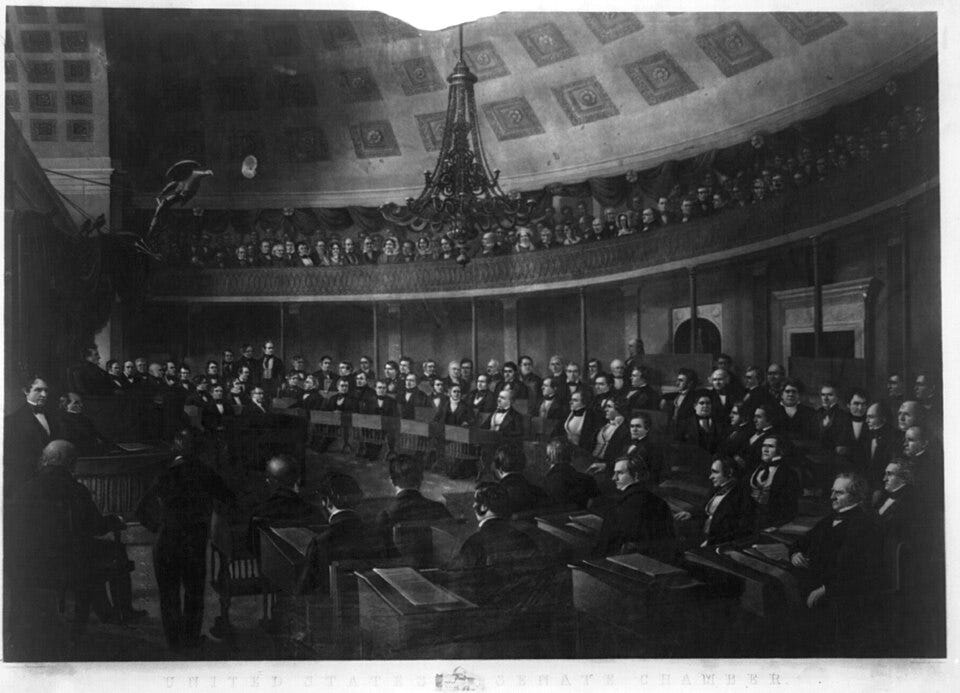
The filibuster is a good example. The 60-vote threshold is a Congressional rule, not a constitutional mandate (Article I, Section 5 grants each house of Congress the authority to make its own rules). The Senate didn’t adopt a rule requiring a supermajority to end a filibuster until 1917. Several years later, it lowered the threshold to 51. In 2013, the Democrats again changed the rule to allow a simple majority to end a filibuster for Presidential appointments (excluding the Supreme Court). One year later, Republicans changed the rule again to lower the threshold for Supreme Court nominations. These examples show that a procedural rule can change, and in this case did change frequently, and does not necessarily violate the rules that govern the conduct of the Senate.
Some rules restrain power. Others organize it.
The Constitution limits the federal government in many ways. For example, it guarantees certain rights, such as the right to remain silent and the right to be free from unreasonable searches and seizures.
The Constitution also protects the right to vote and limits how long government officials may serve. The Constitution gives state and federal residents the right to a trial by a jury of their peers.
The Constitution does not, however, require a legislature to follow a particular procedure. For instance, a legislature need not permit unlimited debate. A legislature may make rules allowing a majority of its members to determine the legislature’s business. A procedure that allows unlimited debate could be adopted or maintained for a variety of reasons, and the constituencies affected by those reasons may care about the consequences of eliminating it.
Even though a legislature may amend its rules at any time, there are instances when a rule should not be changed. Ultimately, each member of a legislative body must weigh the consequences of amending rules.
Then my original test needs another question
I’m not giving up on the question, “Would I give this power to the other side?” but Duckworth has shown this can’t be considered in a vacuum. The next question should be, “Would the use of this power by the other side break the democracy?” The answer to this changes the analysis.
Let’s say the Senate majority changes the rules to restrict debate. Critics say this is unconstitutional. Let’s say, a few years later, the Senate rules change hands, and the new majority also operates under the restrictive rules. The first Senate majority to implement the rules change regrets this. However, the critics of the rules change can and do vote. They can and do campaign. They can and do win a Senate majority. Once they win, they can and do change the rules.
Again, let’s say a government passes laws that restrict and obstruct its political opponents from participating in elections. Finally, let’s say a Government opts not to abide by court decisions.
In all these cases, something has changed that affects the ability of the Government’s political opponents to participate in the democratic process. If a democratic government takes these actions, it undermines political opponents’ ability to participate in the democratic process and weakens independent institutions’ ability to check and balance the government.
This raises the stakes. This democratic test asks: would using this power prevent the government from participating in the democratic process in the future?
Democracy does not require political passivity
One danger in discussing democratic restraint is that it may appear as if you are endorsing weakness. That is not the case.
If Congress, the courts, political parties, the media, or the public challenges or questions the others’ actions, that is a hallmark of democracy. Restraint and challenges to the others’ actions are what the democratic system requires.
What matters is whether the political system recognizes and preserves the rules and processes of the democratic system, for example, by allowing the opponents of a governing party to keep their resources to organize and challenge the actions of the government, or by allowing government officials to lose an election and leave office. It matters whether election losers can challenge and investigate the actions of government officials.
Restraint matters, but so does conflict and contestation.
What matters is not only whether the losing party accepts the election outcome, but whether the system lets that party keep challenging and contesting the government’s actions.
But escalation creates its own danger
Duckworth’s reasoning can be turned around. In politics, there is always a chance of justifying an action by invoking a precedent set by a rival. Democratic polities can devolve into a zero-sum game where restraint is gradually discarded. People justify their actions by what they perceive to be an equivalent transgression by their opponent.
Democracy relies on the belief that other citizens and government personnel will restrain themselves to democratic procedures. Threatening or acting outside the limits of democracy may gradually erode citizens’ will to defend democratic procedures. In a democracy, people often have to judge for themselves if there are justifiable limits to what they can do to protect democratic procedures.
Democracy presents a dilemma. Too much restraint gives unscrupulous people the opportunity to act without regard for the same constraints. Too little restraint results in a situation where people stop observing constraints and democratic procedures become a sham. If people believe their adversary acted first, they are less likely to cooperate in defending democracy.
So where is the line?
“Follow every tradition” is not a strong enough answer. Nor is “They did it first.” Even if that were an adequate answer, we would still have to consider the effect of our political opponents’ actions.
Are the actions being taken lawful? Will actions taken against our political opponents be allowed when our opponents gain power? Do the actions allow our opponents to organize? Can the actions be undone? Do the actions enhance the rule of law and make those in power more accountable? Are the actions in the interest of the public?
Our political opponents’ actions provide an opportunity to be principled and to strengthen and build the necessary institutions of democracy. Restraint alone will not allow democracy to flourish.
Democracy requires the people and institutions to exercise power and to be held accountable. Elections alone will not bring about self-governance. Restraint and the people’s power to do what is necessary to hold people accountable must occur simultaneously.
The harder question
I previously asked whether the public would defend the limits of democracy, even when those same limits restrain friendly actions. I think this is an important question, but it is not the only one.
Duckworth identifies another. What happens when political leaders abandon the belief that adversaries will also practice restraint? Democracy can endure only so much. The essence of democracy, however, is that people control their own destiny, and that can never mean a collective decision to accept political impotence.
Democracy also has limits on the kind of defense it can provide itself. We can never allow ourselves to fulfill an adversary’s wishes through actions that would normally be antidemocratic and transgressive, because we risk subverting democracy. Every such act erodes citizens’ confidence in political leaders’ willingness to abide by rules and norms.
We have to be mindful of these distinctions. The aim should not just be to instill a greater sense of democratic self-restraint in citizens. Instead, we need a stronger commitment to educating citizens to distinguish the use of democratic power from the abusive use of power that weakens democracy.
Citizens must understand when the rules of democracy protect the public’s ability to hold power and when they protect the powerful’s ability to fortify their position.
The answer is not endless restraint. Nor is it retaliation without limits.
Democracy requires the willingness to use power, sometimes aggressively, to defend the public’s ability to participate, organize, challenge government, and remove leaders from office. The line is crossed when that power is used to make those things harder or impossible.
That is the distinction we have to learn to make. Restraint is a democratic virtue only when it protects democracy. When restraint merely leaves democratic institutions defenseless against people willing to exploit them, it stops being a virtue and becomes surrender.
So the question cannot simply be, Would I give this power to the other side?
It must also be: Does using this power preserve the other side’s ability to fight me tomorrow?
If the answer is yes, democracy can survive the conflict.
If the answer is no, we are no longer arguing about how forcefully to practice democracy. We are arguing about whether democracy will remain possible at all.