
In an opinion signed March 11, Chief U.S. District Judge James Boasberg quashed two federal grand-jury subpoenas served on the Federal Reserve. He concluded that prosecutors had issued them for an improper purpose: to pressure then-Federal Reserve Chair Jerome Powell to lower interest rates or resign.
The ruling did not merely question whether prosecutors had enough evidence. Boasberg found that the government had produced “essentially zero evidence” that Powell had committed a crime and that its stated reasons for the subpoenas were pretextual. The court found abundant evidence that their dominant purpose was to pressure Powell to yield to President Donald Trump’s demands or leave office. Justia Law
That finding turns what might otherwise look like another dispute between a president and the Federal Reserve into a clear example of a Pattern of Power: Attack independent institutions.
The concern was not criticism. It was the use of criminal investigative authority against an official whose institution was designed to make decisions the president cannot directly control.
From political pressure to criminal process
Trump publicly criticized Powell about interest rates for years and by 2025, his criticism was more obvious and direct.
Boasberg’s article said there were at least 100 public statements from Trump or his administration officials criticizing Powell or demanding lower rates. Trump said in June 2025, that if the Fed did not cut rates, he might have to “force something.” In November, he said he wanted Powell out.
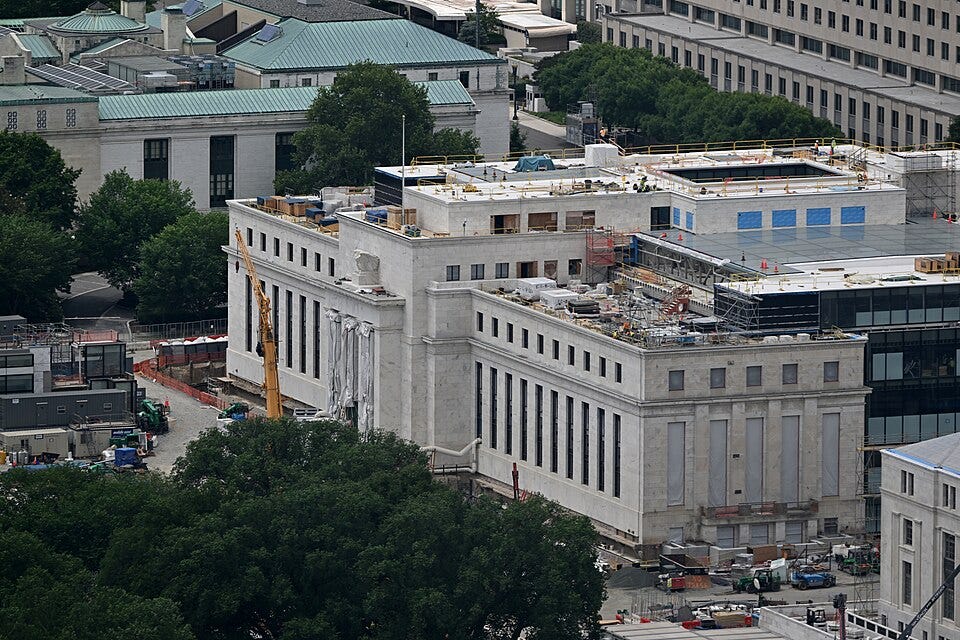
Independent of this, the controversy with the renovation of the Federal Reserve building in Washington D.C. was also gaining attention.
The renovation was also faced with many issues. It cost twice as much as what was originally budgeted, from $921 million in the Board’s February 2020 renovation budget to $2.018 billion in its 2024 budget. In July 2025, William Pulte, the head of the Federal Housing Finance Agency Director said Powell should be investigated for the renovation and his testimony regarding it and said it could serve as grounds for his removal. Trump said Powell should also be immediately removed. The White House also it would look into the renovations.
In November, the U.S. Attorney’s Office for the District of Columbia opened a criminal investigation into possible fraud regarding the renovation and possible false statements by Powell to Congress. In January, the Federal Reserve received grand-jury subpoenas seeking records of the renovation and information related to Powell’s congressional testimony.
Powell responded publicly on January 11, saying the investigation posed the threat of criminal charges and defended the renovations as part of the administrative function of the Federal Reserve.
“This is about whether the Fed will be able to continue to set interest rates based on evidence and economic conditions,” Powell said, “or whether instead monetary policy will be directed by political pressure or intimidation.”
At that point, Powell’s description was an allegation. Two months later, a federal judge reviewed the documents the government submitted to the court to support the subpoenas and came to the same conclusion.
What the government said
The Justice Department did have an argument for investigating.
The renovation was far over budget. Prosecutors said that raised the possibility of fraud. They also pointed to what they described as possible discrepancies in Powell’s testimony before the Senate Banking Committee.
The government also said prosecutors had tried to obtain information without subpoenas. According to a Justice Department court filing, the U.S. Attorney’s Office contacted the Federal Reserve twice in December 2025 seeking a meeting and received no response. Prosecutors argued that the grand jury therefore had legitimate reasons to investigate whether crimes had occurred.
Boasberg did not find those explanations persuasive.
A large construction overrun did not by itself establish evidence of fraud, he wrote. The government also failed to identify what was supposedly false in Powell’s congressional testimony. The judge gave prosecutors an opportunity to provide additional evidence privately to the court without revealing it to Powell or the Federal Reserve.
The court still found no substantial evidence supporting a criminal investigation. Instead, Boasberg found a sequence in which political pressure for lower interest rates was followed by demands for Powell’s removal, calls for investigation and then grand-jury subpoenas.
The Justice Department closed the investigation on April 24 rather than continue litigating the subpoenas. U.S. Attorney Jeanine Pirro referred the renovation issues to the Federal Reserve inspector general and said a criminal investigation could resume if the watchdog uncovered evidence warranting one.
That evidence never emerged.
What the Inspector General found
The inspector general’s September report matters because it did not clear the Fed of wrongdoing.
It outlined several failures. The Board did not utilize the available tools to reduce costs. It did not successfully implement a contracting method to control financial risk. Its oversight and governance processes were inadequate. The inspector general made seven recommendations, all of which the Board accepted.
The watchdog, however, distinguished between mismanagement and criminal conduct.
The inspector general found no basis to make a criminal referral and no evidence of administrative misconduct. It also stated that the design features, such as marble, water, and garden features, did not account for the cost overruns.
On October 2, the Justice Department said it will not reopen the Powell criminal investigation based on the Inspector General’s report. Attorney General Todd Blanche left the possibility of taking other actions if additional evidence of wrongdoing became available.
The Pattern: Attack independent institutions
The Fed isn’t independent because its personnel have no real accountability.
The arrangement Congress created is different. Congress sets the monetary policy goals and oversees the Federal Reserve, while the Fed decides the means to achieve those goals, without presidential control over interest-rate decisions. This removes short-term political considerations from monetary policy.
Distinguishing the above is the Pattern operating here.
Investigating fraud by no means is an attack on an institution’s independence. The same is true with Congressional hearings and the case with the Inspector General reviewing a billion-dollar increase in costs.
It becomes the Pattern when an official with the authority to investigate uses that power to impose a cost on a person for exercising the independence the law conferred on that official.
A criminal investigation is a cost. An official doesn’t need an indictment to hire lawyers, produce records, and defend their actions. The risk of indictment always remains. Boasberg has specifically said that a subpoena has the effect of creating expense, anxiety, and fear even if an indictment is never obtained.
That changes the cost of saying no.
Presidents cannot order the Federal Reserve to lower interest rates. However, the independence established by law means the Fed can refuse the President’s demands and still risk investigations, subpoenas, or possible criminal charges; then the law will begin to function under a different set of incentives.
The legal authority to say no remains, but the cost of saying no has changed.
The difference between accountability and pressure
The analysis of the renovation illustrates why this is important.
The IG found considerable mismanagement. That is an example of institutional accountability.
The criminal investigation was different, because the court found that its dominant purpose was not to investigate evidence of a crime. It was to pressure Powell to change his position on a policy matter.
It is not whether an independent agency has made poor decisions that warrant an investigation.
It is whether documented wrongdoing is being used to justify changing the limits of an independent agency’s autonomy.
What to watch for next
The same process does not require another Federal Reserve dispute. It can happen when an official or institution retains the legal power to act on its own but faces political pressure not to. Courts, Inspectors General, prosecutors, election officials, regulators, universities, school boards, counties, and many others can face one-way or multiple-way pressure to use their power independently (investigations, subpoenas, loss of funding, etc.) without an explicit loss of independence.
Which happened first? Was documented wrongdoing the impetus for oversight to act? Or did coercive action follow the executive order not to act? Do the means of the investigation fit the ends of the alleged misconduct?
In Powell’s case, a federal court found that the subpoenas were issued for an improper purpose. However, the Inspector General of the Federal Reserve found serious management failures but no grounds for a criminal referral. The Federal Reserve never lost its independence to set interest rates.
That is the Pattern of undermining an independent institution without formally abolishing it. The authority remains the same, on paper, and the government uses its own coercive power to make acting on the independence costly.
Sources
Federal court opinion, In re Grand Jury Subpoenas, March 2026
Federal Reserve, Jerome Powell statement on the DOJ subpoenas, January 11, 2026
Reuters, How the DOJ went from investigating Powell to dropping the case
Reuters, Justice Department closes investigation into Powell
Reuters, Fed watchdog finds deficiencies but no misconduct
Reuters, DOJ will not reopen criminal probe into Powell, October 2, 2026