
On a stage flanked by state flags and a printed copy of Article V of the U.S. Constitution, Florida Gov. Ron DeSantis stood beside Kentucky legislators and urged states to use the Constitution’s convention clause to propose a federal balanced budget amendment. The event was framed as a formal step in a long-running campaign to reach the threshold required to trigger a convention. Kentucky lawmakers described pending or proposed legislation intended to align the Commonwealth with that effort while attempting to confine the convention to a single subject: a balanced federal budget requirement.
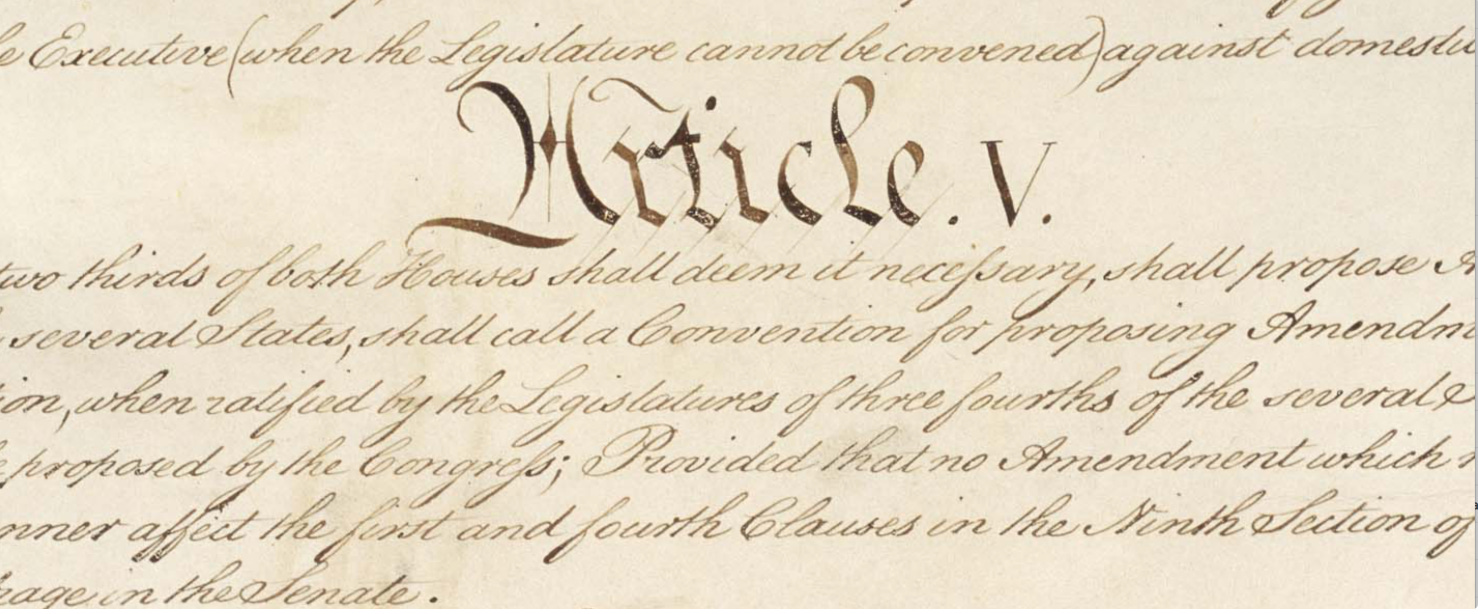
The governing text is short. Article V provides two methods to propose amendments. Congress may propose amendments with a two-thirds vote in both chambers, or, “on the application of the legislatures of two thirds of the several States,” Congress must call a convention for proposing amendments. Any proposed amendment must then be ratified by three-fourths of the states. The Constitution does not specify the procedures for selecting delegates, setting agendas, or resolving disputes over scope once a convention is called.
This push places Kentucky inside that constitutional clause.
The Article V Clause in the U.S. Constitution
Article V is the operative authority. It directs Congress to call a convention when applications from two-thirds of state legislatures have been received. The threshold is currently 34 states. Advocates of a balanced budget amendment have been tracking applications across states for years, arguing that the tally is approaching the required number. Critics dispute how applications should be counted, whether older applications remain valid, and whether applications on related topics may be aggregated.
Kentucky has previously enacted resolutions applying for an Article V convention on fiscal restraints. Those resolutions are recorded in the Kentucky Legislative Research Commission’s archives and transmitted to Congress as formal applications. Under Article V, Congress’s role after the threshold is reached is ministerial in one respect. The text says Congress “shall call a Convention.” The text does not define the scope of that call or the rules governing the gathering.
The absence of detailed procedures in Article V means that once the 34-state threshold is reached, Congress would need to determine logistics, delegate allocation, and operational rules. Those decisions would likely be contested in court.
Kentucky House and Senate Resolutions on a Balanced Budget Amendment
Kentucky legislators supporting the effort have pointed to prior resolutions adopted by the Kentucky General Assembly calling for a convention limited to a balanced budget amendment. Those measures cite the Commonwealth’s authority under Article V to apply for a convention and often include language attempting to limit the subject matter.
Recent proposals discussed at the event with DeSantis referenced draft bills that would reaffirm Kentucky’s application and specify instructions to any Kentucky delegates. Legislators described guardrails in the form of delegate oaths and recall provisions, intended to prevent Kentucky’s representatives from voting on amendments outside the balanced budget subject.
Under Kentucky law, resolutions applying for an Article V convention are adopted by simple majorities in each chamber and do not require the Governor’s signature. If enacted, they are transmitted to Congress as official applications. Kentucky’s Secretary of State maintains records of such legislative acts.
The proposed legislation discussed alongside DeSantis would likely move through committee hearings in the Kentucky House or Senate, with recorded votes. As of the event, bill numbers and committee assignments were being finalized. Once filed, they would appear in the Legislative Research Commission’s bill tracking system, with scheduled hearings posted in committee agendas.
Counting State Applications and the 34-State Threshold
Advocates argue that more than two dozen states have active applications for a convention focused on fiscal restraints. Organizations supporting the effort maintain public tallies listing states with live applications. Disputes center on whether applications must be identical in wording, whether rescinded applications count, and whether Congress has authority to aggregate applications on related subjects.
Kentucky’s participation affects the national count. Each additional application moves the tally closer to 34. If Congress receives and verifies that threshold, it would issue a call for a convention. No such convention has been called since the Constitution was ratified in 1788. The Philadelphia Convention of 1787 operated under different legal circumstances, convened under the Articles of Confederation.
Legal scholars have noted that modern Article V conventions lack precedent regarding scope enforcement. Some argue that states can bind delegates through state law. Others contend that once convened, a convention would determine its own rules. Federal courts have not resolved these questions.
Kentucky legislators speaking at the event acknowledged those uncertainties while emphasizing that their proposed statutes would include enforcement mechanisms under Kentucky law. Enforcement could involve recall of delegates or invalidation of votes cast beyond instructions. Any such state action would likely face constitutional challenges.
Delegate Selection and Scope-Limiting Language in Proposed Kentucky Bills
Draft language referenced by lawmakers includes provisions specifying how Kentucky delegates would be selected, possibly by legislative leadership or by joint resolution of both chambers. The bills also contemplate criminal or civil penalties for delegates who exceed their authority.
Such provisions would operate under Kentucky’s state law authority over its appointed delegates. Whether those constraints would be recognized by the convention itself, or by Congress when transmitting proposed amendments for ratification, remains unsettled.
The Kentucky Constitution does not contain a detailed procedure for appointing Article V convention delegates. The General Assembly has authority to enact statutes governing state participation in interstate processes. Once a bill is filed, it would be assigned to a standing committee, receive a first reading, and proceed through standard legislative stages, including floor votes and possible amendments.
If passed, Kentucky’s application would remain active unless rescinded by subsequent resolution. Kentucky has rescinded certain past Article V applications in other subject areas, illustrating that applications are treated as legislative acts subject to later repeal.
Fiscal Governance Rules at Issue in a Balanced Budget Amendment
A balanced budget amendment proposal generally seeks to require the federal government to match annual expenditures with revenues, subject to defined exceptions such as declared war. The specific text varies among drafts circulated in Congress and among states.
Federal balanced budget proposals have been introduced in Congress repeatedly but have not secured the two-thirds majorities required under Article V’s congressional proposal method. The convention route is viewed by proponents as an alternative pathway.
For Kentucky residents, the immediate legal change from the current push is procedural. Adoption of an application resolution does not amend the Constitution. It contributes to the national count. The next procedural milestone would occur only if Congress determines that two-thirds of states have submitted valid applications on the same subject and issues a formal call.
Kentucky agencies such as the Office of the Attorney General could be involved if litigation arises over delegate authority or over the validity of Kentucky’s application. State courts might be asked to interpret Kentucky statutes governing delegate conduct. Federal courts could be asked to resolve disputes over Congress’s role in calling or structuring a convention.
Two Documented National Efforts to Use Article V
The balanced budget amendment campaign is one of two prominent national efforts to use Article V’s convention clause. Another coalition of states has pursued applications related to broader fiscal restraints and federal authority limits. In both efforts, the counting methodology has been contested publicly by scholars and by the Congressional Research Service.
Congressional Research Service reports have examined historical applications and noted that Congress has never adopted comprehensive procedures for calling or managing an Article V convention. Those reports are frequently cited in legislative debates.
Kentucky’s involvement therefore intersects with a documented national campaign that has unfolded over multiple legislative sessions in several states. Florida’s legislature has adopted its own applications and is part of the active coalition. DeSantis’s appearance with Kentucky lawmakers reflects coordination among state officials pursuing the same constitutional route.
What Happens Next Procedurally
The immediate next steps in Kentucky are legislative. Bills must be filed, assigned numbers, and referred to committee. Committee hearings would generate testimony and recorded votes. Floor votes in each chamber would determine whether Kentucky reaffirms or expands its application.
At the national level, proponents continue to track state tallies. If advocates assert that the 34-state threshold has been reached, Congress would face pressure to determine whether the applications meet Article V’s requirements. That determination would likely generate litigation over counting methods and scope.
The ratification stage, if any amendment were proposed by a convention, would require approval by 38 states. Kentucky’s General Assembly would then vote on ratification if Congress designates state legislatures as the ratifying bodies, as has been the common method historically.
For now, Kentucky’s role is legislative and cumulative. Each resolution alters the national count maintained by advocates and monitored by Congress. The next decision point in the Commonwealth will occur when the proposed bills are formally introduced and scheduled for committee consideration.
Suggested Actions for Readers
Review the text of Article V of the U.S. Constitution directly.
Examine the Kentucky Legislative Research Commission’s bill tracking system for filed resolutions related to an Article V convention.
Monitor committee agendas and recorded votes in the Kentucky House and Senate.
Track statements from congressional leadership regarding how applications would be counted.
Consult nonpartisan legal analyses to understand the range of views on delegate authority and scope enforcement.
Further Reading
U.S. Constitution, Article V
https://constitution.congress.gov/constitution/article-5/
Kentucky Constitution (for reference on state legislative authority)
https://apps.legislature.ky.gov/law/constitution/
Congressional Research Service report on Article V Conventions
https://crsreports.congress.gov/product/pdf/R/R42589
Florida Legislature – Applications for an Article V Convention
https://www.flsenate.gov/
U.S. House balanced budget amendment proposals (example resolution search)
https://www.congress.gov/search?q=%7B%22source%22%3A%22legislation%22%2C%22search%22%3A%22balanced+budget+amendment%22%7D