
Before the Senate voted in the middle of the night, Kentucky county jails were already holding people for ICE.
That is the part of this story that can get lost if we treat the vote as another Washington funding fight.
Kentucky is not a border state. But Kentucky is already part of the federal immigration enforcement system.
People are being held for ICE in county jails here. Local governments are signing agreements. Jail budgets are absorbing federal detention money. Families and attorneys are trying to find people in a system that can be hard to see.
So when the U.S. Senate voted at 3:22 a.m. on April 23 to advance a budget framework for ICE and Border Patrol, the question for Kentucky was not abstract. The Senate roll call shows a 50-48 vote on S.Con.Res. 33, as amended. Reuters described it as a plan to advance $70 billion for Immigration and Customs Enforcement and Border Patrol over three years. The measure now moves to the House, where further action is needed before detailed funding legislation can be written and passed.
This is not a final appropriation yet, but it is a serious escalation toward expanding federal immigration enforcement.
It creates a pathway for Congress to pour more money into the enforcement agencies that drive arrests, detention, deportation operations, and local-federal cooperation. And in Kentucky, those operations do not exist only at the federal level. They run through county jails.
The Senate vote begins in Washington. The detention system already reaches Kentucky.
The League of Women Voters of Kentucky reported that, as of February 5, 2026, ICE listed an average daily population of 1,041 people detained in Kentucky jails. That report also found Kentucky’s ICE detainee count had more than doubled from September 2025 to February 2026, rising from 434 to 1,041. The percentage of people identified by ICE as non-criminal also rose during that period, from 47 percent to 72 percent.
That is the Kentucky frame.
The Senate vote is not only about what happens at the southern border.
It is about the federal money that can expand the infrastructure of immigration enforcement across the country. In Kentucky, that infrastructure includes local jails that hold people for ICE and local officials who decide whether to participate in federal enforcement programs.
When Congress expands ICE and Border Patrol funding, the effects will show up in jail contracts, transportation arrangements, county budgets, staffing decisions, public records fights, and families trying to locate a loved one.
ICE funding is not just a border issue
The phrase “border security” is often used to make the policy sound distant from everyday life in Kentucky. But the agencies named in this funding plan do more than patrol a border.
ICE operates detention and deportation systems. Border Patrol is part of Customs and Border Protection. Both sit inside the Department of Homeland Security. Reuters reported that the Senate plan would fund ICE and Border Patrol for the next three years and that Democrats had pushed for additional oversight after fatal immigration-enforcement shootings.
The Associated Press reported that the Senate vote was part of a new effort to reopen the Department of Homeland Security, with Republicans using the budget process to move ICE and Border Patrol funding over Democratic objections. The reconciliation process matters because it can allow certain budget legislation to move through the Senate with a simple majority rather than the 60 votes usually needed to overcome a filibuster.
That makes this both an enforcement story and a governance story.
Congress is not merely debating how much money to spend. It is deciding whether to expand enforcement capacity before stronger guardrails, transparency requirements, or accountability measures are in place.
For Kentucky, that raises a practical question: if federal enforcement money grows, what will that do to the local jail system already participating in ICE detention?
Kentucky county jails are already part of ICE’s detention network
The most important thing to understand is that immigration detention is not limited to federal buildings.
In Kentucky, ICE detention can happen in county facilities. The League of Women Voters report identified more than 1,000 people held for ICE in Kentucky county jails as of early February. That means local institutions, local budgets, local jailers, and local elected officials are part of the system.
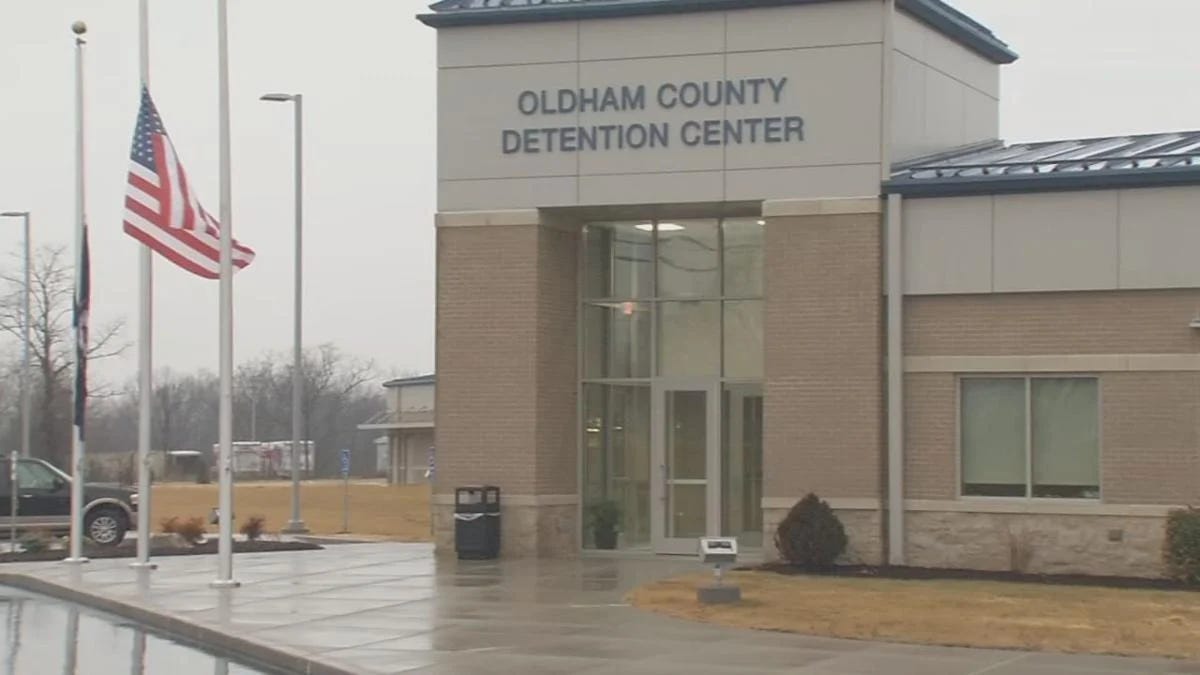
Oldham County is one example. ICE lists the Oldham County Detention Center as an ICE detention facility, and Oldham County has a 287(g) Jail Enforcement Model agreement with ICE. That means the local facility is not merely affected by federal immigration policy. It is connected to it.
This is where the story becomes more concrete.
Federal funding can increase the capacity and pressure of the system.
But local officials still make choices. Counties decide whether to sign or maintain agreements. Jailers operate facilities. Fiscal courts approve budgets. Public agencies decide how transparent they will be. Residents decide whether to ask questions before the system grows further.
Federal detention money can reshape local jail decisions
Any major federal funding plan creates incentives.
If ICE and Border Patrol receive a large three-year funding stream, the agencies will have more capacity to carry out enforcement. That can mean more arrests, more detention, more transportation, more contracting, and more pressure on local systems willing to cooperate.
Kentucky counties already have a financial relationship with ICE detention. When local jails hold people for ICE, they can receive federal payments. That creates a budget question that should be asked in public:
Are counties making detention choices because they believe those choices are necessary for public safety, or because federal detention dollars have become part of the jail’s financial model?
That question matters in every Kentucky county where ICE detention or 287(g) cooperation is present.
It matters even more when Congress is considering a major infusion of federal enforcement money.
Kentucky’s Senate vote now shifts attention to the House
The Senate vote also had a Kentucky-specific political detail.
Reuters reported that Kentucky Sen. Rand Paul and Alaska Sen. Lisa Murkowski were the two Republicans who opposed the measure. The official Senate roll call shows the resolution passed 50-48, with two senators not voting.
That does not settle the issue for Kentucky. The House is now the next federal pressure point.
Kentucky’s House delegation matters because the Senate framework still needs House action before the process can move forward. If the House approves the framework, committees can write the detailed legislation. That is where the specifics matter: guardrails, reporting requirements, detention transparency, limits on local jail expansion, oversight after enforcement incidents, and conditions on how federal money can be used.
Kentuckians should not wait until the money is already flowing through the system to ask what safeguards were attached.
Enforcement funding is moving faster than public oversight
The central problem is not only the size of the funding package.
The central problem is enforcement expansion without accountability strong enough to match it.
A government can expand detention faster than it expands oversight.
It can increase arrests faster than it increases due-process protections. It can fund local cooperation faster than the public can track how those agreements work. It can turn county jail beds into federal enforcement capacity while residents are told this is simply a federal issue.
That is how power moves.
It does not always arrive as one national order. It moves through contracts, budgets, agreements, local jails, reimbursement rates, transportation arrangements, and administrative decisions. The public often sees the consequences only after the structure is already in place.
Kentucky has already seen how hard it can be to get basic information about ICE detention in local jails. If Congress expands enforcement funding while local transparency remains weak, the public may have even less ability to see what is happening in its own communities.
This is how state power moves through local institutions
Under the Six Pillars framework, this belongs primarily under State Power.
The mechanism is enforcement: detention, policing, surveillance, deportation systems, local-federal cooperation, and jail infrastructure. The policy topic is immigration, but the power operates through the state’s coercive machinery.
It also fits Democracy Erosion because the funding pathway uses a majoritarian budget process to expand enforcement capacity while oversight fights remain unresolved. Public accountability becomes weaker when enforcement power grows faster than transparency, reporting, and local democratic control.
There is also a Corporate & Wealth Power angle when detention becomes tied to revenue, contracting, reimbursement, or private detention vendors. For a Kentucky-focused piece, the local jail revenue question may be more important than private contractors because county jails are already central to the story.
The next pressure points are federal and local
This story can feel overwhelming because the Senate vote is national. But the pressure points are not only national.
At the federal level, Kentucky’s House members can be pressed before the next step. They should be asked whether they support an ICE and Border Patrol funding package without stronger guardrails. They should be asked whether they will require public reporting on detention populations, enforcement incidents, local contracts, 287(g) agreements, and conditions inside facilities holding ICE detainees.
At the county level, fiscal courts and jailers can be pressed now. They should be asked whether their county holds people for ICE. They should be asked for contracts, per diem rates, invoices, transportation payments, policies, inspection reports, and population counts. They should be asked whether they will hold public hearings before entering, renewing, or expanding ICE cooperation.
At the state level, Kentucky lawmakers can be pressed to require transparency when county jails hold people for federal immigration enforcement. If a local jail is operating as part of the federal detention system, the public should not have to guess how many people are held there, what the county is being paid, what standards apply, or how families and attorneys can reach people.
That is the practical civic opening.
The Senate vote happened in Washington. The accountability fight can happen here.
What Kentuckians can do
Contact Kentucky’s U.S. House members before House action.
Ask them to oppose any ICE and Border Patrol funding package that lacks guardrails, including public reporting, detention transparency, limits on local jail expansion, clear officer identification requirements, and oversight after enforcement incidents.
Ask your fiscal court whether your county has an ICE detention contract or 287(g) agreement.
If the answer is yes, ask when the agreement was approved, whether there was a public hearing, what the county is paid, and whether the agreement will be reviewed before renewal.
File open records requests for local ICE-related records.
Request contracts, invoices, per diem rates, transportation payments, daily population counts, policies, inspection records, and communications about ICE agreements. If the county refuses, ask for the specific legal basis.
Support groups doing detention transparency work in Kentucky.
The League of Women Voters of Kentucky, Kentucky Center for Economic Policy, ACLU of Kentucky, immigrant-support coalitions, local journalists, and public-records advocates are helping make the system visible.
Make ICE detention a local government issue.
Do not let county officials treat federal detention as something outside local responsibility. If a county jail holds people for ICE, local officials are part of the system.
The question is where the money lands next
The Senate vote did not create Kentucky’s ICE detention infrastructure. It moves toward funding the federal agencies that can expand it.
That is why the Kentucky question is narrower and more urgent than the national debate.
Will more federal enforcement money flow through local jails without stronger public oversight?
Will county officials treat ICE detention as an administrative arrangement or as a public decision?
Will lawmakers attach guardrails before expanding enforcement power?
Will Kentuckians be able to see what is happening inside the institutions their communities fund and live beside?
A federal budget vote may happen far from Kentucky, but its consequences can settle into local jail beds.
The jail is staffed by local people. It sits inside a community. It appears in a county budget. It is overseen by local officials. And when it holds people for ICE, it becomes part of a federal enforcement system.
That is the story Kentucky cannot afford to miss.
The Senate has moved the money forward. Now Kentuckians need to follow where that money can land.
Direct sources
U.S. Senate Roll Call Vote 105, S.Con.Res. 33, April 23, 2026
Official Senate vote showing the resolution, vote time, result, and 50-48 tally.
https://www.senate.gov/legislative/LIS/roll_call_votes/vote1192/vote_119_2_00105.htm
Reuters: “US Senate votes to advance $70 billion funding plan for ICE, Border Patrol”
Useful for the $70 billion figure, three-year funding frame, House next step, Rand Paul’s vote, and Democratic concerns over guardrails.
https://www.reuters.com/legal/government/us-senate-edges-toward-advancing-ice-border-funding-plan-2026-04-23/
Associated Press: “Senate passes budget plan for ICE and Border Patrol in bid to reopen Homeland Security Department”
Useful for explaining the DHS shutdown context, budget process, House next step, and political framing.
https://apnews.com/article/senate-homeland-security-shutdown-ice-border-patrol-cc395349d03dea6d3080b06be7974899
League of Women Voters of Kentucky: “ICE Detention in Kentucky: An Initial Report”
Best Kentucky-specific source for ICE detention counts in Kentucky jails, including the 1,041 average daily population figure from February 2026.
https://static1.squarespace.com/static/5da3dbee03dd2c4493abed8b/t/69b2bad0f245e642505847b6/1773320912349/Immigration%2BInitial%2BReport.LWVKY.Feb122026.pdf
Northern Kentucky Tribune summary of League of Women Voters of Kentucky report
Useful for a short accessible summary of the report’s major findings, including the increase from 434 to 1,041 and the rise in detainees identified as non-criminal.
https://nkytribune.com/2026/03/kentucky-league-of-women-voters-release-report-on-ice-detainees-being-held-in-county-jails/
ICE Detention Management data page
Primary federal data source for detention statistics and spreadsheets.
https://www.ice.gov/detain/detention-management
ICE Oldham County Detention Center facility page
Primary federal source identifying OCDC as an ICE detention facility.
https://www.ice.gov/detain/detention-facilities/oldham-county-detention-center
ICE 287(g) Jail Enforcement Model agreement for Oldham County
Primary federal source for Oldham County’s 287(g) agreement.
https://www.ice.gov/doclib/287gMOA/OldhamCountySheriffKY_JEM_MOA_030725.pdf
Kentucky Center for Economic Policy: “ICE Enforcement in Kentucky”
Useful for statewide analysis of 287(g), local law enforcement cooperation, and county jail participation.
https://kypolicy.org/ice-enforcement-in-kentucky/
Prison Policy Initiative: “Is your county collaborating with ICE?”
Useful national context on local government participation in ICE detention and 287(g) agreements.
https://www.prisonpolicy.org/blog/2026/02/23/ice_county_collaboration/
ACLU of Kentucky, Immigrants’ Rights
Useful for civil-liberties and community-impact framing.
https://www.aclu-ky.org/issues/immigrants-rights/