
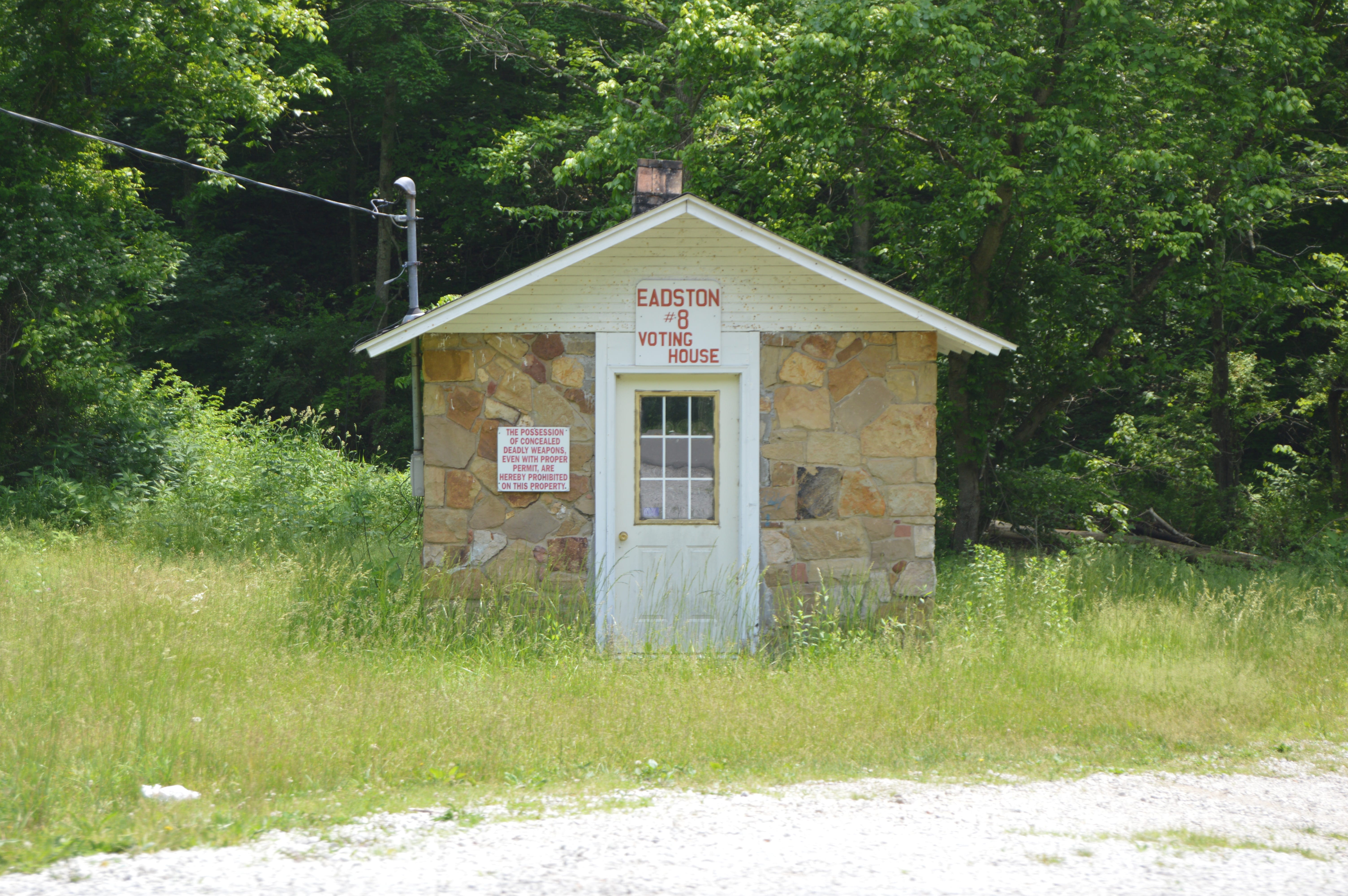
Kentucky’s absentee voting system is not a free-for-all. It is narrow, rule-bound, and administered through state law.
A Kentucky voter cannot simply decide to vote by mail because it is convenient. The state limits mail-in absentee voting to specific categories of people: covered voters, students temporarily outside their home county, voters who are ill, disabled, or advanced in age, people temporarily living outside Kentucky, and people incarcerated in jail who have been charged but not convicted. Requests generally go through a secure online portal, and once a voter qualifies, the request is transmitted to the county clerk in the voter’s county of registration.
That is the system already in place here.
Now a federal court in Washington, D.C., is weighing whether President Trump can insert a new federal layer into that process.
On Thursday, U.S. District Judge Carl Nichols heard arguments over Trump’s March 31 executive order on federal elections. The order directs federal agencies to compile state-by-state lists of eligible voters, directs the U.S. Postal Service to transmit mail ballots only to voters on official lists, and requires states and localities to keep election-related records for five years. Judge Nichols did not rule immediately. The Justice Department argued the lawsuit is premature because the federal voter list has not yet been created. Challengers argue the order exceeds presidential authority and could disrupt election administration before the 2026 midterms.
For Kentucky, the question is not whether elections should be secure. Kentucky already has voter registration rules, absentee voting rules, identification requirements, county clerks, a State Board of Elections, and voter-roll maintenance procedures.
The question is who controls the path between an eligible Kentucky voter and a ballot.
The order would turn federal agencies into election gatekeepers
The White House titled the March 31 order “Ensuring Citizenship Verification and Integrity in Federal Elections.” It cites federal election laws and the Constitution’s guarantee clause as authority for the president to direct federal action around voter eligibility, citizenship verification, mail-ballot handling, and election-record retention.
The practical effect is more important than the title.
The order tries to move federal agencies into the election-administration chain. It directs the federal government to help identify eligible voters by state. It places the U.S. Postal Service into the mail-ballot process by directing that ballots be transmitted only to voters on official lists. It also adds a five-year record-retention requirement for states and localities.
That is not a small technical adjustment.
In Kentucky, absentee voting already depends on a sequence of state and local steps. The voter must qualify. The request must be made within the required window. The State Board of Elections portal must process the request. The county clerk must receive and administer it. The voter must return the ballot properly.
A federal eligible-voter list would add another gate.
If that gate is wrong, incomplete, delayed, or built from mismatched records, the impact would not stay in Washington. It would appear at the county clerk’s office, in a voter’s mailbox, or on the online status screen where a Kentucky voter checks whether an absentee ballot request was received.
The voters most at risk are already navigating barriers
Kentucky does not rely on a universal vote-by-mail system. That makes the affected group smaller than in some states, but not less important.
The people most likely to rely on mail-in absentee ballots in Kentucky are people with specific circumstances that make ordinary in-person voting harder. They include military and overseas voters, students temporarily living outside their county, voters who are ill or disabled, older voters, people temporarily outside Kentucky, and eligible voters in jail who have not been convicted.
Those categories matter.
A student registered at home but living away for school may already need to navigate deadlines and documentation. A military-connected voter may be relying on mail from outside the state or country. An older voter or disabled voter may not have a simple backup plan if a ballot is delayed. A person sitting in jail before conviction depends on other people and institutions to make access possible.
Kentucky law even recognizes that jailed voters may need assistance reaching the county clerk. KRS 117.085 says that if an eligible jailed voter expresses a desire to request a mail-in absentee ballot, jail staff must allow the voter, during normal business hours, to use a telephone to receive assistance from the county clerk.
That is a fragile kind of access. It depends on clear rules, timely communication, and local officials knowing what to do.
Adding a federal list does not automatically make that system more secure. It may make it more complicated.
Kentucky is already in the voter-data fight
This court fight does not stand alone.
Kentucky is already involved in a separate legal conflict over federal access to voter data. In March, the League of Women Voters of Kentucky, the New Americans Initiative, and two Kentucky voters moved to intervene in United States v. Adams, a case involving the Department of Justice’s effort to obtain private Kentucky voter data. They are represented by the ACLU of Kentucky and the ACLU Voting Rights Project.
The ACLU describes the data at issue as sensitive, non-public information from Kentucky’s voter registration database, including Social Security numbers, driver’s license numbers, dates of birth, and home addresses. The ACLU-KY case page also warns that cross-agency matching systems used to identify alleged noncitizens can produce false positives, incorrectly flagging U.S. citizens as ineligible.
That is the Kentucky connection that should make this new executive-order case harder to ignore.
One fight centers on federal access to Kentucky voter data. The other centers on federal power to compile eligible-voter lists and shape how mail ballots are handled.
They are not identical cases, but they fall within the same larger pattern: the federal executive branch seeking a greater role in systems historically administered by states and local election officials.
That pattern deserves scrutiny before it becomes normal.
Waiting for harm can mean waiting too long
The Justice Department’s argument in the D.C. hearing is straightforward: the list has not yet been created, so the challengers cannot show the kind of immediate harm required for a court order blocking it. Reuters reported that Judge Nichols acknowledged the urgency but questioned whether the plaintiffs had shown immediate harm.
That argument may matter legally. Courts have rules around timing, standing, and proof of injury.
Waiting for the damage to arrive is not the same thing as governing carefully.
Election systems are not built overnight. County clerks need clear rules. State election officials need stable guidance. Voters need deadlines they can understand. Advocacy groups need enough time to educate people accurately. When a federal directive threatens to add a new screening mechanism to ballot access, the harm may begin before a single voter is formally rejected.
It begins when local officials do not know which list controls.
It begins when voters do not know whether they should trust the state portal, the county clerk, the Postal Service, or a federal verification system.
It begins when advocacy groups have to explain a system that has not been fully built, tested, or publicly understood.
Kentucky has already seen how absentee ballot confusion can affect voters. ACLU-KY previously asked the State Board of Elections for clearer absentee ballot guidance after reports that voters in several counties received mixed messages from poll workers and clerks after requesting absentee ballots and then attempting to vote in person. Those reports came from Fayette, Boone, Warren, Kenton, and Jefferson counties.
That example does not prove what will happen under Trump’s order. It does show how quickly confusion can become a voting-access problem when rules are unclear at the local level.
Kentucky already maintains its voter rolls
Another reason Kentucky should watch this closely: the state already has voter-roll maintenance processes in place.
The Kentucky State Board of Elections says registration statistics are updated monthly and made available by congressional district, state Senate district, state House district, county, and precinct. The board also states that after each federal election, it purges inactive voter registrations in accordance with state and federal law. Its website says Kentucky purged 225,311 inactive registrations on February 25, 2025, and that since 2019, more than 734,000 voter registrations have been removed from the rolls for all ineligibility reasons.
Those numbers do not answer every question about election administration. They do show that Kentucky is not operating without a system.
So the issue raised by the executive order is not whether Kentucky voter rolls should be maintained. They already are.
The issue is whether a president can use an executive order to place federal agencies, federal datasets, and the Postal Service into the middle of that process.
Federal power becomes real at the county clerk’s office
Federal election orders can sound distant until they reach a county office.
In Kentucky, county clerks are the people voters call when something goes wrong. They administer local election processes, handle absentee-voting logistics, and serve as the public face of systems they did not always design.
If a federal list delays a ballot, a voter may call the county clerk.
If the Postal Service does not transmit a ballot because a voter is missing from a list, a voter may call the county clerk.
If state guidance changes after litigation, a county clerk may have to explain the change.
If a federal agency’s data does not match a Kentucky voter’s information, the voter may not know which office can fix it.
That is why this story belongs in Kentucky. Not because Kentucky controls the executive order. Not because Kentucky voters are the only voters affected.
Federal power often becomes real at the local counter, inbox, and phone line.
And when the issue is voting, delay can function like denial.
What Kentuckians can do now
Kentuckians do not have to wait passively for the court system to complete its work.
Check your voter registration through Kentucky’s official voter information tools and make sure your information is current well before any deadline.
If you qualify for mail-in absentee voting, read the eligibility rules directly from the Kentucky State Board of Elections and your county clerk. Do not rely only on social media summaries or secondhand explanations.
Watch the Kentucky State Board of Elections and the Secretary of State for guidance on the March 31 executive order, federal voter-list creation, mail-ballot procedures, or DOJ voter-data requests.
Contact your county clerk with specific, practical questions: whether any federal guidance has changed absentee ballot procedures, whether ballot tracking remains the same, and what voters should do if their absentee ballot request or ballot delivery is delayed.
Support organizations doing voter education and voter protection work in Kentucky, including the League of Women Voters of Kentucky, ACLU of Kentucky, Our People Our Vote, and local nonpartisan civic groups.
Document confusion. If voters receive conflicting information from officials, portals, mail notices, or poll workers, that should not vanish as a private frustration. It should be reported to election officials, voter-protection organizations, and local journalists.
This case is still in court. The federal list has not yet been created. The order may be blocked, narrowed, delayed, or allowed to move forward.
Kentucky should not treat this as someone else’s election story.
The structure of voting access is being tested in real time. The question is whether Kentucky’s system remains accountable to Kentucky law, Kentucky election officials, and Kentucky voters, or whether a new federal checkpoint starts deciding who moves cleanly through the process and who gets caught in it.
Direct Sources
White House, “Ensuring Citizenship Verification and Integrity in Federal Elections”
https://www.whitehouse.gov/presidential-actions/2026/03/ensuring-citizenship-verification-and-integrity-in-federal-elections/
White House Fact Sheet on citizenship verification and voter eligibility
https://www.whitehouse.gov/fact-sheets/2026/03/fact-sheet-president-donald-j-trump-ensures-citizenship-verification-and-voter-eligibility-in-federal-elections/
Associated Press, “Lawyers urge judge to block Trump order that would create eligible voter list, limit mail ballots”
https://apnews.com/article/ac61e7d4bb77f9901eb6f1a2c1f4b087
Reuters, “Judge weighs Democrats’ bid to block Trump’s executive order on voting”
https://www.reuters.com/legal/government/judge-weigh-democrats-bid-block-trumps-executive-order-voting-2026-05-14/
Kentucky State Board of Elections, Absentee Voting by Mail
https://elect.ky.gov/Voters/Pages/Absentee-Voting.aspx
KRS 117.085, Mail-in absentee ballots
https://apps.legislature.ky.gov/law/statutes/statute.aspx?id=56445
Kentucky State Board of Elections, Registration Statistics
https://elect.ky.gov/Resources/Pages/Registration-Statistics.aspx
Kentucky State Board of Elections homepage, voter-roll purge information
https://elect.ky.gov/Pages/default.aspx
League of Women Voters, “Civil Rights Groups File Motion to Protect Sensitive Kentucky Voter Data”
https://www.lwv.org/newsroom/press-releases/civil-rights-groups-file-motion-protect-sensitive-kentucky-voter-data
ACLU, “United States v. Adams”
https://www.aclu.org/cases/united-states-v-adams
ACLU-KY, “U.S. v. Adams”
https://www.aclu-ky.org/cases/us-v-adams/
ACLU-KY, “ACLU-KY Asks State Elections Board for Clearer Absentee Ballot Guidance”
https://www.aclu-ky.org/news/aclu-ky-asks-state-elections-board-clearer-absentee-ballot-guidance/