
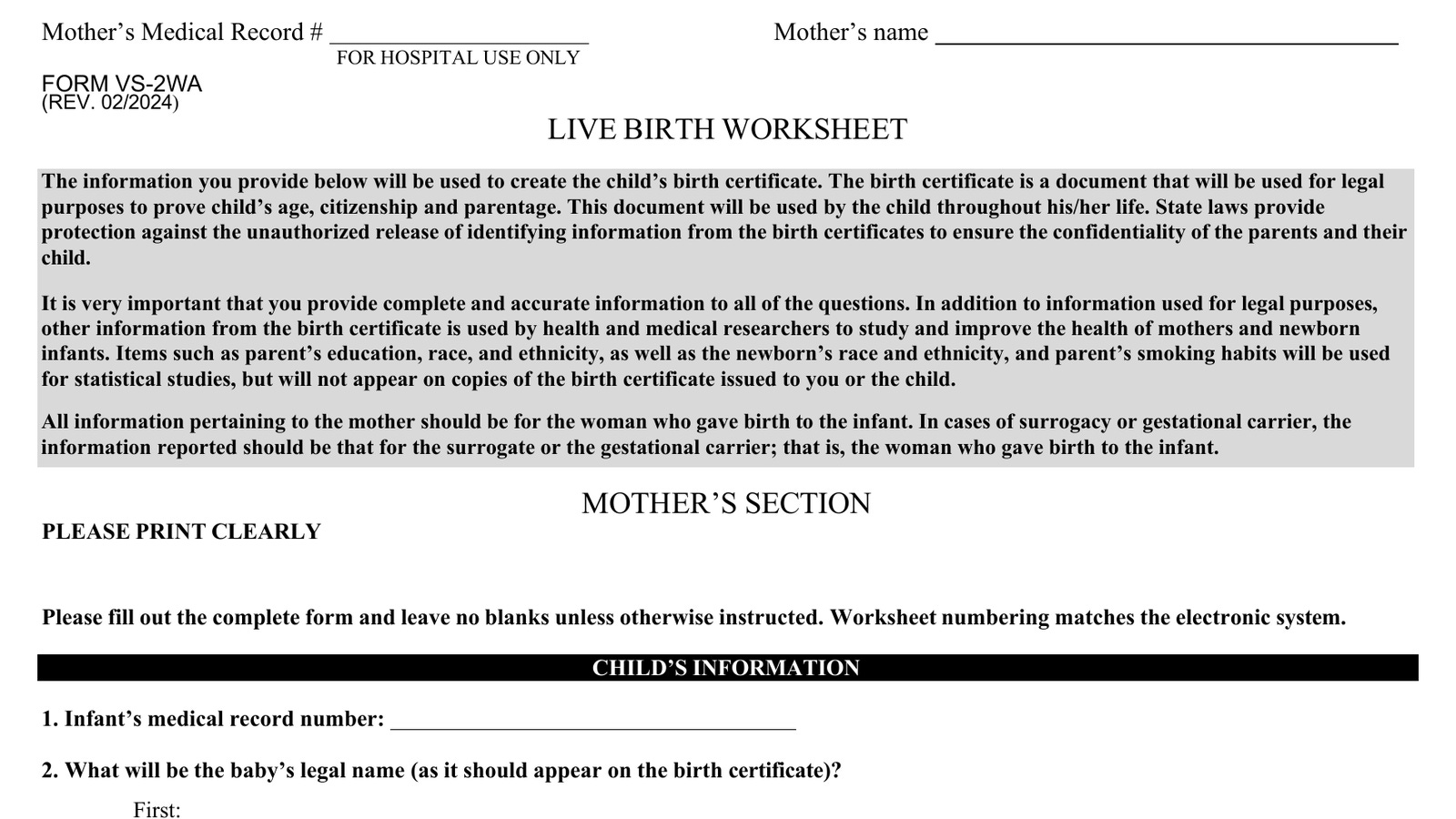
At the top of Kentucky’s Live Birth Worksheet, the state tells new parents something simple and consequential. The information they provide will create a birth certificate used to prove the child’s “age, citizenship and parentage.” On Aug. 6, President Donald Trump signed an executive order directing federal agencies not to accept state or local documents as recognition of U.S. citizenship for certain U.S.-born people when neither parent is a citizen.
Kentucky’s birth-registration system is already connected to the federal government. Parents can request a Social Security number for a newborn on the Kentucky birth worksheet. The state then sends birth-registration information electronically to the Social Security Administration, which says it uses those records to establish the newborn’s age, identity and U.S. citizenship.
That puts Kentucky inside a new and still unsettled question. The Supreme Court ruled June 30 that children born in the United States to parents who are here unlawfully or temporarily are citizens at birth. Trump’s new order does not simply repeat the policy the Court rejected. It creates narrower exclusions and tells federal agencies to decide when a state record will no longer be enough to establish citizenship.
The Court had already drawn a line
In Trump v. Barbara, the Supreme Court held that children born in the United States to parents who are unlawfully or temporarily present are protected by the Fourteenth Amendment’s Citizenship Clause. The Court traced birthright citizenship through English common law, early American law and the 1898 case United States v. Wong Kim Ark. It described a broad rule with narrow historical exceptions.
Justice Brett Kavanaugh provided the sixth vote against Trump’s earlier order on a separate ground. He disagreed with the Court’s constitutional reasoning but concluded that federal law does not allow the president to create the two new citizenship exceptions in that order. Congress could change the law, he wrote, but “Congress has not yet done so.”
The Aug. 6 order takes a narrower approach. It covers several groups the administration says fall outside the rule the Supreme Court announced, including some children of foreign-government employees, children whose parent is classified as an “alien enemy,” and children whose parents allegedly used fraud or a commercial arrangement to obtain citizenship through a U.S. birth. The last category includes arrangements intended to ensure that a mother gives birth in the United States, often called birth tourism.
The administration argues that these categories fit within exceptions the Court left intact. There is a legitimate legal argument for at least some of them. Children of diplomats, for example, have long been treated differently because their parents are not subject to U.S. authority in the same way as ordinary residents and visitors. Reuters reported that legal experts see a stronger possible basis for some narrowly defined foreign-official exceptions.
The birth-tourism provision faces a harder test. The Supreme Court specifically held that temporary presence does not by itself remove a child from the Citizenship Clause, and federal law already gives a separate way to punish visa fraud. Whether the government may punish a parent’s conduct by refusing to recognize the citizenship of the U.S.-born child is likely to be among the questions courts confront if the new order is challenged. Reuters reported Friday that legal experts expect litigation, but I found no filed challenge to this specific Aug. 6 order as of early Saturday afternoon.
The narrower Kentucky story begins before any court gets that case. The president has already ordered federal agencies to change their policies.
Kentucky already feeds birth records into the federal system
Kentucky’s birth worksheet asks for the newborn’s name, place and date of birth and information about the parents. It asks for parents’ Social Security numbers and places of birth, and it allows parents to request a Social Security number for the baby. The currently posted form does not ask whether a parent is a U.S. citizen, has a particular immigration status, works for a foreign government or falls into the other categories in Trump’s new order.
Federal regulations explain what happens when a parent requests a Social Security number during birth registration. Kentucky’s vital-statistics office sends the newborn’s information electronically to Social Security. The federal agency says it uses the state information to establish the child’s “age, identity, and U.S. citizenship” before issuing a number.
The federal government has already shown how it could add another layer to that process.
Last year, while Trump’s earlier birthright-citizenship order was blocked in court, Social Security prepared an implementation plan for the newborn-registration program. The agency proposed using parents’ Social Security numbers to check its own records for citizenship or immigration status. If those records were not enough, it planned to check a Homeland Security immigration database.
If federal systems still could not verify a parent’s status, Social Security planned to hold the newborn’s record rather than process it normally. Parents could then be asked for more information. That plan never became the operating rule and does not govern the Aug. 6 order, but it establishes that the federal government has already designed a way to add parental-status screening to the state birth-record process without first rebuilding Kentucky’s system.
The new order now directs the secretaries of State and Homeland Security, the attorney general and the Social Security commissioner to make their policies consistent with its citizenship restrictions. Every executive department and agency must publish guidance within 30 days.
As of early Saturday afternoon, I found no new public Social Security, Homeland Security, State Department or Justice Department guidance explaining how those agencies will carry out the order. I also found no evidence that Kentucky has changed its birth form, that Kentucky hospitals have received new instructions or that a Kentucky newborn has been denied a Social Security number because of the Aug. 6 order.
Kentucky produces a birth record that it tells parents will be used to prove citizenship.
That record already enters a federal process used to establish a newborn’s citizenship. Trump has now ordered federal agencies not to accept state documents as recognition of citizenship for people who fall into his new categories.
Here the method becomes visible.
The administration is pursuing narrower citizenship exclusions through the federal systems that decide which documents count and how a person’s legal status is recognized after the Supreme Court rejected its broader rule. Birth records, database checks and agency instructions are ordinary tools of government. The concern arises when those administrative tools are used to press a policy objective against a boundary a court has just established.
That pattern is associated with modern authoritarian government: judicial limits remain on paper while executive agencies look for administrative routes to preserve as much of the restricted policy as possible. The evidence here strongly indicates that pattern, but it does not establish that every part of the Aug. 6 order violates the Supreme Court’s decision. Some of the new categories may survive judicial review.
The democratic safeguard under pressure is judicial review itself, especially its practical force after a court has ruled.
Most people do not exercise constitutional rights in a courtroom. They encounter those rights when an agency accepts a birth certificate, issues a passport, processes a record or recognizes a legal status.
A court victory loses some of its protective force if executive agencies can substantially recreate the rejected result through the administrative rules people must navigate afterward.
The next answers are due within 30 days
The most revealing documents may be technical instructions rather than another presidential speech. Social Security must decide how its newborn process will treat Kentucky birth records under the new order. Other agencies will have to explain how they determine who falls into the new citizenship categories.
The order gives federal agencies 30 days from Aug. 6 to publish implementation guidance, putting the deadline around Sept. 5. Among the questions are whether parents’ federal records will be checked, whether Kentucky will be asked to collect different information, what happens when government databases are incomplete or wrong, and how a family can challenge an incorrect determination.
This is the warning sign worth recognizing beyond birthright citizenship: watch what happens after a court limits executive power.
If the same objective begins reappearing in document rules, database checks, eligibility standards or agency instructions, the fight has shifted from the courtroom into administration.
Kentuckians can make that shift visible now. The Kentucky Cabinet for Health and Family Services uses an online Open Records Center for public-records requests. A focused request can seek communications created or received since Aug. 6 by the Office of Vital Statistics concerning the new citizenship order, Social Security’s newborn process, changes to birth-registration data or instructions from federal agencies.
The second point to watch is the federal guidance due in early September. Preserve Social Security’s first version and compare it with the 2025 plan: what information is checked, what happens when a parent’s status cannot be confirmed, whether a Kentucky birth certificate remains sufficient, and what process exists to correct a mistake.
Kentucky’s birth worksheet already tells us where to look.
Further Reading and Sources
White House: Continuing to Protect the Meaning and Value of American Citizenship, Aug. 6, 2026
U.S. Supreme Court: Trump v. Barbara, June 30, 2026
Kentucky Live Birth Worksheet, Form VS-2WA
Social Security regulation governing state birth-registration records
Social Security’s 2025 implementation plan for the earlier citizenship order
Kentucky Cabinet for Health and Family Services Open Records Requests
Reuters: Trump signs orders to limit U.S. birthright citizenship