
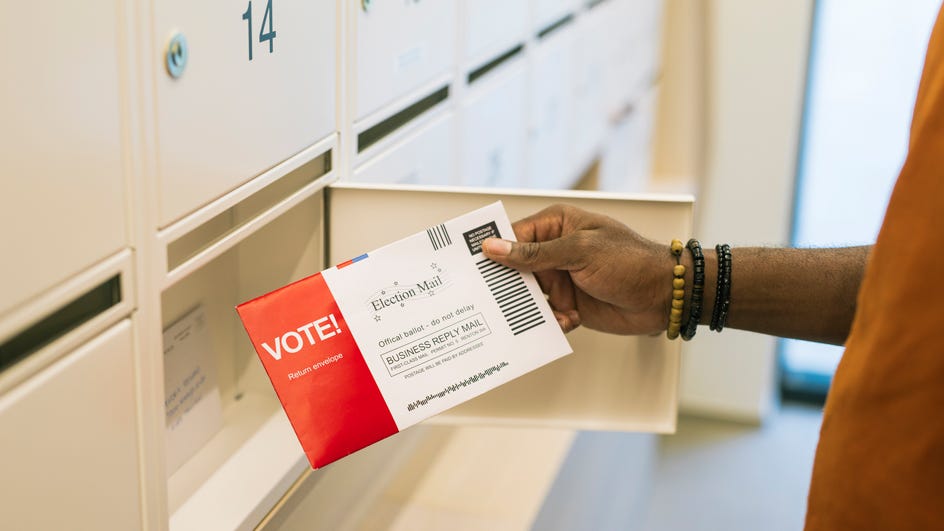
A federal judge in Boston heard arguments on June 2 over President Donald Trump’s March 31 executive order directing federal agencies to create state citizenship lists and pushing the U.S. Postal Service toward new mail-ballot rules before federal elections. Voting-rights groups and a coalition of states are asking courts to block the order, arguing that the president is trying to take authority that belongs to states and Congress.
Kentucky is not part of the multistate lawsuit. The order could still create work for Kentucky’s Secretary of State, State Board of Elections, county clerks, and county boards of elections because Kentucky already has mail-in absentee ballot rules written into state law.
The practical concern for Kentucky starts with the calendar.
Kentucky’s online mail-in absentee ballot portal cannot open more than 45 days before an election and closes 14 days before Election Day. Trump’s executive order and the USPS proposal rely on 60-day pre-election lists and federal handling rules for ballot mail.
That timing gap could force Kentucky election administrators to answer a basic operational question: how can the state submit or match mail-ballot information 60 days before an election when many Kentucky voters are not yet allowed to request a mail-in absentee ballot?
What happened
On March 31, Trump signed Executive Order 14399, titled “Ensuring Citizenship Verification and Integrity in Federal Elections.” The order directs the Department of Homeland Security, working through U.S. Citizenship and Immigration Services and in coordination with the Social Security Administration, to compile “State Citizenship Lists” and send them to state election officials before federal elections.
The order says those lists should include individuals confirmed to be U.S. citizens, over 18, and residing in each state. It names federal citizenship and naturalization records, Social Security records, SAVE data, and other federal databases as sources.
The same order directs the U.S. Postal Service to begin rulemaking on mail-in and absentee ballots. USPS then proposed a rule called “Ballot Mail for Federal Elections,” which would amend the Domestic Mail Manual for federal-election ballot mail. The proposed rule cites Executive Order 14399 and USPS’s authority under 39 U.S.C. § § 401 and 404.
Reuters reported that the USPS proposal would require states to submit names of voters receiving mail ballots, along with unique barcodes tied to those ballots, for federal elections. Reuters also reported that the proposal does not apply to primary elections and includes a 30-day public comment period before the rule can be finalized.
On April 2, voting-rights organizations filed a lawsuit in the U.S. District Court for the District of Massachusetts. The plaintiffs include League of Women Voters organizations, the Association of Americans Resident Overseas, U.S. Vote Foundation, OCA-Asian Pacific American Advocates, and Delta Sigma Theta Sorority, Inc. They argue that the Constitution gives election-rule authority to states and Congress, not the president.
On April 3, New York Attorney General Letitia James announced a separate lawsuit by a coalition of 22 other attorneys general and Pennsylvania’s governor. The coalition argues that the order unlawfully takes election authority from states, threatens election officials with prosecution, restricts mail voting, and pressures states to use federal voter lists.
The federal agencies assigned new election roles
The executive order uses federal data, mail rules, and prosecution priorities. DHS and USCIS would compile state citizenship lists. SSA would coordinate with DHS. USPS would write rules for ballot mail. The Department of Justice would prioritize enforcement against people accused of distributing ballots to voters the administration considers ineligible.
That combination changes the fight from a campaign talking point into a possible administrative burden for state election offices.
Federal agencies would not merely comment on election integrity.
They would gather voter-related data, shape how ballot mail is handled, and pose a law-enforcement risk to state and local election administrators.
The USPS proposal would require specific handling of outbound and return ballot envelopes. It refers to Official Election Mail markings, automation compatibility, and uniquely serialized Intelligent Mail barcodes or successor USPS technology. It would not apply to ballots covered under the Uniformed and Overseas Citizens Absentee Voting Act.
Kentucky already has ballot-envelope security rules. State regulation requires mail-in absentee ballot outer envelopes to include a unique barcode or label issued by the State Board of Elections. That overlap does not settle the issue. The federal proposal could still require different data reporting, earlier state submissions, or federal review of ballot-mail lists.
The lawsuit in Massachusetts targets the broader claim of authority. The voting-rights groups argue that the president cannot use federal agencies to override state mail-voting laws or turn USPS into a gatekeeper for ballot delivery.
Kentucky’s 45-day absentee calendar creates the conflict
Kentucky does not have universal vote-by-mail. Mail-in absentee voting is limited to specific categories of voters under state law. Those categories include military and overseas voters; students temporarily outside their county; voters who are ill, disabled, or advanced in age; voters temporarily away from their county; voters in the Secretary of State’s crime victim address confidentiality program; and some incarcerated voters who have been charged but not convicted.
Those voters are the Kentucky residents most likely to feel confused if federal rules change how ballots are mailed before the 2026 general election. A student away at college, a disabled voter at home, a Kentuckian temporarily out of the county, or a pretrial detainee trying to vote through the county clerk does not need conflicting instructions from Washington and Frankfort.
Kentucky’s absentee ballot timing creates a direct implementation problem. State law says the online mail-in absentee request portal may not open more than 45 days before an election. It closes at 11:59 p.m. local time 14 days before the election.
Trump’s order and the USPS proposal rely on 60-day pre-election list concepts. If a federal rule expects Kentucky to submit a list of voters who will receive mail-in absentee ballots 60 days before Election Day, the state may not yet know many of those voters because Kentucky law has not opened the request portal.
That conflict could place Kentucky county clerks in a difficult position. County clerks process mail-in absentee requests after the State Board of Elections portal transmits eligible voter requests to the voter’s county clerk. If federal mail rules demand earlier lists, clerks may need new guidance from Secretary of State Michael Adams and the Kentucky State Board of Elections.
Kentucky voters could also face data-matching problems.
Federal citizenship lists compiled from DHS, USCIS, SSA, SAVE, and other databases may not perfectly match Kentucky voter-registration records. Name changes, address changes, naturalization timing, clerical errors, and database lags can create problems for eligible voters.
That risk is one reason Judge Indira Talwani raised concern during the June 2 hearing. Reuters reported that she questioned whether incomplete federal lists could leave eligible voters out and whether the order could unlawfully interfere with state authority over elections.
What you can watch or do
Track the Massachusetts case. Watch for Judge Talwani’s decision on whether to block the executive order while the lawsuit continues. If the order is blocked, the immediate risk to Kentucky’s absentee calendar may decrease. If the order survives, Kentucky election officials will need guidance quickly.
Track the USPS proposed rule. Submit a public comment if the comment window is still open. Ask USPS to explain how a 60-day mail-ballot list requirement can work in states like Kentucky, where voters cannot request mail-in absentee ballots until 45 days before an election.
Ask Secretary of State Michael Adams whether Kentucky has submitted or plans to submit comments on the USPS proposed rule. Ask whether his office has identified conflicts between the federal proposal and KRS 117.085.
Ask the Kentucky State Board of Elections whether county clerks will receive written guidance if USPS finalizes the proposed rule. The guidance should explain ballot envelope requirements, voter list reporting, barcode reporting, voter notification, and correction procedures for federal list errors.
Ask your county clerk what voters should do if federal rules change before the 2026 general election. Voters should know whether their county will post updates on absentee ballot requests, ballot mailing, envelope rules, ballot tracking, and deadlines.
Document confusion when it happens. If a voter receives conflicting information from a county clerk, USPS, the State Board of Elections, or an online voter portal, save screenshots, dates, names, and written responses.
Election confusion becomes harder to fix when nobody documents it.
Share this with voters in Kentucky who qualify for mail-in absentee ballots. The most affected readers are disabled voters, older voters, students away from home, military and overseas voters, voters away from their county during voting windows, and people helping family members request ballots.
Further reading and sources
Federal Register, Executive Order 14399, “Ensuring Citizenship Verification and Integrity in Federal Elections”
https://www.federalregister.gov/documents/2026/04/03/2026-06601/ensuring-citizenship-verification-and-integrity-in-federal-elections
White House, Executive Order 14399
https://www.whitehouse.gov/presidential-actions/2026/03/ensuring-citizenship-verification-and-integrity-in-federal-elections/
USPS proposed rule, “Ballot Mail for Federal Elections”
https://public-inspection.federalregister.gov/2026-10968.pdf
ACLU of Massachusetts, lawsuit announcement
https://www.aclum.org/press-releases/voting-rights-groups-challenge-executive-order-on-mail-in-ballots-as-illegal-interference-in-elections/
ACLU, League of Women Voters of Massachusetts v. Trump case page
https://www.aclu.org/cases/league-of-women-voters-of-massachusetts-v-trump
Brennan Center, League of Women Voters of Massachusetts v. Trump case page
https://www.brennancenter.org/our-work/court-cases/league-women-voters-massachusetts-v-trump-march-2026-mail-voting-executive
New York Attorney General, multistate lawsuit announcement
https://ag.ny.gov/press-release/2026/attorney-general-james-challenges-unconstitutional-executive-order-threatening
Associated Press, federal court hearing on Trump mail-in executive order
https://apnews.com/article/0605d78112c6a1cb8685ca0f053a79b8
Reuters, Boston judge weighs blocking Trump mail-in voting executive order
https://www.reuters.com/legal/government/boston-judge-weigh-blocking-trumps-mail-in-voting-executive-order-2026-06-02/
Reuters, USPS seeks to require states to submit voter lists
https://www.reuters.com/world/us-postal-service-seeks-require-states-submit-lists-voters-2026-05-29/
Kentucky Revised Statute 117.085, mail-in absentee ballots
https://apps.legislature.ky.gov/law/statutes/statute.aspx?id=56445
Kentucky State Board of Elections, absentee voting by mail
https://elect.ky.gov/Voters/Pages/Absentee-Voting.aspx
31 KAR 5:026, Kentucky ballot standards and election security
https://apps.legislature.ky.gov/Law/kar/titles/031/005/026/REG/