
On September 4, the Department of Homeland Security is directed to send Kentucky a list of adult citizens who live in the state. Kentuckians will then have another 31 days, until October 5, to register for the November election.
A federal list delivered on September 4 cannot describe Kentucky’s final November electorate.
President Donald Trump ordered DHS to create the list on March 31 in Executive Order 14399. The order also directed the U.S. Postal Service to develop a second data system linking mail-ballot recipients’ names and addresses to unique barcodes on their ballot envelopes.
A federal judge has blocked those provisions for 23 states and the District of Columbia through the November 3 election. Kentucky is not covered by that injunction. Secretary of State Michael Adams and the Kentucky State Board of Elections have not publicly explained how they would handle the federal citizenship data, who would have access to the postal records, or what protections would apply when state and federal records disagree.
Two lists with different functions
The executive order creates two separate lists that have often been blurred together in public accounts.
DHS would compile a State Citizenship List from citizenship and naturalization records, Social Security records, the federal SAVE verification service, and other databases. It would include people the federal government can confirm are citizens, will be at least 18 by the election, and maintain a residence in Kentucky.
The order says that appearing on the list does not mean a person is registered to vote. The federal government has also acknowledged in court that the list will necessarily be incomplete because the underlying records do not identify every citizen or reflect every change in citizenship status.
The Postal Service proposal works differently. Under its June 2 proposed rule, Kentucky election offices or approved mailing contractors would submit each mail-ballot recipient’s name, address, issuing jurisdiction and two unique Intelligent Mail barcodes through a Federal Ballot Mail Portal. One barcode would identify the envelope carrying the blank ballot to the voter, and the second would identify the return envelope.
Postal employees would not compare voters with the DHS citizenship list. Kentucky would remain responsible for deciding who qualifies for a mail ballot, while USPS would compare each outbound mailing with the information Kentucky had uploaded.
USPS would review those mailings before accepting them. A batch that failed the envelope, barcode, certification or portal requirements could be returned to a county clerk or mailing provider for correction.
The Postal Service also proposed retaining the names, addresses, jurisdictions and ballot-envelope barcodes for five years. Its July 17 privacy notice says the records would be kept at USPS headquarters and in a supplier cloud-computing environment, with uses that include determining compliance with federal law and facilitating law-enforcement efforts. The notice does not identify the supplier.
The court order stops before Kentucky
The legal challenge began three days after Trump signed the order. Twenty-three states, the District of Columbia and Pennsylvania Gov. Josh Shapiro sued in federal court in Massachusetts, arguing that the president had attempted to impose federal election rules without legislation from Congress.
U.S. District Judge Indira Talwani agreed. Her June 25 ruling declared the citizenship-list and postal provisions unlawful, concluding that the Constitution assigns authority over federal election rules to state legislatures and Congress, not to the president acting alone. The final injunction protects the plaintiff jurisdictions for federal elections through November 3.
The First U.S. Circuit Court of Appeals refused to suspend the injunction on July 25. The court emphasized that election preparation begins months before Election Day, when states buy envelopes, program software, assign staff and issue instructions. Nearly half of the plaintiff states had already purchased ballot envelopes that did not meet the proposed federal specifications.
The administration filed an emergency application with the U.S. Supreme Court on July 27. It asked the justices to suspend the injunction while the First Circuit appeal continues, arguing largely that the states sued before DHS and USPS completed their decisions.
The application does not ask the Supreme Court for a final ruling on the constitutionality of the order. As of July 28, the Court had not acted, and Justice Ketanji Brown Jackson had requested responses by 4 p.m. on August 3.
Federal agencies remain free to develop and transmit a DHS list for Kentucky because the Commonwealth did not join the lawsuit. The postal requirement is less settled. USPS has said it will not issue a final rule unless the government obtains relief from the injunctions affecting the proposal.
Kentucky’s 31-day gap
Kentucky’s election calendar exposes the limits of using the citizenship list as an authoritative guide to voter eligibility.
DHS is directed to send the list at least 60 days before the November 3 election, making September 4 the deadline. Kentucky’s mail-in absentee-ballot request portal opens September 19. Voter registration remains open through October 5, and the absentee request portal closes October 20.
A citizen who properly registers after September 4 would not need to appear on the earlier federal list to be eligible. A person already registered in Kentucky might also be missing because of an outdated Social Security record, incomplete naturalization information, an address mismatch, or another federal data problem.
Kentucky law already prohibits ineligible people from registering or voting. The unresolved issue is the evidentiary weight the State Board would give a federal list that the government concedes does not contain every citizen.
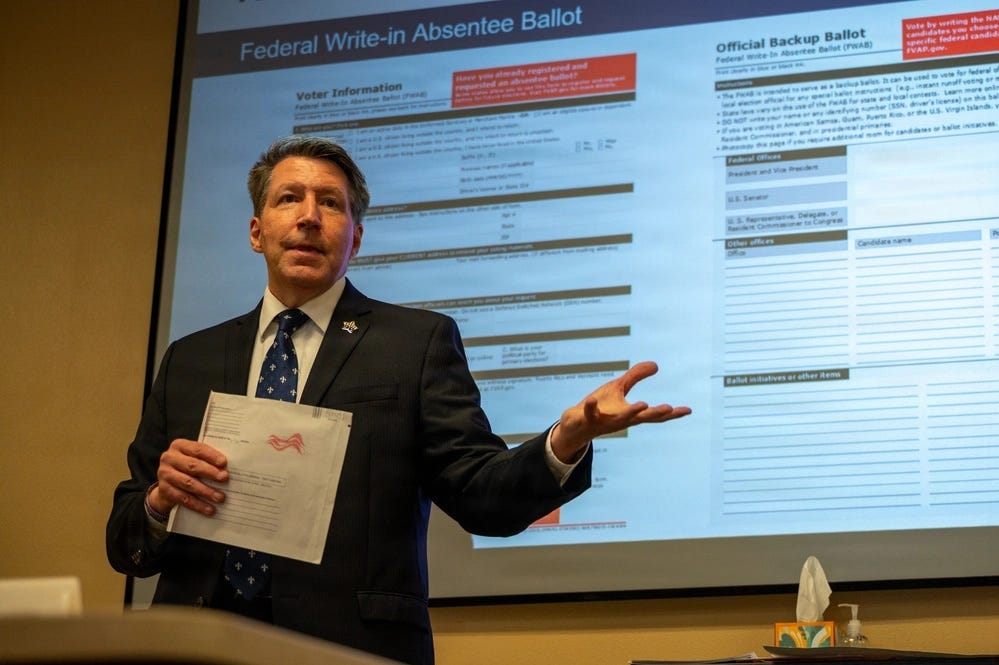
Kentucky is not an all-mail state, but the number of ballots affected is substantial. During the 2024 general election, Kentucky transmitted 131,762 mail ballots, and 116,324 were counted, according to the U.S. Election Assistance Commission. Mail ballots represented 5.6 percent of votes cast.
Each outbound mailing involved a county clerk, a voter record, an envelope and a delivery route. Under the USPS proposal, it would also involve a federal portal submission, two linked barcodes and postal verification before the mailing was accepted.
The decision in Frankfort
Kentucky law names Secretary Adams as the Commonwealth’s chief election official and chairman of the State Board of Elections. The board is an independent state agency charged with administering Kentucky election laws and supervising voter registration and purgation.
If DHS delivers a Kentucky citizenship list, the State Board will be the principal state body confronting it. The board would have to determine whether to compare the federal data with Kentucky’s voter-registration records, which discrepancies merit further review, and what notice or correction procedure a voter should receive.
The executive order does not direct Kentucky to remove someone from the voter rolls solely because the person is absent from the federal list.
Nor does it give Kentucky a complete procedure for verifying a mismatch or protecting a voter from an erroneous conclusion.
The public record reviewed for this article contained no confirmation that Kentucky had received a citizenship list, portal specifications, a data-sharing agreement or instructions to redesign absentee-ballot envelopes. Adams and the State Board had not publicly said whether they intended to use the DHS list, whether Kentucky’s existing ballot barcodes would satisfy the proposed postal rule or how much implementation would cost.
They had also not publicly answered the central due-process question: Will Kentucky commit that no voter will be removed, denied a ballot or referred for investigation solely because that person is missing from an incomplete federal database?
A presidential directive can alter state election administration without changing a single line of Kentucky law. Here, the leverage comes from federal identity records, postal acceptance rules, law-enforcement referrals and the deadlines state election offices must meet.
Responsibility then becomes divided. Federal agencies produce the data and postal requirements. The State Board decides how Kentucky responds. County clerks and mailing vendors perform the work, while an individual voter may be left trying to learn which office made the decision that delayed a ballot or questioned a registration.
Records Kentucky should make public
The immediate Kentucky questions do not depend on predicting how the Supreme Court will rule. They depend on what Adams and the State Board have already received, discussed or prepared.
An open-records request to the Secretary of State and State Board of Elections should seek communications since March 31 concerning Executive Order 14399, the DHS State Citizenship List, the Federal Ballot Mail Portal, Intelligent Mail barcodes and absentee-envelope design. The request should also seek legal memoranda, cost estimates, vendor communications, data-sharing agreements, meeting notes, privacy reviews and cybersecurity assessments.
You can ask Adams and the State Board directly:
Has Kentucky received draft data, instructions or technical specifications from DHS or USPS?
Will absence from the federal citizenship list initiate a voter-registration review?
What notice, evidence, and appeal rights would follow a mismatch?
Which state employees, county officials or contractors would be authorized to upload voter information to USPS?
Will the State Board publish its legal and privacy analysis before implementation?
County clerks can document whether the State Board, USPS, ballot printers or mailing vendors have sent them new instructions. Their correspondence may reveal envelope deadlines, software changes and costs before those details appear in a statewide announcement.
You can also track the Supreme Court docket in Trump v. California, No. 26A124, read State Board meeting agendas and compare any Kentucky implementation plan with the executive order and the final USPS rule, should one be issued.
A Supreme Court order will determine whether federal implementation accelerates. The Kentucky State Board of Elections must still explain how the Commonwealth will use the data, what protections it will provide, and who will answer when the records are wrong.