
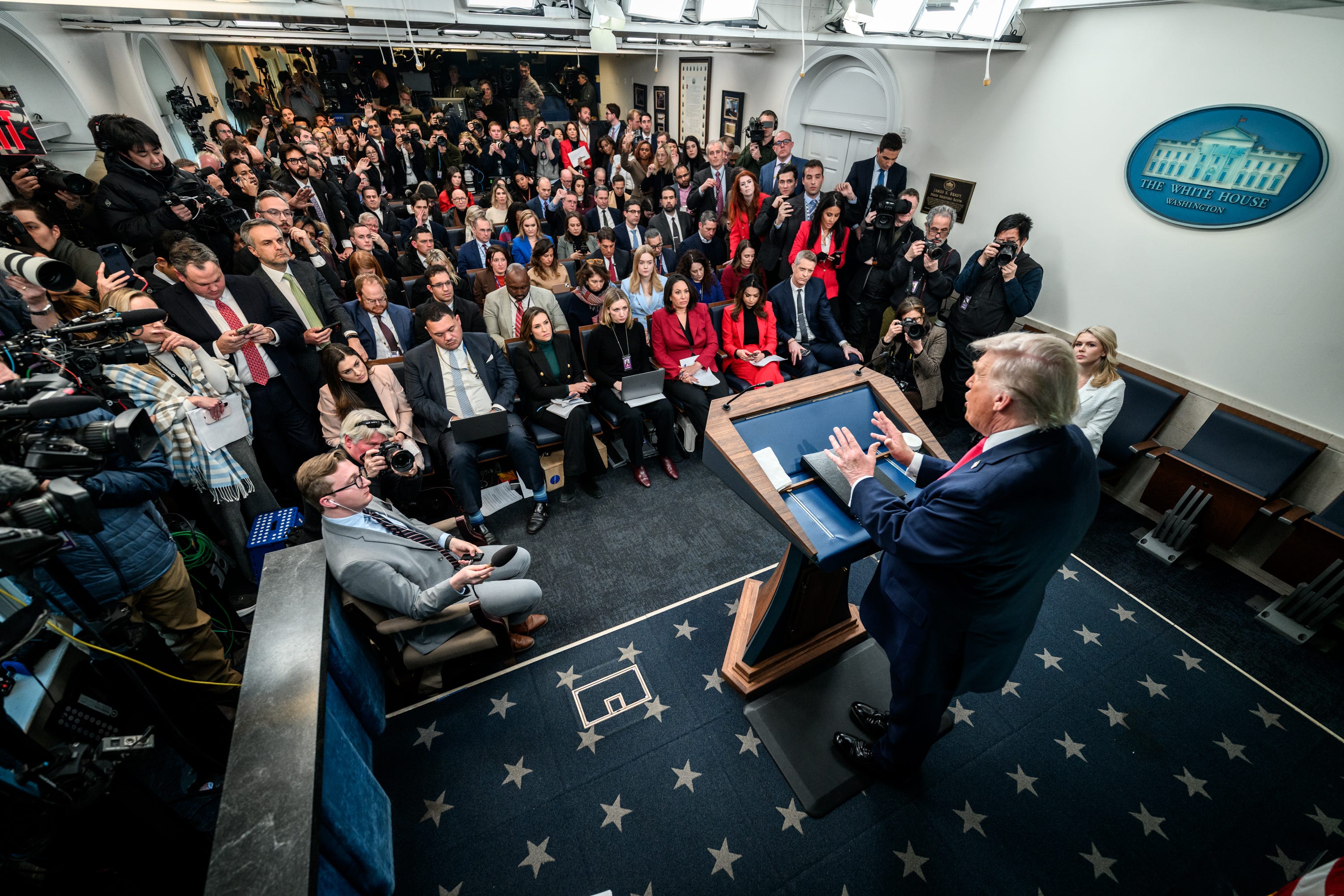
Upon arrival at the White House on Sept. 19, MS NOW correspondent Akayla Gardner successfully passed the initial security clearance. However, after Gardner presented her credentials to a member of the Secret Service, she was told that her credentials had been revoked and the member of the Secret Service retained them.
Gardner and several other media members have experienced the same situation. CNN senior White House reporter Betsy Klein’s credential was deactivated and confiscated. Politico White House reporter Cheyenne Haslett was denied entry, and her credential was taken. According to CBS News, members of CNN and MS NOW had been turned away.
Trump initiated the situation on September 18, when he announced the inclusion of CNN, MS NOW, and Politico in a permanent news ban that would take effect immediately.
He said why: their journalism.
According to Trump, the excluded news outlets published false and rude stories about him and his administration. He did not identify a security incident or credential violation as the reason for the exclusion. He also warned that other news organizations could face the same consequence.
On September 19, Trump’s announced revocation took effect. Shortly after Trump’s announcement, the White House credentials of the journalists of the named organizations became worthless.
Most concerning is the lack of internal communication explaining how the Trump Administration directed the White House to carry out the revocation of news agency credentials.
The restrictions were not as clear as they appeared to be to Trump.
Not all employees of the affected departments were prohibited from entering the White House. Gardner said an MS NOW producer accompanying her was allowed inside even as she and a photographer were turned away.
There was also no evidence that the Secret Service determined which departments lost access. Trump publicly made that decision. Gardner said that an SS officer stated the decision came from above him.
The legal rules can depend on what kind of White House access was taken away.
The courts have interpreted this to mean that while a President can prohibit access to himself, he cannot do the same to the White House Press Corps.
In Sherrill v. Knight, the D.C. Circuit held in 1977 that once the White House opened press facilities to journalists, First Amendment protections applied to access. The court required notice of the reasons for denying a credential, an opportunity to respond, and a final written explanation.
That does not give every journalist a right to follow the president everywhere.
This happened again in 2025, after the White House limited access for the Associated Press (AP) for refusing to change AP’s style from “Gulf of Mexico” to “Gulf of America.”
A judge ruled in favor of the AP, and a temporary order lifted the restriction. The Court of Appeals (D.C. Circuit) sided with the White House and said restrictions the president imposed on very limited press access should remain in place while the case was further analyzed.
Trump said he was banning the AP from the “White House.” There have been many varying ways that this restriction has been implemented.
During part of this time, the AP was not permitted to work on the White House grounds. CNN and MS NOW also lost access to workspaces, television equipment and camera positions on the grounds, according to reporting cited in the organizations’ challenge. And CNN was removed from its scheduled Sept. 21 television and travel-pool assignment for Trump’s trip to New York for the United Nations General Assembly.
On September 21, AP, MSNBC and Politico filed a complaint, asking a judge to declare the restriction on their First Amendment rights unconstitutional. Additionally, they asked the court to order the White House to reinstate their press privileges.
The lawsuit claims the administration stripped the media organizations of their White House credentials for exercising their First Amendment right to practice journalism. The organizations have asked the court to grant them a temporary restraining order to reinstate their hard passes and access while the case is heard.
As of the time this article was published, the organizations have not confirmed Dispatches’ independent research on the case caption and docket number.
The filing does not resolve the constitutional questions. It puts those questions before a federal court.
Whatever the eventual legal answer, the immediate consequences are already concrete.
CNN, MS NOW and Politico can still report on the administration, interview sources and publish their journalism. The White House has not prohibited the organizations from covering the federal government.
What it has taken away is a channel for doing that reporting.
The White House gives credentialed journalists the ability to work from its grounds, observe events firsthand and operate near administration officials. For CNN and MS NOW, the restriction has also meant losing access to workspaces and equipment there. CNN has also been restricted from using a White House press facility and equipment. As a result, CNN could not cover the President on his September 21, 2018, foreign trip.
AP has shown that it lost the ability to send news and photos during the litigation and lost an advertising contract as a result. Similar cases have not been documented for MSNBC, CNN, Politico, etc.
Altering news coverage has not been documented.
Trump was very clear that the access restriction would be extended to other news organizations, and that he would consider extending it to The New York Times and The Washington Post.
So, the question is, will other news organizations modify their behavior and self-censor to keep their White House access?
Another question, no longer hypothetical, is: what effect would such an announcement have on the current occupant of the White House’s behavior and attitude toward the news media? The case, of course, is also about the processes through which the news media, and the public, hold the executive branch of the federal government accountable. It appears the news outlets have decided to pursue legal remedies first. They may also consider other options to address this unprecedented situation.
The White House Office and advisers are not required to comply with the federal Freedom of Information Act (FOIA), and neither is the Office of the President.
A FOIA request to the Secret Service could potentially provide information about instructions, notifications, and/or modifications to the agency’s security-related databases concerning White House credentials issued to the journalists named in the request, on or about September 18-20, 2021.
The Secret Service could withhold records pertaining to protected Secret Service security and/or protective interests. However, records that do not pertain to protected interests are required to be disclosed. Records responsive to the request could help provide the answers to the many questions raised by the Secret Service’s gate activities.
Who instructed security personnel to stop allowing these journalists into the White House?
And what, exactly, were they told to do?
Sources
Reuters, Sept. 18, 2026: “Trump says he is banning media outlets CNN, MS NOW, Politico from White House.” Trump’s announcement, his stated reason for the ban and his warning that other outlets could follow. Reuters article
Reuters, Sept. 19, 2026: “White House turns away CNN, MS NOW, Politico reporters after Trump’s ban.” Documents implementation of the ban and denial of White House access. Reuters article
CBS News, Sept. 19, 2026: “CNN, MS NOW and Politico staffers turned away from White House after Trump ban.” CBS reporters witnessed journalists being denied entry and documented the revocation or confiscation of press credentials. CBS News article
Associated Press, Sept. 21, 2026: “CNN, MS NOW, Politico sue over denied White House access, citing First Amendment.” Covers the joint federal lawsuit, the First and Fifth Amendment claims and the organizations’ contention that their credentials were revoked because of their reporting. Associated Press article
Reuters, Sept. 21, 2026: “CNN, MS NOW and Politico sue Trump over White House ban.” Covers the filing of the lawsuit, the request for emergency relief and the effect of the ban on White House television-pool coverage. Reuters article
Los Angeles Times, Sept. 21, 2026: “CNN, MS NOW and Politico file court challenge to Trump’s press ban.” Documents that CNN had been scheduled to provide pooled television coverage for Trump’s Sept. 21 trip to New York for the U.N. General Assembly and was removed from the White House press schedule. Los Angeles Times article
U.S. Court of Appeals for the D.C. Circuit, Sherrill v. Knight, 569 F.2d 124 (1977): Found that a bona fide journalist’s interest in obtaining a White House press pass is protected by the First Amendment and that denial requires procedural protections, including notice and an opportunity to respond. Sherrill v. Knight opinion
U.S. Court of Appeals for the D.C. Circuit, Associated Press v. Budowich, No. 25-5109: Docket for the continuing litigation over the Trump White House’s restrictions on Associated Press access, including the appeals court’s June 6, 2025 order partially staying the district court’s preliminary injunction. D.C. Circuit docket and orders