
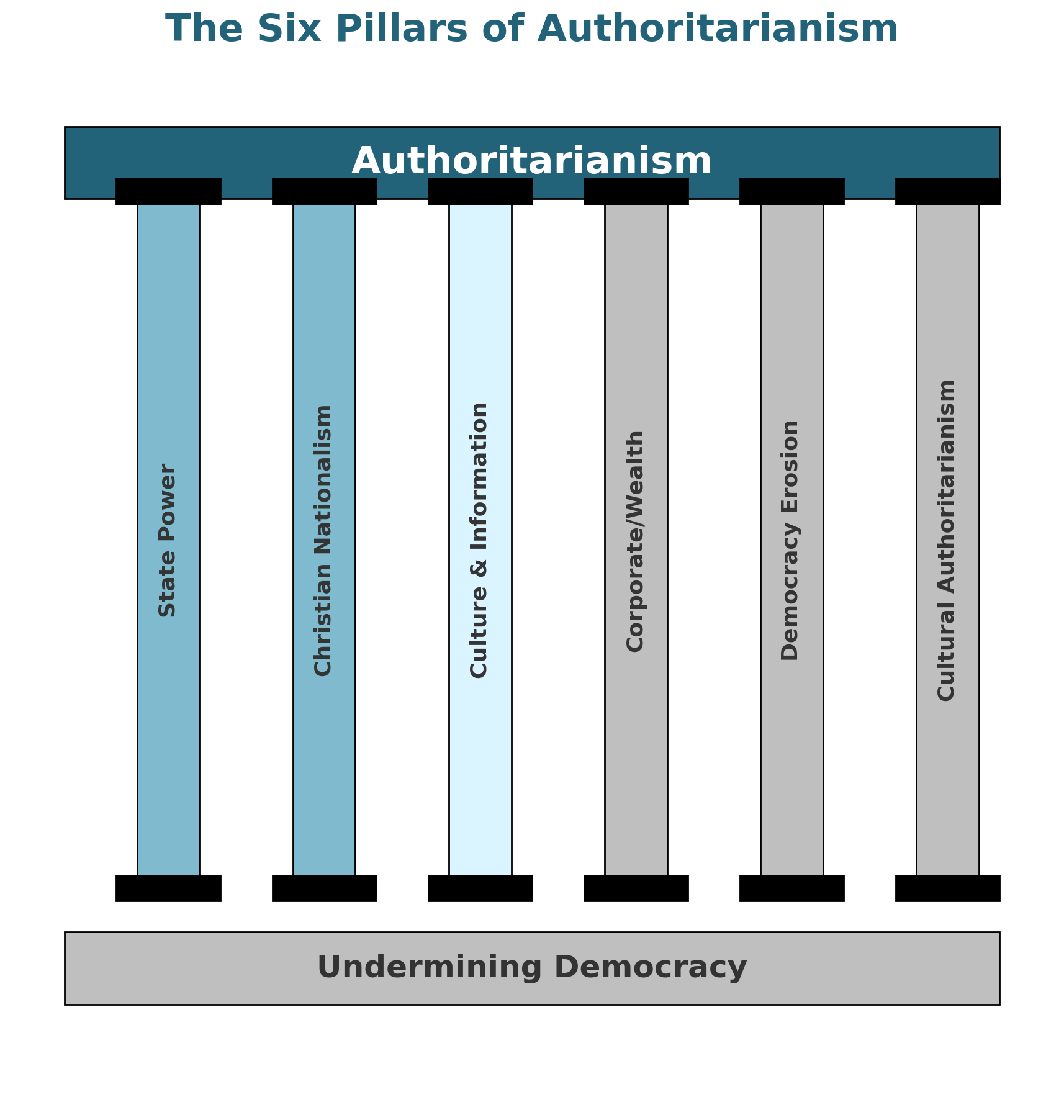
Authoritarianism doesn’t arrive with sirens or tanks rolling through town. Instead, it seeps in—through laws that feel technical, school board decisions made under “morality,” and bureaucratic changes disguised as efficiency. At first, each one seems small. But when you connect them, they form a structure propped up by six distinct pillars of power.
That’s what I see in Kentucky right now, in our towns and communities. These pillars aren’t abstract—they’re real, and they’re bearing the weight of troubling change. In the pages ahead, I’ll show how each one is emerging here, how they’re anchored into policy, practice, and politics, and why pushing back matters now, more than ever.
State Power
The first pillar is state power—police, prisons, surveillance—the machinery designed to protect can easily become an instrument of control.
Take House Bill 520. Passed in March this year, it rewrote Kentucky’s open records law to allow law enforcement agencies to deny access to records simply by suggesting that disclosure could pose a risk to their investigation, rather than demonstrating actual harm. The shift—from “would” to “could”—removes a crucial safeguard for transparency and accountability. Legislature Kentucky Kentucky Lantern Faruki PLL
Late in the legislative session, open-government advocates warned that the weakened language effectively grants law enforcement blanket discretion to hide behind vague claims. What used to require justification now demands only imagination. Kentucky Lantern Louisville Public Media
Then there’s how detention gets funded in Kentucky. Local jails—including Grayson, Oldham, and Laurel counties—have contracts to house ICE detainees. These agreements bring in per-diem revenue, turning incarceration into a business model. LEX 18 News - Lexington, KY (WLEX) Kentucky Vera Institute of Justice Over time, the capacity fast becomes a dependency, incentivizing more detention under the guise of economic development. Vera Institute of Justice
And the expansion of surveillance quietly intensifies. License plate readers, drones, and face-recognition technologies creep into public use, marketed as tools for efficiency. But once they’re in place, they can be aimed at anyone—immigrant families, protestors, or those just exercising their rights without oversight. The infrastructure outpaces the regulation.
State power isn’t inherently oppressive. In a democracy, it protects lives and rights—but only when it operates under guardrails: transparency, accountability, and limits. When those vanish, the machinery starts to lean in another direction: toward secrecy, profit-driven incarceration, and unchecked monitoring. In Kentucky, this pillar is quietly but steadily being cemented.
Christian Nationalism
This pillar chips away at the separation between church and state by embedding religious instruction, subtly or overtly, into public life—often under a veneer of values and tradition.
Kentucky’s 2025 General Assembly passed Senate Bill 19, overriding Governor Andy Beshear’s veto. It mandates that each school day begins with a moment of silence and allows students to be excused for up to one hour per week for “moral instruction” provided off-campus, with parental consent. The troubling vagueness? The law doesn’t define “moral instruction,” opening a pathway for programs with overt religious content to gain a foothold in our schools. Legislature Kentucky LEX 18 News - Lexington, KY (WLEX) https://www.fox19.com
That very ambiguity is now being tested in real-time. In Oldham County, school board members are considering a proposal from LifeWise Academy, a Christian nonprofit. The plan would allow students to leave campus during the school day—typically substituting art or music classes—to attend biblical lessons. Some parents warmly describe it as a values program; others recognize it as religious indoctrination during public school hours. WLKY Kentucky Lantern WHAS11
This isn’t a limited pilot—the push is statewide. LifeWise has established planning teams in roughly 45 Kentucky school districts and actively runs programs in six schools within Marshall County. Kentucky Lantern Yahoo
Warren County’s school board narrowly rejected a similar LifeWise proposal via a 3–2 vote, signaling the tension and division these programs provoke in local districts. Kentucky Kentucky Lantern
What’s unfolding in Kentucky is a textbook example of Christian nationalism in action: using public school infrastructure, schedules, and legitimacy to advance a particular faith under the guise of “moral development.” Critics—like parents, educators, and even public commentators—point out that these programs could disrupt inclusive public schooling, sideline the arts, and pressure students into religious exercise they may not share. Kentucky Citizens for Democracy Wikipedia
On the surface, it may feel harmless—“just values,” “just one hour.” But that’s how normative shifts occur: incrementally, quietly, until the secular ground has shifted beneath everyone’s feet. The public school system should be a space of common learning, not subtle proselytizing. Allowing programs like LifeWise to operate with public approval and logistical support blurs the fundamental boundary between church and state.
Culture & Information
If authoritarianism survives on control, then controlling culture and information is its lifeblood. Here in Kentucky, that shows up both in which stories we can access—and which voices are allowed to speak.
In Boyle County, in late 2023, school leaders quietly pulled more than 100 books from local libraries—titles like The Bluest Eye, Gender Queer, and A Court of Mist and Fury—claiming compliance with Senate Bill 150, which restricts instruction around gender identity and sexual orientation. But the Kentucky Department of Education later clarified that this law does not authorize removing library media. After public outcry, the district reversed course and returned the books. Louisville Public Media The Advocate-Messenger Kentucky
This isn’t an isolated moment—it’s part of a disturbing spike in censorship. Challenges to library content across Kentucky surged dramatically: from just 26 in 2023 to over 300 by 2024, revealing a growing zeal to limit what Kentuckians can read. The Nation
Meanwhile, in Pulaski County, control over digital discourse became the battleground. The school district publicly campaigned against Amendment 2—an effort to allow public funding for private or charter schools—using its official social media channels. When educational advocate Corey DeAngelis criticized that campaign, he was blocked. A lawsuit followed, culminating in a federal consent decree requiring the district to stop suppressing criticism, to undergo First Amendment training, and to pay $30,000 in fees, though the district admitted no fault. Kentucky Lantern Kentucky WHAS11 Liberty Justice Center
These patterns—removing books, silencing critics online—aren’t isolated disputes. They reflect a broader strategy: suppress dissent, narrow the spectrum of acceptable ideas, and define what counts as truth. When books vanish or voices are muted, the civic arena shrinks—until only officially sanctioned narratives remain.
We’re not just losing stories—we’re losing our shared reality.
Corporate & Wealth Power
Money isn’t just a backdrop in the fight for public policy—it’s a pillar shaping what battles get fought and who gets heard. In Kentucky, the 2024 campaign over Amendment 2 laid bare how deeply “big money” influences the direction of our schools, our communities, and our democracy.
Take billionaire Jeff Yass, for example. In early September, he contributed $5 million—nearly the entire budget—to the PAC “Protect Freedom,” fueling pro-Amendment 2 advertising across Kentucky. Opponents of the measure noted that it allowed him to “single-handedly fund” most of the campaign pushing to divert public education funds to private or charter schools. Kentucky Lantern
And that wasn’t the only check on the table. Total campaign spending for the referendum soared past $14 million, shattering previous records for constitutional amendment campaigns in the state. Money flowed in from both sides: billionaire-backed school choice groups and teacher unions alike pulled out deep pockets for ads, canvassing, and messaging. Louisville Public Media Kentucky Lantern
Yet despite all that funding, Kentucky voters rejected the proposal in a landslide, with “No” winning in every county by a two-thirds margin. Weku AP News Wikipedia
One of the most powerful counter-narratives came from student organizers. The Kentucky Student Voice Team mobilized from classrooms and cafeterias to rallies and op-eds—putting a human face on the stakes of public education. Their advocacy emphasized how public funding shouldn't drift into private coffers, especially at the expense of rural schools, special education, and teacher jobs. Teen Vogue
Moreover, the Kentucky Center for Economic Policy calculated the financial implications plainly: if Amendment 2 had passed, it could have diverted up to $1.19 billion—enough funding to pay nearly 10,000 educators statewide. Teen Vogue
That’s the essence of the Corporate & Wealth Power pillar—not simply that money influences policy, but that a single donor or network can shape an entire campaign. When public institutions can be re-engineered with private dollars, the public good risks becoming the public auction. Money makes narratives louder, but as Kentuckians showed, it can’t change community values overnight.
Democracy Erosion
The erosion of democracy doesn’t always come as a dramatic collapse. More often, it happens quietly—when decisions that once rested with communities are pulled upward, away from the people most affected.
That’s exactly what Kentucky has faced in recent years with the fight over charter schools. In 2022, lawmakers passed House Bill 9, which attempted to funnel public dollars into charter schools. These schools wouldn’t be governed by locally elected school boards. Instead, they would be authorized by state-approved entities, effectively removing direct community oversight.
In December 2023, Franklin Circuit Judge Phillip Shepherd struck the law down, declaring it unconstitutional because charter schools don’t qualify as “common schools” under Kentucky’s constitution. He explained that common schools must be “substantially uniform, free to all children, and under the management of officers directly responsible to the people.” Charters, he ruled, simply don’t meet that test.
The defeat of HB 9 didn’t end the push. In 2024, lawmakers brought Amendment 2 to the ballot, asking voters to change the state constitution so public money could flow to private and charter schools. Millions of dollars poured into the campaign—much of it from out-of-state donors. But when the votes were counted, Kentuckians rejected it resoundingly. Amendment 2 lost in all 120 counties, with roughly two-thirds of voters saying no.
👉 Sources: AP News, WEKU
That landslide rejection was a strong defense of public education and local control. But the fact that the legislature attempted to bypass community governance at all is a reminder of how fragile democratic structures can be. Every attempt to strip authority from local school boards, every effort to centralize decision-making, is part of the slow drip of democracy erosion.
Cultural Authoritarianism
It’s in the symbols, the slogans, the silent pressure to conform to a certain idea of identity. In Kentucky, this dynamic has quietly taken root in places we expect might honor neutral public space—like our schools.
You may have noticed the phrase In God We Trust now appearing in stairwells, cafeterias, and entryways across Kentucky. What started in 2019 when the General Assembly passed a law requiring the motto to be displayed in a “prominent place” in every school has become a subtle yet insistent reminder that public institutions can carry a particular religious identity. Some schools even responded by framing an enlarged copy of a dollar bill—bearing the motto—as a creative workaround. The Guardian Kentucky.com
Those displays might feel harmless—or even patriotic—but they do something deeper: they signal that public spaces are aligned with one faith or value system. That can make anyone outside that narrative feel unseen or unwelcome. It’s not overt, but that’s exactly why it works.
The consolidation of this religious messaging extends beyond signs. Take Kentucky’s elective Bible instruction courses. State academic standards now allow schools to offer social studies electives on the historical and literary influence of the Bible—both Hebrew Scriptures and the New Testament—but only if done with neutrality and respect for diverse beliefs. Kentucky Department of Education
That legal framing shows some awareness of religious pluralism—but as these programs expand, I worry: Are they presenting biblical texts as cultural artifacts, or subtly reinforcing one worldview as foundational to Kentucky identity?
Meanwhile, the same 2025 law that allowed Bible lessons under Senate Bill 19 provoked public concern. In Oldham County, a proposal from LifeWise Academy—an evangelical nonprofit wanting to offer off-campus Bible instruction during the school day—sparked a packed school board meeting where parents voiced deep divisions. Kentucky Lantern
At the same time, neighboring Warren County rejected a similar LifeWise pitch—voting 3–2 against it, despite the law permitting “moral instruction” off-campus with parental consent. Kentucky Lantern
All of this—official mottos in halls, elective Bible classes, religious instruction cloaked as “moral education”—pushes a certain cultural narrative into systems meant to serve everyone. It’s not about banning difference so much as making difference feel unwelcome. And that’s how cultural authoritarianism works: not a knockout blow, but a slow squeezing of inclusion until predetermined norms are the only space left to occupy.
Conclusion: Holding the Line
When I step back and look at Kentucky today, I see more than isolated controversies. Each one—whether it’s a police records bill, a LifeWise proposal, a book ban, or a billionaire-funded campaign—connects to something larger. They are not scattered battles. They are pillars, holding up an architecture of authoritarianism that is taking shape before our eyes.
State Power creeps in through secrecy and surveillance. Christian Nationalism enters schools under the language of “moral instruction.” Culture & Information narrows as books are removed and critics silenced. Corporate & Wealth Power pushes privatization through massive donations and dark money. Democracy Erosion chips away at local control when laws bypass elected boards. And Cultural Authoritarianism presses conformity, turning mottos and electives into signals about who belongs.
Together, they build something heavy and dangerous. But if it can be built, it can also be weakened. Every time a community pushes back against secrecy, every time a school board says no to religious indoctrination, every time students rally to defend their libraries, we chip away at the supports. The roof only holds if the pillars stand strong.
And that’s where you come in.
Watch what’s happening in your own community. Show up at school board meetings. Ask your legislators where they stand on transparency and public funding. Support local journalists and organizers who keep these fights visible. Authoritarianism thrives in silence, but it falters when people pay attention and push back.
No one can tear down all six pillars alone. But together, we can. Every lawsuit won, every banned book restored, every policy rejected by voters—that’s proof of our collective strength. If you’re weary, remember this: even small acts of resistance, when multiplied, become cracks in the foundation of authoritarianism.
Hold the line. Lean on each other. The pillars can fall.