
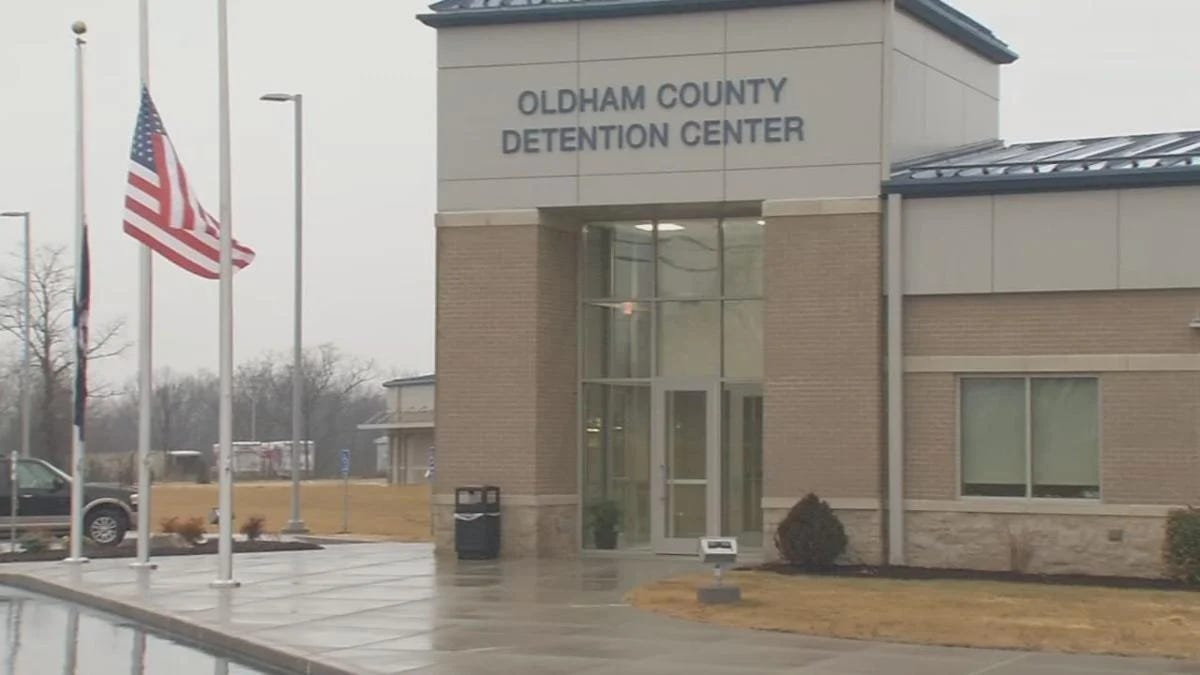
When Congress talks about “border funding,” the language can make the story sound far away. In Kentucky, it is not far away at all. County jails here already hold more than 1,000 ICE detainees. Local law-enforcement agencies have signed cooperation agreements with ICE. Federal detention money already reaches county institutions. So when the Senate moves to unlock a new wave of funding for ICE and Border Patrol, this is not just a Washington spending fight. It is a Kentucky infrastructure story.
Early Thursday, the Senate voted 50 to 48 to adopt a budget plan Republicans say will fund ICE and Border Patrol for the next three years and help reopen the Department of Homeland Security. The vote did not finalize the spending itself, but it created the path Republicans want to use to move that money through reconciliation with a simple majority.
Kentucky is not outside this system
As of February 5, 2026, ICE reported an average daily population of 1,041 detainees in Kentucky jails, according to the League of Women Voters of Kentucky. The same report says 72% of those detainees were classified by ICE as having no criminal conviction. The report lists facilities across the state, including Boone, Campbell, Christian, Daviess, Grayson, Kenton, Laurel, Mason, Oldham, Webster, and Woodford counties.
That number alone should change how this story is read in Kentucky. This is not a hypothetical future pipeline.
The pipeline already exists.
The Kentucky Center for Economic Policy reported in February that 24 local law-enforcement groups in Kentucky have signed 287(g) agreements and 11 county jails are contracting with ICE to hold detainees. That means federal immigration enforcement is not operating only through distant detention centers or border facilities. It is operating through local institutions, local budgets, and local public officials.
KET put the trend even more plainly. In a February report, it said Kentucky county jails were holding 900 more immigration inmates than a year earlier, and it tied that increase to millions of federal dollars flowing into local jails through ICE bed rentals.
That is the Kentucky-centered frame for this story. Congress is not proposing to create an enforcement system from scratch. It is proposing to expand a system that counties in Kentucky are already helping to operate.
What this vote set in motion
Budget votes are easy to tune out because they often sound like inside baseball. This one should not be ignored.
Reuters reported that Senate Republicans are using the budget process to advance a plan that would fund ICE and Border Patrol through the rest of President Trump’s term. AP described it as the first step in a new effort to reopen DHS by moving immigration-enforcement funding over Democratic objections. Reuters also reported that Democrats opposed the plan because it did not include new oversight or accountability measures for immigration enforcement agents.
That is the key point. The fight here is not only over how much money goes to ICE and Border Patrol. It is also over whether more money will come with any new limits, transparency requirements, or constraints. So far, the answer appears to be no.
Senate Budget Committee Chair Lindsey Graham said the resolution was designed to “unlock legislation to keep the border secure,” and Reuters reported that Republicans want to use reconciliation so they can bypass a filibuster and move the next phase on party-line terms.
That is why this vote deserves attention. It is a move to harden enforcement through budget design.
In Kentucky, federal detention becomes county business
The easiest mistake in telling this story would be to stop in Washington.
In Kentucky, detention is not just a federal issue. It becomes local in at least three ways. First, county jails hold ICE detainees. Second, sheriffs and other agencies enter formal cooperation agreements. Third, local governments become financially tied to the detention system through federal payments.
That local entanglement matters because it changes the political incentives. Once a jail is receiving federal money for bed space, immigration detention is no longer only an ideological debate. It becomes a revenue stream. Once local agencies are participating in 287(g), federal enforcement priorities begin to shape local law-enforcement practice. Once detention numbers rise, local residents, schools, churches, and families are the ones living with the human consequences.
This is where Kentucky readers should look past the phrase “border funding.” A state does not need to sit on the southern border to become part of the detention buildout. It only needs local institutions willing to house people, transport people, or partner with ICE. Kentucky already has those institutions.
Your members of Congress are part of this story
Kentucky members of Congress are part of this story, even if not all of them have issued formal statements on this exact Senate vote.
Rep. Morgan McGarvey has already taken a public position against more ICE funding. In a January statement on the DHS appropriations fight, he said, “I will not cut a blank check with taxpayer money, your money, to fund ICE’s campaign of terror against our own neighbors.” That is one of the clearest public statements from Kentucky’s delegation on the broader fight over ICE funding.
Sen. Rand Paul voted against the Senate budget plan, according to AP’s reporting on the vote. I did not find a separate direct statement from his office in this reporting pass, so the strongest verified point is his vote.
That leaves an accountability gap that matters. Readers in Kentucky should know where the rest of the delegation stands, not only on border rhetoric, but on whether they support sending more money into a detention system that already runs through Kentucky counties.
What happens next will not stay in Washington
This is a governance story.
Who decides whether Kentucky counties keep deepening their role in immigration detention? Who benefits financially? What local oversight exists when federal enforcement money grows? Which county officials can say no, and which choose not to? Those are not border questions. They are democracy and accountability questions here at home.
The Senate vote should also be read as part of a broader pattern. Nationally, Republicans are pushing to increase enforcement capacity while resisting new oversight. In Kentucky, local detention infrastructure is already in place. Put those two facts together, and the likely result is not just more money in Washington. It is more pressure on counties, more detention capacity in practice, and more normalization of a system that is already expanding.
That is why this deserves attention before the next phase of legislation is finalized.
Once detention infrastructure is expanded, it becomes much harder to unwind than to build.
What Kentuckians can do now
The next question is whether the House accepts the Senate pathway and what the final reconciliation package actually contains. AP reported that the House had not yet approved the resolution and that internal Republican divisions could complicate the next step. Reuters likewise reported that the Senate vote sends the measure to the House, where the politics are still unsettled.
Kentucky readers should also watch for something closer to home: whether more county officials begin talking openly about detention revenue, whether additional agencies enter or expand 287(g) cooperation, and whether more Kentucky members of Congress start issuing public statements once the funding bill itself is closer to passage. The federal vote is the headline. The county-level implementation is where the story becomes real.
Actions readers can take
Call Kentucky’s U.S. senators and House members and ask one direct question: Do you support sending more money to ICE and Border Patrol without new oversight requirements? Ask for a public answer.
If your county jail holds ICE detainees or your local agencies participate in 287(g), contact your jailer, sheriff, and fiscal court. Ask how much federal money comes into your county through immigration detention, what agreements are in place, and what public oversight exists. Kentucky already has more than 1,000 ICE detainees in county jails, and 24 local law-enforcement groups have signed 287(g) agreements.
Share Kentucky-based reporting and source documents, not just national headlines. This story is easiest to ignore when it is framed as something happening somewhere else.
Support organizations that are already dealing with the local consequences, including immigrant-support groups, legal aid networks, and civic watchdogs tracking detention and local cooperation agreements.
This is the part Kentucky should not miss. Congress is not proposing to build an enforcement system from nothing. It is proposing to expand one that already runs through county jails, local budgets, and public officials in this state.
Kentucky is already inside the machinery. More federal money would not create that relationship. It would deepen it.
That is why this story matters before the final bill is written. Once detention capacity expands, oversight usually trails behind it. And once counties become financially and operationally tied to the system, stepping back becomes harder than stepping in. Reuters reported that Democrats pushed for more guardrails and lost. That makes the next phase of this fight even more important.
Direct sources
Senate vote and national coverage
Reuters, US Senate votes to advance $70 billion funding plan for ICE, Border Patrol
https://www.reuters.com/legal/government/us-senate-edges-toward-advancing-ice-border-funding-plan-2026-04-23/
Reuters, US Senate Republicans to move forward with budget plan for Trump immigration enforcement
https://www.reuters.com/world/us/us-senate-republicans-move-forward-with-budget-plan-trump-immigration-2026-04-21/
Associated Press, Senate passes budget plan for ICE and Border Patrol in bid to reopen Homeland Security Department
https://apnews.com/article/cc395349d03dea6d3080b06be7974899
Kentucky detention infrastructure
League of Women Voters of Kentucky, ICE Detention in Kentucky: An Initial Report
https://static1.squarespace.com/static/5da3dbee03dd2c4493abed8b/t/69b2bad0f245e642505847b6/1773320912349/Immigration%2BInitial%2BReport.LWVKY.Feb122026.pdf
Kentucky Center for Economic Policy, Amid Mounting Harms, Kentucky Is Ramping Up Anti-Immigrant Enforcement
https://kypolicy.org/ice-enforcement-in-kentucky/
KET, Some Kentucky Jails Getting Millions Renting Beds to ICE
https://www.pbs.org/video/some-kentucky-jails-getting-millions-renting-beds-to-ice-fajb3u/
Kentucky delegation
Rep. Morgan McGarvey, Congressman Morgan McGarvey Votes Against DHS Funding Bill
https://mcgarvey.house.gov/media/press-releases/congressman-morgan-mcgarvey-votes-against-dhs-funding-bill