
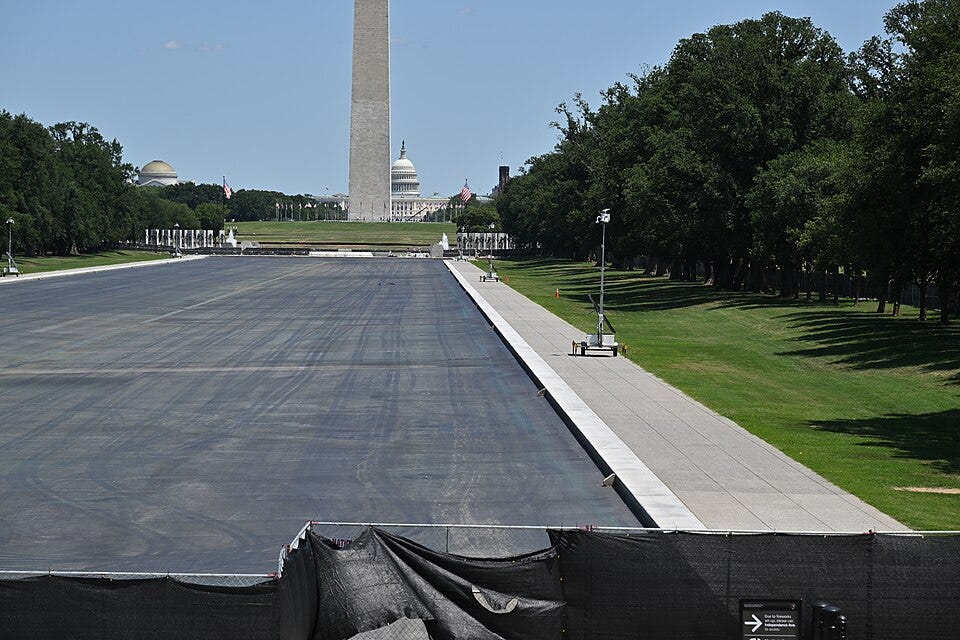
On October 1, D.C. Superior Court Judge Todd E. Edelman permanently barred federal prosecutors from reviving a felony property-destruction charge against David Hearn, a former Olympic canoeist accused of damaging the Lincoln Memorial Reflecting Pool.
The government itself had asked to dismiss the case after concluding that Hearn’s conduct had not caused the damage required for the offense. Ordinarily, such a dismissal would leave prosecutors free to bring the charge again if new evidence emerged. Edelman instead dismissed the case with prejudice, preventing the government from prosecuting Hearn again on the same charge.
The reason was not simply that the original case had fallen apart. President Donald Trump repeatedly and publicly pressed the U.S. Attorney’s Office to reverse its decision, while the government found no evidence likely to make the prosecution viable in the future.
Hearn was arrested June 19 after a National Park Service employee said he had pulled at the blue coating inside the Reflecting Pool. Hearn maintained from the beginning that he had touched material that was already peeling and had not torn or removed the liner. A grand jury indicted him July 2 on one felony count of malicious destruction of property causing at least $1,000 in damage.
Then prosecutors received additional records from the Department of the Interior and National Park Service.
A National Park Service engineer had written on June 11, more than a week before Hearn’s arrest, that overspray around the pool was vulnerable to peeling. An engineering analysis conducted after the pool was drained attributed damage to overspraying and a failure of the coating to bond. After reviewing those records and hundreds of megabytes of material, the U.S. Attorney’s Office concluded that flawed installation and the rush to finish the project before America 250 events had caused the damage.
The government’s July 31 motion acknowledged that the new information made it difficult to attribute the widespread damage to vandalism, much less prove that proposition beyond a reasonable doubt. Prosecutors said they would not have sought Hearn’s indictment had they received the information earlier.
They moved to dismiss.
President Trump objected almost immediately.
On August 1, Trump posted that he disagreed “100%” with U.S. Attorney Jeanine Pirro’s decision. Two days later, speaking at the White House, he said, “Jeanine Pirro made a mistake. It was vandalism.” He later said he was disappointed with Pirro and that she had “folded like an umbrella.”
On August 4, Trump publicly left open whether he might remove Pirro because of the decision. On August 7, he urged her to revisit the case and specifically referred to Hearn’s political activity through ActBlue and his representation by lawyer Norm Eisen as reasons for reconsideration.
The U.S. Attorney’s Office did not reverse itself. It maintained that the case should be dismissed. But it asked Edelman to dismiss the charge without prejudice, which would preserve its ability to prosecute Hearn again during the applicable limitations period.
That is where this case becomes an example of the Pattern of Power “Turn public office into personal power”.
The Pattern appears when a public officeholder uses control over government enforcement to press for action against a particular person after the evidence-based reason for that action has fallen away.
The criminal justice system necessarily gives prosecutors considerable discretion. They decide which cases to pursue, which charges the evidence supports, and when circumstances require dismissal. Presidents also supervise the executive branch, appoint U.S. attorneys, establish enforcement priorities and publicly disagree with prosecutorial decisions.
None of those powers, standing alone, demonstrates this Pattern.
What changed in Hearn’s case was the relationship between the evidence, the prosecutorial decision and presidential power. The office responsible for the prosecution had concluded from government records and engineering evidence that Hearn’s conduct had not caused the economic damage necessary for the charged offense. Trump nevertheless repeatedly demanded that his subordinate prosecutors revisit that conclusion. He did not point to newly discovered evidence establishing Hearn’s guilt. His public argument included Hearn’s political activity and his choice of attorney.
The power at issue here was not the president’s ability to express an opinion. It was his ability to place career consequences behind a demand that subordinate prosecutors reverse a case-specific judgment.
That difference mattered because Trump was not commenting from outside the government. The prosecutors worked within the executive branch he headed. At the September hearing, the government acknowledged that the president could replace the U.S. attorney and her assistants. Edelman found that Trump’s statements therefore created a risk that the existing prosecutors might eventually yield to the pressure or be replaced by prosecutors more willing to revive the case.
A dismissal without prejudice would have left Hearn open to renewed felony prosecution, even though the prosecuting office said the evidence showed he had committed no crime.
The government told Edelman it had no current plans to prosecute Hearn again. But when the judge asked what evidence might make a future case possible, prosecutors could not identify any. The court described the prospect as “theoretical at best” and noted that the government had stopped investigating Hearn’s conduct.
That left two different forms of discretion operating at the same time.
One was ordinary prosecutorial discretion: the government’s authority to reassess evidence, abandon a case that could not be proved, and preserve the possibility of acting if meaningful new evidence eventually appeared.
The other was political power reaching into an individual prosecution: a president repeatedly demanding a different outcome from subordinate prosecutors and identifying the defendant’s political activity and lawyer in the process.
Edelman did not find that Pirro or the prosecutors handling the case had acted in bad faith. His order expressly declined to decide that question and said the government’s quick decision to abandon the prosecution strongly supported its contention that it acted in good faith when it dismissed the case.
The Pattern does not require assuming prosecutors secretly shared Trump’s purpose or had already surrendered their independent judgment.
In this case, they did the opposite: once additional evidence arrived, they told the court the prosecution lacked merit and asked to end it.
The judge’s problem was what would happen if the door remained open afterward.
Courts normally dismiss charges without prejudice for practical reasons. A missing witness may appear. New evidence may emerge. An investigative problem may be solved. Edelman’s order emphasized that such dismissals are routine and that courts generally defer to prosecutors about which cases should proceed.
Hearn’s case was different because the government could identify no unresolved evidentiary problem that might realistically be cured. At the same time, the official with ultimate authority over the executive branch was publicly insisting that the case should be revived.
That combination gives readers a useful way to distinguish ordinary oversight from personal power.
When government officials revisit an investigation or prosecution, three questions can help identify what is happening:
What new evidence or legal basis justifies changing the earlier decision?
Is a political leader setting a general enforcement policy, or demanding a particular outcome against a named person from officials responsible for applying the law?
Are the person’s political activity, criticism, associations or choice of lawyer being cited as reasons to investigate, prosecute or keep the possibility of prosecution alive?
Those questions apply well beyond the Department of Justice. Regulatory agencies, inspectors general, licensing bodies and other government offices also possess powers that can impose costs on particular people. A president, governor, mayor or other executive official may legitimately supervise those institutions. The Pattern begins to appear when the government’s coercive authority is redirected toward a particular person because the officeholder wants action that the institution’s own evidentiary or professional judgment does not support.
In Hearn’s case, the safeguard that mattered was a judge’s authority to decide whether dismissal left the door open. Edelman closed it.
The line to watch is whether prosecution follows evidence and law, or whether evidence and law are being asked to follow the preferences of the person who controls the office.
Once a leader’s personal demand can preserve the threat of prosecution after prosecutors themselves say the case cannot be sustained, public office is no longer being used only to enforce the law. It is being used to keep a particular person within reach of government punishment.
Sources
1. D.C. Superior Court, Judge Todd E. Edelman, October 1, 2026 order dismissing United States v. David C. Hearn with prejudice. This is the principal source for the chronology, the government’s evidentiary conclusions, Trump’s statements, the Rule 48 analysis and the court’s reason for permanently barring reprosecution. Democracy Defenders Fund
Read the complete October 1 court order
2. U.S. Attorney’s Office for the District of Columbia, Government’s Motion to Dismiss the Indictment, July 31, 2026. The government’s own filing explains why it concluded that flawed contractor installation rather than Hearn’s conduct caused the relevant damage. NACDL
Read the government’s July 31 motion to dismiss
3. National Archives / GovInfo, presidential remarks, August 3, 2026. Official transcript of Trump’s public statements that Pirro had made a mistake, his claim that the pool damage was vandalism, and his criticism of her handling of the case. GovInfo
Read the official August 3 presidential transcript
4. National Association of Criminal Defense Lawyers case file. Provides the case docket and links to the indictment, government’s dismissal motion and subsequent filings. NACDL
United States v. Hearn case file
5. Bloomberg Law, October 1, 2026. Independent reporting confirming the permanent dismissal, the government’s position and the practical effect of the ruling. Bloomberg Law
Ex-Olympian Protected from Future Reflecting Pool Charges