
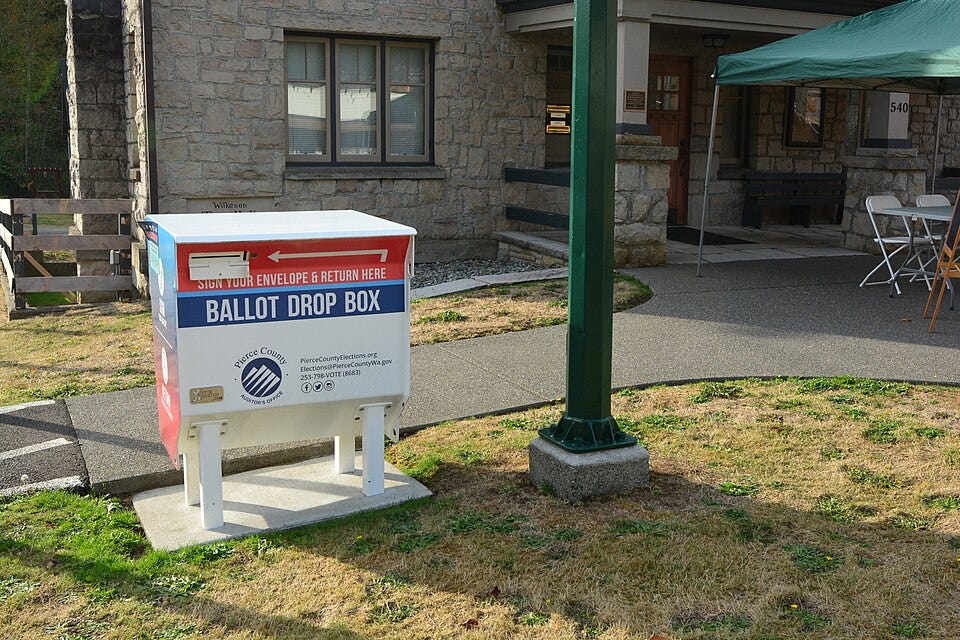
On October 26, the Justice Department asked Washington election officials to set aside the ballots of 405 voters.
The voters in question allegedly lack citizenship and have voted in multiple elections. Voting officials have not agreed to set ballots aside.
Washington’s Secretary of State, Steve Hobbs, said his office is legally required to review the request. Hobbs has also raised that the request was made a week before the election.
Hobbs has also questioned why the federal government is intervening. This leaves election officials to decide what standard they should require of voters to set aside their ballots.
What the Justice Department says it found
On Monday, Acting U.S. Attorney Neil Floyd held a press conference and disclosed the outcomes of a federal investigation into voting fraud.
Floyd stated that 405 noncitizens were discovered voting in federal elections despite not having U.S. citizenship. First Assistant U.S. Attorney for Eastern Washington Pete Serrano also attended the press conference.
Prosecutors reported that the 405 noncitizens voted more than 1,500 times over several years.
According to Floyd, the investigation into these 405 cases is still ongoing. The DOJ claims that a majority of the 405 noncitizens are lawful permanent residents, or those with green cards.
Noncitizens have also been registered to vote through Washington’s motor-voter system.
Prosecutors maintain that, in these cases, the noncitizens were registered to vote, but prosecutors believed registration did not give them the right to vote. The DOJ should investigate these cases. Permanent residents do not gain the right to vote by receiving a ballot.
Additionally, under federal law, noncitizens may not vote in any election in the U.S.
Falsely registering to vote or voting illegally has consequences, but so does knowingly making false statements. The DOJ report is an accusation, and the voting illegality of the 405 people in question has not been established.
As of the DOJ briefing, no charges had been filed against any of those people. Evidence supporting the department’s analysis has not been made public.
A person’s immigration status is fluid.
Someone could have been a lawful permanent resident (LPR), voted, and, in the ensuing years, become a naturalized U.S. citizen.
The DOJ report acknowledges that possibility. Notably, the Washington State 2026 election materials date back to 1994. The DOJ report could very well be accurate. The information the report is based on could be out of date. The DOJ is asking the state of Washington, which is conducting an election, to take action against voters. In addition, some of the DOJ’s requested procedures, such as reviewing ballots, may invade a person’s right to vote. Without clear and convincing evidence of pervasive voting fraud, the DOJ should not interfere in a state election.
Washington has not said yes
Hobbs said Monday that his office received the DOJ’s letter and would review it and respond lawfully.
“We take our responsibility to protect voter information seriously and will only respond to requests that follow due process,” Hobbs said.
Hobbs also said that under the PATRIOT Act, the federal government cannot request the removal of voters in the 90 days before a federal election.
This does not limit election officials from removing ineligible voters. Hobbs said that unless Washington state can confirm that the DOJ provided enough information to believe the voters listed in the letter were ineligible to vote, Washington state must make the determination.
Washington state election officials cannot assist the DOJ in its election law investigations.
Procedures exist for determining voter eligibility. Federal prosecutors can investigate potential election law violations and pursue appropriate legal remedies.
A letter from federal prosecutors is not a court order.
If Washington state officials do not believe the action the DOJ is requesting is warranted, the DOJ can petition the court, as it has done in California.
Until a court orders Washington state to set the vote apart, Hobbs said he is inclined not to do so. Hobbs said he can neither confirm nor deny how he will ultimately decide on the 405 challenged ballots.
California shows why the evidence matters
This isn't the first time a neighboring state has seen this type of request.
Earlier this month, the DOJ sued California to prevent election officials there from processing the voter registrations of about 20,000 individuals thought to be non-citizens by blocking the processing of their mailed-in voter registration forms.
California election officials questioned the accuracy of the information the DOJ provided.
In a filing, Los Angeles County election officials said they reviewed 200 of the 20,000 names the DOJ provided. Of the 200, they found many names belonged to individuals with no voting history, and many registrations had been canceled or were completely inactive. Officials determined that many of the individuals were born in the U.S.
On Monday, the 9th Circuit denied the DOJ an emergency order to stop processing the voter registration forms. A judge has not ruled on the merits of the case.
The court still needs to examine other legal issues.
The disagreement is not over whether noncitizens should be allowed to vote. Both sides recognize that federal law prohibits it.
The parties agree that noncitizens are currently not permitted to vote, as reflected in the laws and regulations.
The dispute centers on how and when election officials determine voters’ eligibility.
It also concerns federal prosecutors’ authority to bring criminal charges and require changes to state election processes. Courts may consider the need for flexibility in election processes, especially regarding state officials’ discretion.
Election processes and election officers must strike the right balance between the right of eligible persons to vote and the right of eligible persons to have their votes counted.
This balance must be considered in the context of other eligible persons' votes not being counted.
Kentucky has already faced a related federal demand
Kentucky has not received any requests from the state’s election officials to segregate ballots as occurred in Washington state.
However, the Justice Department and Kentucky state election officials recently had a legal confrontation when the Justice Department requested the state’s complete, unedited voter database.
The state board of elections and Kentucky’s Secretary of State, Michael Adams, refused to turn over the voter database.
Because of the state’s refusal, the Justice Department sued Kentucky in February.
Three voters of the state, the New Americans Initiative, and the League of Women Voters of Kentucky, supported the state’s position and asked to intervene in the case.
The plaintiffs also supported Kentucky’s position, arguing that the federal government has no right to require the state to surrender confidential voter information.
The U.S. District Court, in Washington D.C., ruled on July 23, in favor of the state of Kentucky. The Court also ruled that the federal government failed to substantiate its legal right and reason to surrender the confidential state information.
The government can appeal the Court’s ruling.
The Justice Department’s interest in both Washington and Kentucky is to gather and use confidential state information to dictate and regulate state elections.
The decision still belongs to Washington, unless a court intervenes
One reasonable question Washington state residents can ask the state office responsible for oversight of elections statewide is whether the state will require the Department of Justice (DOJ) to provide them with independently verified evidence of a voter’s ineligibility and provide an opportunity for the voter to dispute the DOJ’s determination prior to rejecting the voter’s ballot.
The Washington Secretary of State’s Elections Division can be contacted at 1-800-448-4881.
Washington state can legally enact rules governing processes and procedures to protect voter eligibility and assist DOJ in investigating potential voting rights violations.
The more relevant question is what Washington state’s Attorney General, Hobbs, and county election officials will do. Washington must review the DOJ’s findings on the 405 Washington state voters against reliable citizenship records and determine whether those voters should be prohibited from voting.
Will those voters be notified of the state’s inquiry?
Will ballots be segregated while that inquiry is being conducted? Will the DOJ file a civil action to compel Washington to take action? Those issues remain to be resolved. The DOJ has presented its allegations regarding Washington state and 405 voters.
Will Washington state officials change how they treat the 405 voters’ ballots based on the DOJ’s allegations?
Will Washington take the DOJ’s communication seriously? That’s the more important question.
Sources
These direct sources support the article. The official statements provide the competing positions; court reporting and Kentucky’s case record establish the limits of the documented responses.
Washington Secretary of State, October 26: Statement about Washington’s safe and secure elections
Associated Press, October 26: Washington ballot-segregation request
Associated Press, October 26: California appellate court decision
League of Women Voters: United States v. Adams, Kentucky case record and appeal