
This is Part 4 of a five-part Dispatches from Kentucky series investigating the decisions, political forces, and institutional failures that weakened American democracy.
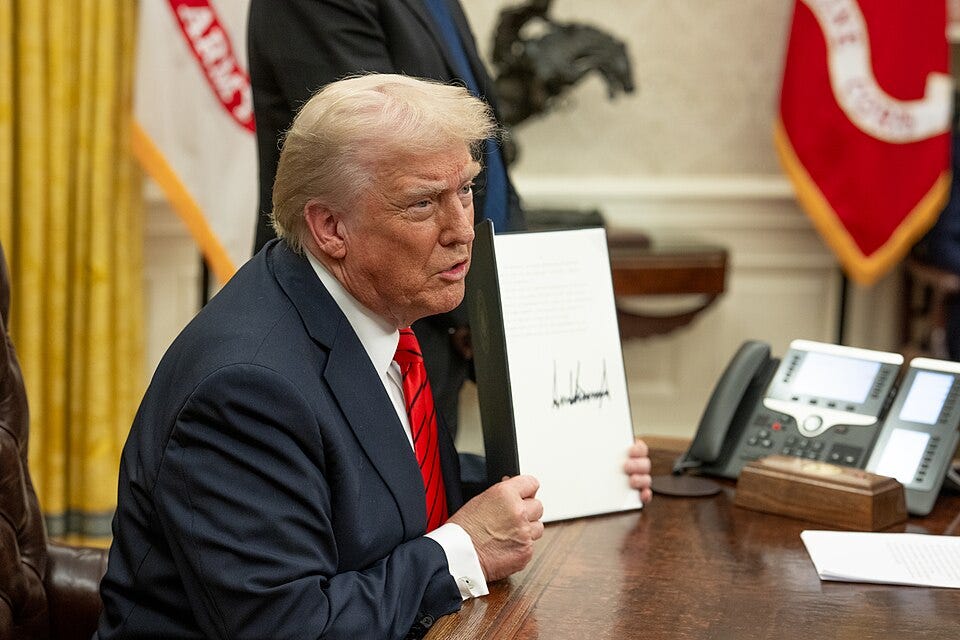
Four days after moving back into the White House on January 24, 2025, Donald Trump’s administration terminated 17 federal agency inspectors general (IG).
Trump’s administration argued these positions were political appointments.
The president may remove IGs under certain conditions. Trump didn’t give Congress 30 days’ notice before the terminations.
Notice is required to allow Congress the opportunity to investigate the president’s rationale for terminating an IG.
On September 24, 2025, Judge Ana Reyes ruled the terminations were unlawful, but stopped short of reinstating the IGs because, among other things, she believed the IGs failed to show they would suffer irreparable injury if a court didn’t issue a temporary restraining order or preliminary injunction.
As Judge Reyes explained, the president could terminate the IGs if he followed the law.
Thus, the IGs remained terminated.
Judicial restraint, in this case, preserved executive power at the expense of congressional oversight.
Removing inspectors general in 2021 was only the beginning.
In 2025, the Trump administration took additional measures to centralize executive power, such as increasing White House oversight of independent regulatory agencies, altering policies that protect the career federal workforce, and directing agency spending in ways that violated the law, as determined by the Government Accountability Office. Some of these actions are the subject of ongoing lawsuits. Others have been implemented and/or upheld through creative readings of the U.S. Constitution.
Together, they reveal another significant cause of American democratic backsliding: the expansion of presidential control over institutions that Congress had designed to exercise independent authority or operate under established legal constraints.
Why the federal government was designed this way
The Constitution places the federal government’s executive power in the President.
This structure of the executive branch is not a defect in the American system. The President heads the executive branch.
The President is responsible for faithfully implementing the law.
The President must implement the law and pursue lawful policies.
The President must manage federal government personnel. The President does not manage all federal government personnel. The President is not solely in charge of the federal government.
The limits of the President’s control of the federal government create a system of checks and balances.
This is evident in the functions of the legislative and judicial branches of the government.
Federal officials must implement the laws of the land.
Many of the federal employees are career employees, and they are obligated to implement and enforce the laws of the land.
These employees are not required to align their duties with the presidential agenda.
This principle also binds federal agents.
All of these employees are legally obligated to implement the laws.
These legal constraints, limits, and balances give effect to the constitutional values of the American system.
They ensure that the government’s power is not monopolized or misdirected.
The Trump administration disrupted and upset many of these limits during its single term in office. These changes will remain in force until subsequent administrations undo them.
Removing independent watchdogs
The Inspector General system began in response to the Watergate scandal and other issues relating to the federal government's checks and balances system.
In 1978, the U.S. Congress passed the Inspector General Act, which established independent offices in federal agencies to investigate and detect fraud and other issues.
Offices established under this act are led by a government inspector. Congress recognized that inspectors are subject to removal by the same people they investigate for mismanagement and malfeasance.
To mitigate this, Congress enacted several measures to protect inspectors from arbitrary removal.
The latest amendment requires the President of the United States to provide Congress with the reasons for his/her decision to remove an Inspector General.
The removal notice is to be provided at least 30 days prior to the effectuation of the removal.
Without such notice, members of Congress may initiate other measures to check the Executive Branch of government.
On January 24, 2025, the Trump administration removed 17 inspectors general without following that procedure.
The dismissals affected watchdog offices across several departments, including Defense, Health and Human Services, Veterans Affairs, Labor, State, and Agriculture.
The removal sparked bipartisan outrage in the Senate.
On January 28, 2025, the Republican Chairman and the Democratic Ranking Member of the Judiciary Committee wrote to President Trump, asking him to provide the reasons for removing the Inspectors General.
Eight of these Inspectors General filed suit in federal court to challenge their removal.
Judge Reyes ruled in September that while the administration failed to follow the proper procedure, she wouldn’t mandate reinstatement.
The court explained that while the offices in question might not have been fully operational, Inspectors General were still performing their duties.
The court’s finding that oversight was not fully disabled was important.
The court didn’t rule that all oversight was disabled. Rather, the court determined that the administration removed various oversight officials without proper legal process.
Because of these removals, Congress couldn’t exercise its oversight duties as the law mandates.
Ultimately, the court didn’t put the removed officials back in their posts.
As a result, the administration could remove oversight officials the law protects without legal constraint.
Thus, the court’s ruling demonstrated the limits of judicial power as it pertains to protections for oversight established by Congress.
Bringing independent regulators under greater presidential control
The administration altered the relationship between the White House and the agencies.
Some agencies are made to be independent.
These agencies are created to perform functions of the federal government.
The FTC investigates and stops deceptive and unfair business practices and upholds and enforces rules and laws that promote and protect competition in the market.
Other independent agencies regulate markets and other public interests.
Congress, in its wisdom, created laws, rules, and policies to protect balance and prevent regulatory decisions detrimental to the public interest from being made and implemented solely by an administration. Continuity is essential in administrative decision-making to prevent arbitrary and politically motivated decisions.
The Trump Administration took a different approach.
On February 18, 2025, the President signed an Executive Order that changed the policies to remove and appoint commissioners and administrators in independent agencies.
The order mandated that independent agencies (such as the SEC) submit significant rules to Congress and the White House.
The order changed how the White House sets priorities with agencies and adjusted agency performance expectations.
Although the order did not affect the Federal Reserve’s monetary policy, the order implemented changes to other aspects of the Fed’s operations.
The order increased White House control over the central bank.
White House interference in monetary policy may increase inflationary pressures.
The White House may also influence monetary policy in an extreme manner that fundamentally alters the economy.
The Trump administration made several arguments about the President’s rights and the Constitution’s checks and balances.
Relying on agency heads to make policy decisions has serious consequences.
The Trump Administration’s Executive Order increased the White House’s power over certain policymaking processes.
Additionally, a subsequent Supreme Court decision affected rules governing the appointment of members to the same set of independent agencies.
The Trump Administration’s policies created uncertainty about how policies are developed and who controls policymaking in the U.S.
A Supreme Court decision changes the rules
On March 18, 2025, Trump dismissed Rebecca Slaughter and Alvaro Bedoya, the two Democratic Commissioners of the Federal Trade Commission.
Trump removed Slaughter and Bedoya despite specific provisions in their appointments that protected them from termination by the President.
The Trump administration argued that Trump removed the commissioners because their interests did not align with the Administration’s interests.
Trump also defended his position, saying that, as head of the Executive branch, he had the power to remove any Executive branch employee for any reason.
Slaughter sued to challenge her termination.
The case reached the Supreme Court.
On June 29, 2026, the Supreme Court released its decision in Trump v. Slaughter.
The Court held that a part of the law that created the FTC and protected commissioners from being removed by the President overturned a part of the Constitution that limits the President’s power.
The Court held that the President has the power to remove FTC commissioners.
The Court also overturned Humphrey’s Executor v. United States, which had given precedent to the part of the FTC Act that protected commissioners from removal by the President.
Justice Sotomayor wrote the dissent, joined by Justices Kagan and Jackson.
The dissent argued that Congress has the authority to limit the President’s power to remove FTC commissioners and that the majority’s opinion threatened protections against political influence over regulatory commissions.
The Court struck down a statutory restriction on the president’s power to remove FTC commissioners.
As a result, presidential control over commissioners’ appointments has increased.
Similar restrictions on other independent agencies are expected to face legal challenges.
On the same day as the FTC ruling, the court decided Trump v. Cook and left in place restrictions on removing Federal Reserve governors.
Thus, the removal of restrictions on presidential power over independent agencies has not been uniform.
As a result of the FTC ruling, the balance of power between the president and Congress regarding the appointment and removal of members of independent agencies has shifted. The president has challenged limitations Congress set.
The Supreme Court has supported the president’s challenges.
As a result, Congress’s limitations have been removed.
The FTC ruling’s alteration, compared with the dismissal of the Inspectors General, demonstrates the ingenuity and versatility of presidential power.
Changing the protections for career government employees
The Trump administration also amended the rules governing a segment of the United States’s civil service.
Unlike political appointees, career employees serve the government independently of any political administration.
Political appointees align with a particular administration to execute that administration’s priorities. Career employees help implement the administration’s policies and also provide experience and continuity in the daily management of federal programs and services.
Traditionally, individuals appointed to work for the federal government relied on political connections.
Loyalty to a particular political party determined an individual’s employment. The party in power would replace federal employees upon assuming office.
The early to late 1800s saw the enactment of several laws to protect federal employees and introduce merit into the hiring process.
These laws were intended to protect federal employees and ensure a professional workforce.
The Trump administration contended that U.S. civil service laws protected inefficient and unscrupulous employees and obstructed the proper execution of the president’s policies.
On January 20, 2025, Trump signed Executive Order 14171, initiating a process of reinstating the former system.
On February 6, 2026, the Office of Personnel Management adopted amending laws.
Scheduled to take effect on March 9, 2026, the new classification system was labeled Schedule Policy/Career.
On June 3, 2026, Trump signed Executive Order 14410, which moved specified positions to the newly created classification.
The Order also provided that the occupied positions would remain career positions.
Political appointment to the positions was not affected by the Order.
While the administration proposed the changes as an improvement to federal service, the new rules removed numerous employment protections.
Restrictions against discrimination and other personnel practices remained.
But the rules transferred responsibility for these practices from the Special Counsel to the employing agency.
The shift in where decisions are made significantly affects an employee’s ability to challenge a personnel action.
An employee may no longer file a complaint with an independent entity and, therefore, is dependent on his employing agency to remedy personnel actions.
The administration stated the changes would modify the behavior of federal employees, especially career employees, to better align with the President’s initiatives and policies.
The changes eliminated or modified employment protections for career federal employees.
The modifications allowed political retaliation against employees.
The changes may have also centralized control of the federal workforce.
The executive branch revoked or modified employment protections for career employees and gave the employing agency more flexibility to make personnel decisions.
This raised concerns about checks and balances and the ability of federal employees to independently challenge agency decisions.
Challenging Congress’s control over federal spending
Another area concerns powers the Constitution gives to Congress.
One of Congress’ major powers is control over federal spending.
Although the president has an important role in setting spending levels and directing federal spending, Congress ultimately determines how much to spend and the conditions for that spending. One of the president’s options when Congress funds a program he dislikes is to refuse to spend the money.
This was the crux of many disputes between Congress and President Richard Nixon.
The Impoundment Control Act of 1974 created rules under which the president could seek to postpone or stop spending that Congress had authorized.
This act, however, limits how a president can reject a spending decision by Congress.
Starting in 2015, the Trump administration took actions to change how spending would be done in ways the Government Accountability Office (GAO) later determined violated the law and rules that regulate spending.
In its reports, the GAO explains its reasoning and offers recommendations to improve compliance with the law.
The National Institutes of Health
Beginning in the first quarter of 2025, the administration issued directives that affected federally funded research.
The Department of Health and Human Services, and subsequently the National Institutes of Health (NIH), began canceling grants that pertained to issues on which the administration held certain political views.
From February to June 2025, the NIH revoked over 1,800 grants.
Additionally, the department suspended its notification and filing of documentation to convene grant review meetings.
As a result, the NIH could not disburse the awarded grant funds.
On August 5, 2025, the Government Accountability Office (GAO) released its decision concerning this situation.
The decision indicated that the NIH, as part of the Department of Health and Human Services (HHS), broke the Impoundment Control Act of 1974.
HHS cited the authority to terminate certain grants and said that some of the affected grants had been reinstated.
The GAO restricted its decision to the funds that Congress made available and HHS withheld.
In essence, HHS argued that it should have the power to determine how to spend funds that were appropriated by Congress for a given purpose.
The Agency for Healthcare Research and Quality
A different GAO report identified similar issues.
In 2025, HHS reorganized its offices and reduced the staff of the Agency for Healthcare Research and Quality.
As a result, AHRQ awarded fewer grants.
On October 7, 2026, GAO reported that HHS’s withholding of the appropriated funds also violated the Impoundment Control Act.
GAO explained that, in general, an agency may determine how to distribute funds within the limits set by Congress.
However, if the law mandates the availability of funds, an agency cannot fail to make the funds available.
The staffing reductions mean that AHRQ could not process grants.
GAO stated that the withholding of the funds was not an administrative delay.
GAO’s report shows that the executive branch can affect congressional spending in other ways, too.
The administration didn’t have to officially inform Congress that it was not appropriating the funds.
In a nutshell, GAO stated that if an agency changed its structure in a way that limited its ability to administer a program, that constituted an illegal money-stopping mechanism.
The distinction here is important.
In July 2025, Congress passed the Rescissions Act and approved about $9 billion in spending rescissions requested by President Trump.
Here, Congress exercised its legislative power to rescind spending.
It is well established that the Legislative and Executive branches are responsible for appropriating and expending funds, respectively.
It is beyond the scope of an Executive agency to effectuate spending decisions.
Generally, the government should make spending decisions in accordance with the law, regardless of the decision.
Why these changes matter in Kentucky
Even if federal agencies seem unrelated to Kentucky residents, they make important decisions that affect Kentucky's universities, hospitals, and businesses.
One example involves research funding.
During fiscal year 2026, according to records kept by the University of Kentucky (UK), 58% of UK's research funding awards, totaling over $290 million, came from various federal agencies.
Over $158.6 million of that funding came from the National Institutes of Health (NIH). Research related to Alzheimer’s disease, substance use disorders, various cancers, and other public health concerns funded by NIH is conducted at UK.
NIH funding typically has strict limitations regarding the nature of the research.
GAO found NIH violated these legal restrictions by awarding over $1 billion in research funding.
Funding restrictions established by Congress and other federal laws and regulations help explain why, in the context of research performed at UK and other institutions, NIH funding was limited to certain research.
When funding research becomes part of Congress’s annual legislative agenda, universities and scientists must work within boundaries set by laws, guidelines, and award stipulations.
In this regard, the president and the federal agencies can exercise a good deal of control and latitude.
However, their powers are limited.
Businesses and consumers in Kentucky are impacted by decisions and policies implemented by various federal agencies.
For Kentucky, it is not important which president controls the federal government, but which federal agencies and departments exercise their powers to implement the laws of the land.
The federal government’s erosion of the rule of law is an important aspect of the diminishing democracy in the United States and is worthy of study and concern to Kentuckians.
What actually changed?
Even if they acted differently, they created similar outcomes.
Members of the administration ignored the notifications to Congress before removing inspectors general.
The administration altered the rules to limit the independence of regulatory agencies and put them under more White House control.
The Supreme Court ruled in favor of the president and removed restrictions on his power to fire members of the Federal Trade Commission.
Other executive branch officials unlawfully made decisions, such as cutting funds, that violated the law.
Still, the General Accounting Office (GAO) reviewed and verified those decisions.
The administration focused on increasing presidential power and occasionally exceeded legal limits.
However, laws do not always protect the president’s interests.
The Constitution and the courts have the last word.
It's also not correct to think that all forms of independent oversight and management stopped working. Offices of Inspectors General kept working.
Courts kept hearing cases.
The GAO kept issuing reports. Congress kept writing laws and making spending decisions.
Based on the available evidence, from 2024 to 2026, the administration’s goal was to shift as much power as possible to the presidency.
During this period, barriers that kept presidential power in check were removed.
In its March 2026 report, the Varieties of Democracy Institute described the U.S. from 2024 to 2025 as having some of the lowest levels of democratic controls on executive power since the Institute began issuing reports.
Researchers said expanded presidential power and diminished congressional oversight were the main reasons for the decline.
While these estimates may not prove that each policy change in this article negatively affected U.S. democracy, they support the conclusions.
The difference between presidential leadership and concentrated power
Presidential elections have consequences.
The Constitution duly empowers presidents to govern.
Unlike other federal officers, presidents can be held politically accountable at the polls.
But presidential accountability is only one element of the separation of powers in the Constitution.
The other elements include an independent Congress and Courts. The Constitution also limits the exercise of governmental power.
Furthermore, the Constitution grants independence to certain government agencies and protects the independence of professional officers.
The Trump administration pursued a campaign to diminish and control these elements of government.
The Trump administration challenged and openly defied laws.
It also altered and sought to control the actions of independent agencies. Many of these changes were carried out through Executive Orders.
At the behest of the Trump administration, and in some instances against the law, Congress amended laws to alter the boundaries of agency independence. In others, courts intervened. The Trump administration further sought to increase the power of the Presidency at the expense of other elements of government through its appointment of judges and agency heads.
In some instances, Federal judges changed the limits on the President’s authority.
As a matter of constitutional law, the Trump administration sought to diminish the independence of professional officers, agents, and employees of Federal agencies.
The Trump administration intended to place such employees and agents under the President’s control.
Supreme Court decisions expanded the President’s ability to control Federal agency employees.
Courts also restrained the Trump administration when it sought to alter limits on the President.
The growth of a president’s power demonstrates what happens when participants in the executive branch change the procedures that govern the enforcement of the laws enacted by Congress and the courts.
However, there is one more element to consider.
What happens to a system of limits on government when the constraints endure, but blatant disregard for them becomes the rule rather than the exception?
Recent cases in which the president dismissed various inspectors general are illustrative.
The laws establishing the IGs and establishing their protection from political retaliation were duly enacted by Congress. The president’s executive actions dismissed the IGs and circumvented the protections Congress provided. A court of law, recognizing the president’s actions to be unlawful, did not, however, provide relief.
The executive’s unlawful actions went unrestrained, and the rule of law suffered.
The chasm between legal restrictions on government action and the people’s ability to hold their government accountable best demonstrates the current condition and decline of American democracy.
Next in the series: Part 5, When the Safeguards Didn’t Hold.
Sources and documentation
This article draws on executive orders, federal regulations, court decisions, congressional records, and official oversight findings.
Independent oversight and inspectors general
Independent agencies and presidential removal authority
Executive Order 14215, Ensuring Accountability for All Agencies, February 18, 2025
Congressional Research Service, Trump v. Slaughter and the Future of For-Cause Removal Protections, July 2, 2026
Federal civil service
Office of Personnel Management, Schedule Policy/Career Rules and Guidance
Executive Order 14410, Implementing Schedule Policy/Career in the Excepted Service, June 3, 2026
Congressional spending authority
Kentucky and democratic assessments