
In democratic systems, the most significant breakdowns rarely arrive as formal policy changes. They emerge through posture, practice, and precedent. A norm bends. An investigation narrows. Oversight becomes conditional. That pattern is visible in the federal response following the fatal shooting of Alex Pretti, a 37-year-old intensive care nurse, by U.S. Border Patrol agents in Minneapolis on January 24, 2026.

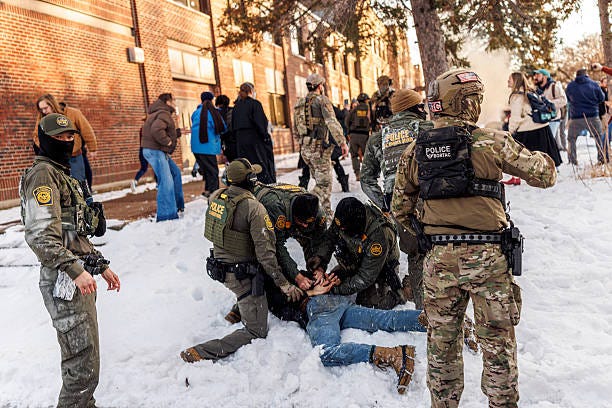
Pretti was killed during a federal immigration enforcement operation in the Whittier neighborhood. According to reporting that examined video footage and eyewitness accounts, he had been filming agents and attempting to intervene as officers pushed individuals during the operation. Federal officials later stated that agents fired “defensive shots” after Pretti allegedly resisted disarmament while carrying a handgun. Video evidence reviewed by journalists, however, raised serious questions about that account, showing Pretti pinned to the ground at the moment shots were fired and his weapon already removed.
The shooting itself was alarming. What followed raised deeper concerns.
In the days after Pretti’s death, Minnesota state authorities moved to open their own investigation, only to encounter what multiple reports described as limited or resisted federal cooperation. Governor Tim Walz and Minneapolis Mayor Jacob Frey, joined by lawmakers from both parties, publicly questioned why federal investigative and prosecutorial involvement appeared constrained and why state officials were being denied fuller access to the scene and evidence. Their concern was not merely procedural. It went to the core question of who holds authority when federal officers use lethal force.
At issue was a posture that placed the Department of Homeland Security in control of investigating its own agents, with the Department of Justice and the FBI playing, at most, a reduced or contested role. That structure matters. Independent review is not a formality. It is the mechanism that preserves credibility when force is used in the name of the state. When that distance collapses, public trust collapses with it.
That fragility was underscored by a separate, closely related development. Reporting described the resignation of an FBI supervisory official who had attempted to pursue an investigation into a fatal shooting involving an ICE agent. According to the account, the effort was met with internal pressure, prompting the supervisor to step away rather than continue under conditions that made meaningful oversight untenable. The resignation functioned less as a personnel story than as a signal: even internal investigators were encountering resistance when accountability touched immigration enforcement.
Taken together, these incidents point to more than isolated failures. They suggest an escalating conflict over accountability itself.
For Kentucky, this matters even though none of the shootings occurred within its borders. Federal immigration enforcement norms are national by design. When accountability mechanisms weaken in one state, expectations shift everywhere else. Communities recalibrate their understanding of risk. Institutions adjust how they cooperate. Silence replaces reporting. Fear replaces trust.
Kentucky schools, hospitals, churches, and service organizations regularly navigate encounters involving federal agencies and mixed-status families. When lethal force by federal officers is followed by opaque review and internal resistance to investigation, those encounters carry new weight. The perceived cost of cooperation rises. The likelihood of avoidance grows. Civic friction becomes a daily condition rather than an abstract concern.
The broader pattern is familiar. Rhetoric escalates. Enforcement intensifies. Accountability becomes contested. Oversight weakens. When consequences fail to materialize, the absence of accountability begins to normalize itself, not through law, but through practice.
This is how democratic erosion advances without fanfare. Not through a single directive, but through repeated signals that power will not be meaningfully reviewed when it harms. Kentucky does not need to be the site of the rupture to inherit its consequences. The inheritance arrives the moment accountability becomes optional anywhere.
There are things that can be done, even when the problem feels federal, opaque, and distant. None of them are perfect. All of them matter.
Let’s think about this in three lanes: pressure, protection, and persistence.
Apply pressure where accountability still exists
Federal agencies may resist oversight internally, but they are not immune to external scrutiny. Congressional oversight remains one of the few levers that can force disclosure, compel testimony, and surface internal records. Kentucky’s congressional delegation does not need a local shooting to justify inquiry into federal enforcement norms that affect their constituents. Calls, letters, and coordinated public pressure asking members of Congress to demand DOJ and FBI independence in use-of-force investigations still carry weight.
Public records requests, litigation, and investigative journalism matter here as well. When internal review narrows, sunlight becomes the substitute mechanism.
Protect institutions and people on the ground
While federal accountability fights play out slowly, Kentucky institutions can act now. Schools, hospitals, churches, and service providers can clarify policies around federal law enforcement access, warrants, and cooperation. Training staff on rights and procedures reduces fear-driven compliance and limits harm during encounters.
Legal aid groups and immigrant advocacy organizations already do much of this work. Supporting them financially, amplifying their guidance, and treating their expertise as essential civic infrastructure strengthens community resilience regardless of federal posture.
Persist without waiting for a crisis
The most dangerous moment is when erosion feels normalized enough to ignore. Join me in pay attention, naming patterns early, and refusing the idea that accountability failures only matter after they arrive locally. I’m writing, documenting, and tracking these developments to create a record that can be used later when officials claim they were isolated or unforeseeable.
This is slow work. It rarely produces immediate wins. But erosion thrives on fatigue and silence. Persistence interrupts both.
None of this restores a life lost. None of it guarantees federal reform. But accountability is not sustained by a single mechanism. It’s sustained by pressure applied repeatedly, protection extended locally, and a refusal to look away when the signals appear.
That is still within reach.
Sources & Further Reading
These articles provide the reporting and context underpinning the discussion of federal accountability after immigration enforcement shootings and the broader questions of oversight.
On the January 24, 2026, Minneapolis shooting and reactions
PBS NewsHour: “Man shot and killed by federal officers in Minnesota was an ICU nurse, his parents say” — details the identity of Alex Pretti and community response to the shooting. PBS NewsHour: ICU Nurse Alex Pretti Killed by Federal Officers
Reuters photos and coverage: “On the streets of Minneapolis after ICE agents kill another US citizen” — photo dispatch showing protest and enforcement context. Reuters photo gallery: Minneapolis after federal shooting
WTTW News: “What’s Known So Far About the Killing of Alex Pretti by Federal Officers in Minneapolis” — a concise summary of events, conflicting accounts, and escalation. WTTW: Overview of Alex Pretti Shooting
The Guardian: “Obamas say Alex Pretti killing a ‘tragedy’ as calls mount for full investigation” — captures national response and calls for accountability. The Guardian: Obamas on Alex Pretti Killing
On federal oversight tensions
Reuters: “FBI agent who tried to probe ICE officer in Minnesota shooting resigns” — reporting on internal pressure faced by an FBI supervisory agent attempting oversight after another immigration enforcement shooting. Reuters: FBI Agent Resigns After Trying to Investigate ICE Officer
KSTP: “FBI agent resigns after trying to investigate ICE officer who shot Renée Good” — local reporting on the resignation of an FBI agent and resistance to a civil rights inquiry. KSTP: FBI Agent Resigns After ICE Shooting Probe
Additional context on the broader enforcement environment
Wikipedia — Killing of Alex Pretti: A continuously updated summary of the shooting, context of federal operations in Minneapolis, and related incidents. Wikipedia: Killing of Alex Pretti (January 24, 2026)
These links reflect reporting available as of late January 2026 and provide entry points for readers to explore the incidents, the responses from state and federal actors, and the emerging oversight questions that are central to the essay’s analysis.