
On June 3, 2025, the Oldham County Fiscal Court adopted its FY26 budget. In public discussion, the 287(g) agreement with ICE was framed as an opportunity. A revenue stream. A way to strengthen the Jail Fund.
The adopted numbers tell a more complicated story.
The Jail Fund totals $7,928,805.87. Of that, $2,131,600 is projected to come from ICE detainees. Last year, ICE revenue was just over $22,000.

In one fiscal year, ICE shifts from marginal revenue to one of the largest funding sources for the jail. If projections hold, more than one quarter of jail operations will be financed by federal immigration detention payments.
What happens if that revenue doesn’t materialize?
That question is not political. It is financial.
What 287(g) Means in Budget Terms
The 287(g) jail model is a federal-local partnership that allows local detention facilities to hold individuals for ICE and receive per diem payments for housing them. The county provides the facility, staff, medical care, and infrastructure. ICE pays a daily rate for detainees housed under the agreement.
From a budgeting standpoint, it functions like a per-bed revenue contract tied directly to detainee volume. If beds are filled, revenue flows. If beds are empty, revenue falls.
The county controls its staffing, salaries, and facility costs. ICE controls how many detainees are sent and how long they stay.
The Revenue Claim
The jail’s FY26 worksheet assumes 80 ICE beds filled at $73 per day for the entire year. If those beds stay full, the jail receives more than $2 million. If they do not, that revenue collapses.
There is no ambiguity in the math. Higher ICE occupancy means more money. Lower occupancy means less.
Summary of the adopted budget:
Projected ICE revenue: $2,131,600
Prior year ICE revenue: just over $22,000
Assumed detention volume: 80 ICE beds, filled daily at $73 per day
The county has effectively built a significant portion of its Jail Fund around sustained federal detention volume. The scale of the shift is not incremental. It is structural.
That makes this more than a supplemental revenue stream. It is a financial dependency.
The Financial Risks
Federal Reimbursement Is Discretionary
ICE funding is not controlled by Oldham County. Enforcement priorities shift. Congressional appropriations fluctuate. Reimbursement rates can change. Detainee transfers can be redirected to other facilities.
Oldham County cannot require ICE to maintain 80 filled beds. It cannot guarantee per diem continuity. It cannot compel federal volume.
Yet the adopted budget assumes that volume will be there.
When a local government builds operating projections around revenue it does not control, it assumes risk. The upside may look attractive. The downside is local.
If federal volume drops, the expenses do not disappear.
Staffing and Overtime Costs
The jail’s largest costs are personnel.
Personnel salaries exceed $3 million.
Retirement contributions exceed $1.2 million.
Health insurance approaches half a million dollars.
These are fixed or semi-fixed obligations. They do not decline automatically if ICE occupancy declines.
The jailer’s salary rises to $153,983.86 in FY26, an approximate budgeted 11% pay raise of more than $15,000 from the prior year. Under the adopted schedule, that places the jailer at the top of the county’s elected pay scale.
The salary is guaranteed and the ICE revenue is not.
If detention volume remains high, federal payments support this compensation structure. If volume falls, the compensation remains.
That gap must be absorbed somewhere.
Medical and Custody Costs
Housing detainees carries operational costs beyond salaries. Medical care. Transportation. Custody supervision. Extended detention durations.
Per diem payments are structured around daily housing rates. They are not structured to protect the county from cost variability.
If detainees require higher levels of medical care, the county carries that cost first. If detention periods extend, staffing hours increase. If specialized services are needed, expenses rise.
Revenue depends on filled beds. Expenses depend on actual conditions inside the facility.
Those are not the same thing.
Liability and Litigation Exposure
Detention contracts bring legal exposure. Civil rights litigation. Defense costs. Insurance adjustments.
Whether lawsuits ultimately succeed is not the point. Defense itself carries expense. Insurance premiums reflect risk. Claims history influences coverage costs.
Those liabilities remain local. The federal government does not indemnify Oldham County against every possible claim arising from jail operations.
Again, the county carries the risk. The federal government does not.
Structural Budget Dependency
The most significant risk is not quarterly fluctuation. It is long-term structural dependency.
When more than $2 million of jail operations are anchored to federal detention volume, future budgets begin to assume continuation. Staffing models stabilize around it. Compensation structures reflect it. Capital decisions incorporate it.
The FY26 budget also increases the Equipment Repair and Replacement line to $278,864, referencing water heater replacements, window replacements, plumbing repairs, and system upgrades. Higher detainee volume increases wear on the facility. Federal per diem payments cover daily housing costs. They do not finance long-term structural upgrades.
The federal government controls detainee volume. Oldham County maintains the building.
If detention volume accelerates maintenance demands, those costs return to Fiscal Court and are paid locally.
Over time, this arrangement shifts from optional partnership to embedded baseline. If federal policy changes in three years, five years, or ten years, Oldham County is left recalibrating a jail budget that grew around a revenue stream it never controlled.
That is not conservative budgeting. It is exposure.
The Core Financial Question
This is not guaranteed revenue. It is speculative income layered on top of guaranteed costs.
If the revenue falls short, the expenses do not disappear.
Remember, personnel salaries exceed $3 million. Retirement contributions exceed $1.2 million. Health insurance approaches half a million dollars. The jailer’s compensation is fixed at $153,983.86.
Those obligations remain whether ICE beds are full or empty.
If ICE occupancy declines, the Jail Fund absorbs the shortfall first. If that fund cannot cover the gap, transfers from the General Fund may be required.
The General Fund exceeds $40 million. It supports county administration, public safety, parks, capital projects, and debt service.
That is where the exposure ultimately lands.
The benefit of high ICE occupancy strengthens the Jail Fund. The risk of low ICE occupancy lands on taxpayers.
Taxpayers are underwriting a contract they do not control.
Responsible Governance Requires Stable Revenue
Local governments routinely evaluate revenue stability. Property taxes are predictable. Occupational taxes fluctuate but are locally regulated. Service fees are measurable.
Federal detention volume is neither predictable nor locally regulated.
Calling 287(g) “revenue-positive” without accounting for volatility is incomplete at best.
Responsible fiscal governance does not build operating baselines around discretionary federal reimbursements. It does not expand structural commitments without secured funding streams. It does not treat variable revenue as guaranteed income.
The county was not required to build its operating baseline around ICE detention revenue. It chose to.
That choice now anchors more than $2 million of jail operations to federal enforcement decisions made outside Oldham County.
If federal priorities shift, if appropriations change, or if detainee routing adjusts, Oldham County cannot compel volume. Yet the FY26 budget assumes sustained volume.
That assumption is the risk.
What This Means for Taxpayers
If projections hold, the Jail Fund stabilizes. If they do not, Fiscal Court will face amendments, transfers, or service tradeoffs.
Shortfalls do not resolve themselves. They require votes. They require reallocations. They require explanations.
That could mean pressure on the General Fund. It could mean delayed capital projects. It could mean adjustments in other departments.
The incentive to keep ICE beds filled strengthens the Jail Fund. The vulnerability created by that dependence rests with taxpayers.
A local government aligned its finances with a federal enforcement stream it does not command, does not regulate, and cannot guarantee.
That is the position Oldham County now occupies.
What You Can Do
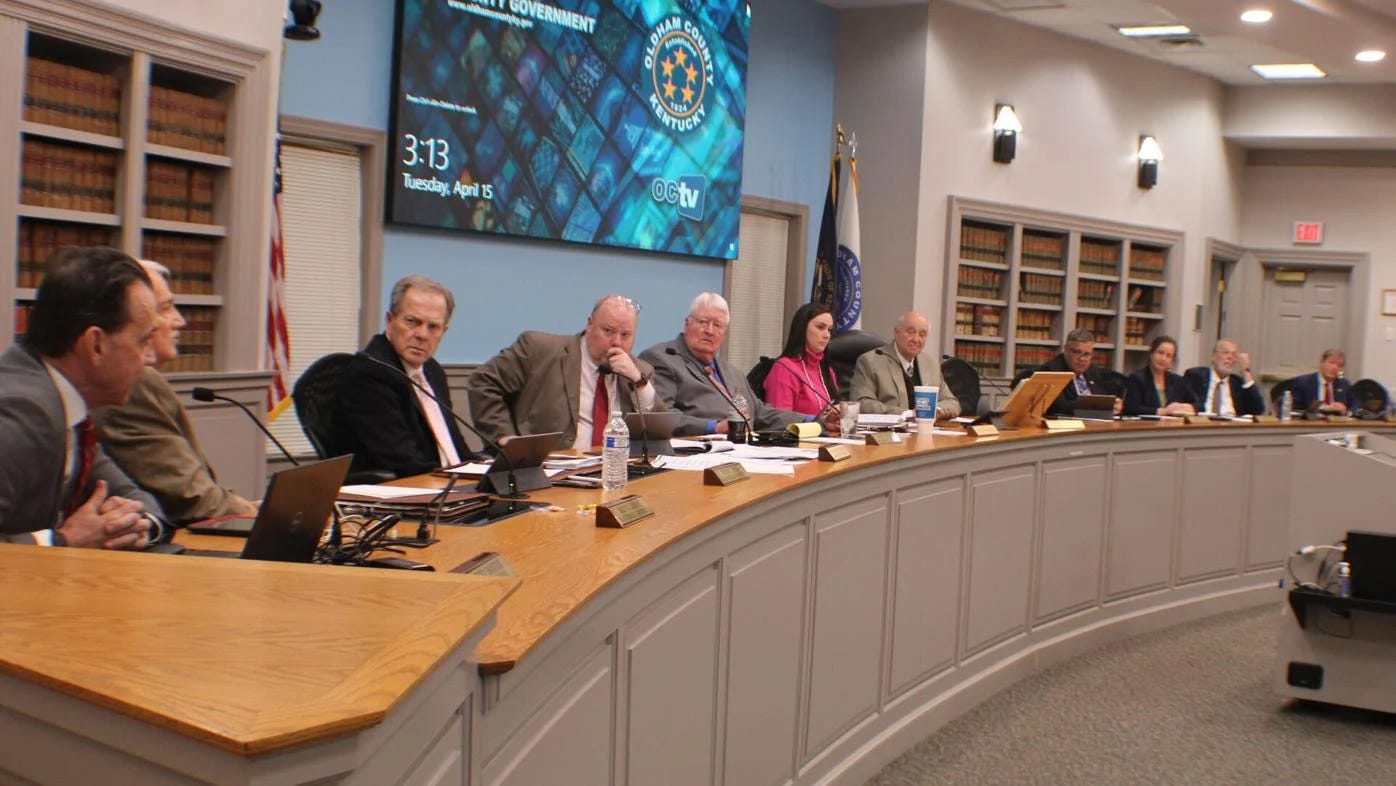
The next Oldham County Fiscal Court meeting is an opportunity for public comment.
Attend. Speak. Ask questions that focus strictly on fiscal accountability:
What contingency plan exists if ICE occupancy falls below projections?
What level of occupancy is required to break even?
What assumptions were made about reimbursement stability?
How will the General Fund be protected from shortfall transfers?
What long-term capital costs are anticipated if ICE volume remains high?
These are not ideological questions. They are budgeting questions.
Fiscal Court adopted a budget projecting $2.13 million in ICE detainee revenue. Voters are entitled to understand the downside scenario as clearly as the upside.
Oldham County voters deserve a jail budget built on stable, controllable revenue, not on federal detention volume that can change with a policy memo in Washington.
Excellent article. All of these KY detention centers rushing to sign 287(g) agreements shoukd really ask themselves what they plan to do once there aren't any more undocumented immigrants to house.
Well written and important question all taxpayers should be asking