
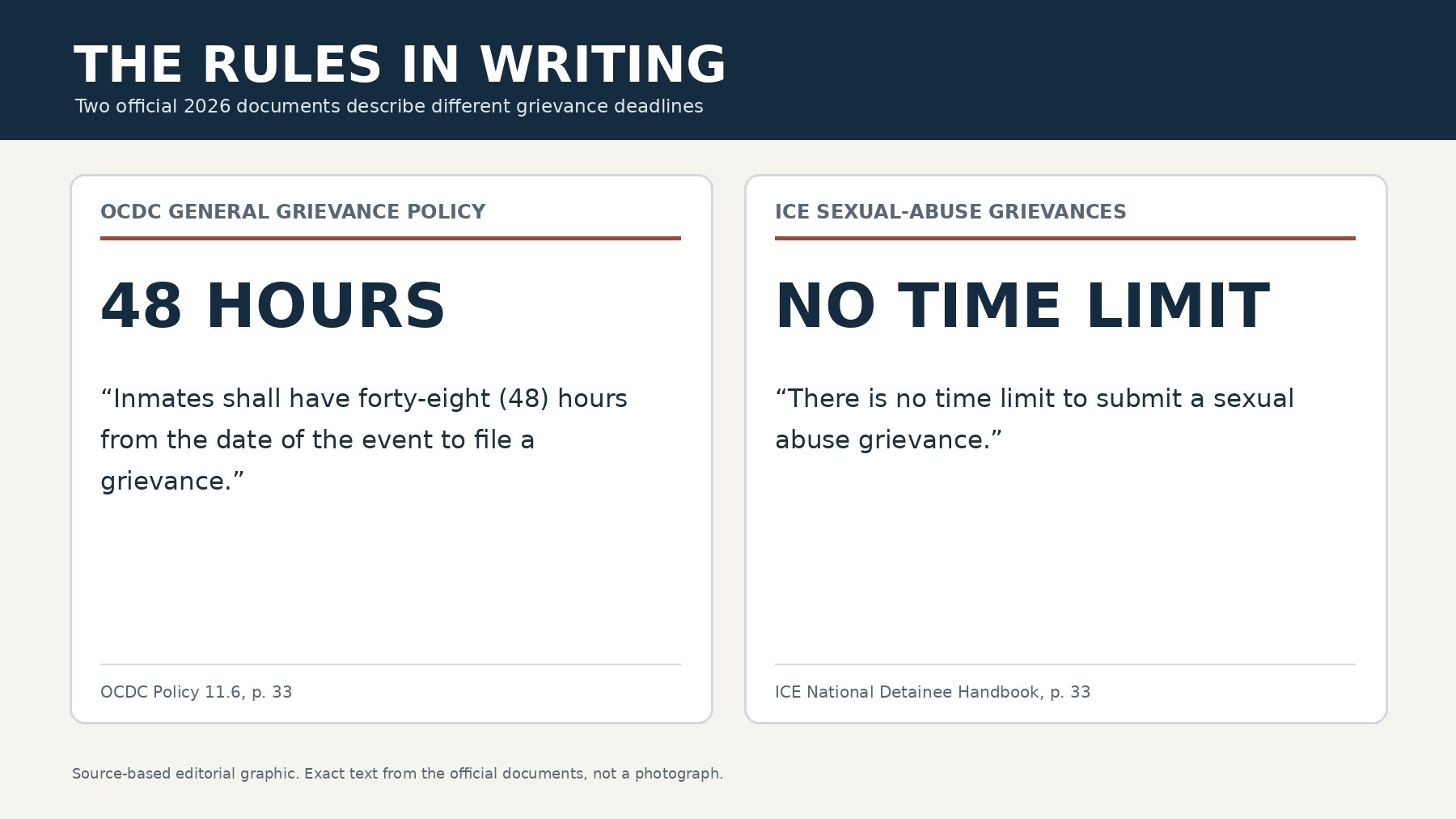
An inmate at the Oldham County Detention Center has 48 hours to file a grievance about something that happened inside the jail. That is what the facility’s written policy says.
But ICE’s 2026 National Detainee Handbook tells people held in immigration detention that there is no filing deadline for grievances involving sexual abuse.
OCDC provides a separate telephone hotline for reporting sexual abuse, including anonymous complaints. Yet its general grievance policy and inmate orientation handbook do not explain that sexual abuse complaints are exempt from the ordinary 48-hour deadline.
The distinction matters. Someone reporting an assault several days after it happened could read the county’s instructions and believe the opportunity to file a formal grievance had already passed.
That is one of several questions raised by OCDC’s written policies, obtained after the Kentucky Attorney General ruled that the jail had improperly withheld public records.
The documents describe protections for people in custody, including access to attorneys, medical services, and procedures for reporting abuse. They also contain rules that differ from ICE’s national guidance.
The records do not establish whether those differences have resulted in ICE detainees receiving fewer protections. The county was given an opportunity to explain the discrepancies and declined to comment.
The records the county initially withheld
On August 12, 2026, a public records request sought OCDC policies governing the treatment of people detained by U.S. Immigration and Customs Enforcement.
The request covered attorney access, medical care, grievances, language assistance, emergency notifications, and detention standards.
OCDC initially withheld most of the requested policies, citing security concerns.
On September 23, the Kentucky Attorney General issued Open Records Decision 26-ORD-428. The decision found that OCDC could withhold information posing legitimate security risks but had violated Kentucky’s Open Records Act by withholding entire policies instead of releasing their nonexempt portions.
OCDC provided an initial group of redacted policies on September 24 and additional records on October 7.
The county’s attorney, Jillian Sauer, explained that Kentucky statutes protecting correctional security kept certain policies withheld. She said the records provided were policies that did not pose a security risk or were already available to inmates.
The released documents therefore are not OCDC’s complete operating manual. Additional procedures may address some of the questions raised by the disclosed material.
But the records do establish what the jail has put in writing about its rules, and what it tells people in its custody to expect.
A grievance deadline with important exceptions
OCDC’s general grievance procedure requires inmates to file complaints within 48 hours. The inmate orientation handbook adds another instruction: an inmate must first speak to the person responsible for the problem before submitting a formal grievance.
Consider how that instruction might apply to someone complaining about mistreatment by a jail employee. Read literally, it tells the person to approach the employee whose conduct is being challenged.
ICE’s published detention standards distinguish between informal complaints and formal grievances. Its 2026 detainee handbook also expressly permits sexual abuse complaints through the formal grievance process without a filing deadline.
Federal regulations addressing sexual abuse in immigration detention, including 6 CFR § 115.52, provide that covered facilities may not impose a filing deadline for such grievances.
OCDC’s orientation materials offer an important alternative. They tell detainees how to report sexual abuse through staff, a kiosk form, or an anonymous telephone hotline. But the general grievance instructions do not identify the separate filing protections that apply to sexual abuse allegations.
A second discrepancy concerns the jail’s response deadline.
OCDC’s policy allows up to ten business days to respond to an initial grievance. Kentucky Administrative Regulation 501 KAR 3:140 requires a response to written grievances within ten days, without specifying business days.
Ten business days can extend substantially beyond ten calendar days.
The U.S. Marshals Service’s published December 2024 detention standards also state that no deadline may be imposed on submitting a formal grievance. A federal agreement with Oldham County references Marshals Service detention standards, although the records reviewed do not establish which revision currently governs the facility.
Those differences do not, by themselves, prove that OCDC is violating a contractual requirement. They do establish that the county’s written deadlines need an explanation that OCDC has not provided.
Does medical care cost ICE detainees money?
OCDC’s inmate orientation handbook states that people held at the facility are entitled to necessary medical, dental, and mental health care.
It also lists charges for medical services: $5 for a nurse visit, $25 for a physician or specialist visit, $10 for prescriptions, and additional charges for certain diagnostic tests.
The handbook says it automatically deducts those fees from inmate accounts, even when an account has a negative balance.
ICE’s 2026 National Detainee Handbook describes necessary and appropriate healthcare as available to immigration detainees without charge.
The county handbook distinguishes inmate classifications when discussing medical bills, but it does not clearly explain whether ICE detainees are exempt from the listed fees.
That omission is notable because OCDC makes an explicit exception elsewhere. Its handbook states that ICE detainees are not charged for copies of legal documents.
There is no comparable ICE-specific explanation in its medical billing instructions.
This does not establish that OCDC actually charges ICE detainees for medical treatment. A separate billing procedure may govern their care.
But a detainee reading the county handbook could reasonably believe that requesting a doctor or prescription would result in a charge. If medical care is supposed to be provided without charge, the instructions should make that clear.
Access to a lawyer
OCDC’s policies provide several protections for people seeking legal representation.
Attorneys may visit outside regular visiting hours, and those meetings do not count against ordinary visitation allowances. Legal mail must be inspected in the inmate’s presence and cannot be read by officers. The orientation handbook also says ICE detainees are not charged for legal copies.
Other provisions raise questions about how those protections operate.
OCDC’s telephone policy requires jailer approval for requests to call attorneys. Its orientation handbook limits legal copying to 25 pages.
ICE’s National Detainee Handbook describes confidential attorney communications, legal research materials, and the ability to obtain copies of legal documents needed for immigration proceedings.
Someone preparing an asylum application or appealing an immigration decision may need more than 25 pages of supporting documents.
OCDC’s disclosed materials do not explain whether exceptions are available when a detainee needs additional copies, or whether jailer approval can delay an urgent attorney call.
The county may have procedures addressing both circumstances. The released records do not establish that detainees have been denied legal access.
They leave unanswered how the listed restrictions are reconciled with the legal protections described in federal detention guidance.
Which handbook does an ICE detainee receive?
ICE’s national handbook tells immigration detainees they will also receive a facility handbook explaining its local rules.
ICE's published detention standards require facilities to provide national and local orientation materials, explain available services, help detainees who cannot understand the information, and document their acknowledgment of receiving the handbooks.
OCDC's written intake policy states that deputies will instruct inmates how to access the county's orientation handbook through an in-cell kiosk when they are moved into general population. Inmates who cannot access the kiosk should receive a printed copy.
The policy also requires special assistance for illiterate and non-English-speaking inmates and a signed orientation acknowledgment.
Those are documented safeguards.
But OCDC’s disclosed materials do not establish whether every ICE detainee receives the national handbook, whether the county’s general inmate handbook serves as ICE’s required local supplement, or whether another ICE-specific orientation document is used.
This question matters because the county and federal materials do not always provide the same instructions.
The same uncertainty appears in the disciplinary rules. OCDC’s policy allows administrative segregation as punishment for serious violations, including periods exceeding 30 days. ICE’s handbook distinguishes nonpunitive administrative segregation from disciplinary segregation and describes hearing and review protections.
OCDC’s released disciplinary policy contains investigation and review requirements, but it does not explain all the procedures described in ICE’s handbook. Other withheld policies may supply them.
Federal inspectors previously found deficiencies
Federal inspectors have previously examined OCDC against federal immigration detention standards.
In September 2024, ICE’s Office of Detention Oversight reviewed Oldham County Jail under the 2019 National Detention Standards.
Inspectors reviewed three detainees' medical records and found that tuberculosis screening had not been conducted in accordance with current CDC guidelines before the detainees entered general population. Inspectors also found no documentation of required emergency medical-response training.
Those findings concern the facility’s operations in September 2024. They do not show the deficiencies continuing into October 2026 or causing the differences found in the newly disclosed policies.
ICE’s subsequently published detention statistics identify an inspection ending June 26, 2025, that received an overall passing rating under the 2019 National Detention Standards. That rating provides a more recent assessment of the facility, although the statistical record does not show how the facility addressed each deficiency identified in 2024.
Taken together, the inspection records show that ICE has evaluated OCDC against federal detention standards, identified deficiencies in 2024, and subsequently awarded the facility an overall passing rating in 2025.
The federal agreement provided for this investigation is a U.S. Marshals Service intergovernmental agreement effective August 1, 2024. It identifies ICE as an authorized user and requires compliance with federal detention standards and additional requirements imposed by authorized agencies.
The agreement is marked perpetual, but the records reviewed do not establish whether subsequent amendments changed the terms or which ICE standards currently govern OCDC.
That limitation prevents a definitive conclusion that the newly identified policy discrepancies constitute federal contract violations.
It does not prevent examination of the rules the county has disclosed.
OCDC declines to explain
On October 8, OCDC’s attorney was asked to clarify six subjects: grievances, medical fees, attorney access, emergency notifications, disciplinary segregation, and language and technology access.
The questions sought explanations of the disclosed rules, not additional security-sensitive operational material.
Sauer declined to answer.
She cited the Kentucky Supreme Court’s decision in City of Fort Thomas v. Cincinnati Enquirer, which holds that public agencies must produce responsive records or justify withholding them under the Open Records Act, but are not required by that law to answer questions or conduct research.
She concluded that, for purposes of the article, OCDC’s response was “no comment.”
The legal distinction is valid. An agency’s obligations under the Open Records Act differ from its decision on whether to answer a journalist’s questions.
But the response did not explain the discrepancies.
The rules need to be clear to the people who must follow them
Oldham County operates the detention center. ICE is responsible for federal immigration custody and oversight under the applicable detention arrangements.
The county's written policies establish important protections. Its orientation handbook identifies a sexual abuse reporting hotline. Its internal policies provide for emergency medical treatment, prohibit officers from reading legal mail, and require printed orientation materials for inmates who cannot access the kiosk.
Those provisions deserve to be recognized.
The unresolved question is whether ICE detainees receive clear instructions about the additional protections available to them and whether the county’s rules are consistent with the federal requirements that actually govern their detention.
A person inside the jail should not have to obtain a federal agreement, compare detention standards, and resolve conflicting instructions before deciding whether to file a grievance or ask for help.
The institutions operating and overseeing the detention system bear that responsibility.
Oldham County officials can explain which rules govern complaints, legal communications, medical charges, and segregation. ICE can identify the detention standards that apply to the facility and the orientation information detainees must receive.
Residents can ask both agencies for those explanations. People with direct concerns about ICE detention can also contact ICE’s Detention Reporting and Information Line at 1-888-351-4024.
The county was asked to reconcile its written policies with ICE’s published guidance. It declined to comment.
The remaining question is not whether every detainee has experienced a violation. The available records do not support that conclusion.
The question is whether people required to follow OCDC’s rules are clearly told which protections apply to them, including the exceptions that may matter most when they need help.
A right that exists in one handbook but isn’t explained in the instructions a detainee relies on is a right that person may never know how to exercise.
Sources
Records obtained through the Kentucky Open Records Act
Oldham County Detention Center, Policy and Procedure, approved April 7, 2026. Redacted records supplied September 24 and October 7, 2026.
Oldham County Detention Center, Inmate Orientation Handbook, 2026.
Kentucky Attorney General, Open Records Decision 26-ORD-428, September 23, 2026.
Correspondence with Jillian Sauer, counsel for OCDC, September 24 through October 8, 2026.
U.S. Marshals Service, Intergovernmental Agreement 33-99-0125, effective August 1, 2024.
Federal and state standards and inspection reports
ICE, 2026 National Detainee Handbook. https://www.ice.gov/detain/detention-management/national-detainee-handbook
ICE, 2019 National Detention Standards for Non-Dedicated Facilities. https://www.ice.gov/doclib/detention-standards/2019/nds2019.pdf
ICE, 2025 National Detention Standards, Standard 6.1, Detainee Handbook. https://www.ice.gov/doclib/detention-standards/2025/nds2025.pdf
U.S. Marshals Service, Federal Performance Based Detention Standards, revised December 2024. https://www.usmarshals.gov/sites/default/files/media/document/performance-based-detention-standards.pdf
ICE Office of Detention Oversight, Oldham County Jail Special Review, September 17–19, 2024. https://www.ice.gov/doclib/foia/odo-compliance-inspections/oldhamCoJail_LaGrangeKY_Sep17-19_2024.pdf
Kentucky Administrative Regulation 501 KAR 3:140, Prisoner Rights. https://apps.legislature.ky.gov/law/kar/titles/501/003/140/
6 CFR § 115.52, Grievances. https://www.ecfr.gov/current/title-6/chapter-I/part-115/section-115.52
City of Fort Thomas v. Cincinnati Enquirer, 406 S.W.3d 842 (Ky. 2013).
Detention Receipts, Oldham County Detention Center, reproducing U.S. Immigration and Customs Enforcement, FY2026 Detention Statistics, July 20, 2026.
https://detentionreceipts.org/facilities/oldham-county-detention-center-la-grange-ky
U.S. Immigration and Customs Enforcement, FY2026 Detention Statistics, July 20, 2026, “Facilities FY26” worksheet. https://www.ice.gov/doclib/detention/FY26_detentionStats07202026.xlsx