
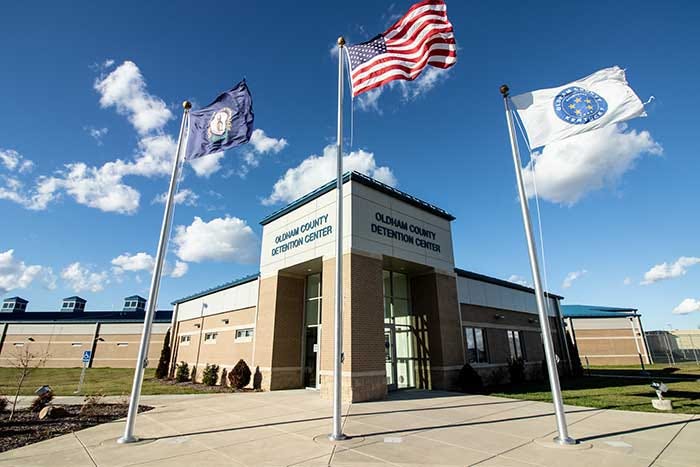
If the debate over ICE feels abstract, it helps to step back and look at something simpler: how the jail actually operates. Not politically or rhetorically, but day to day. Because once that becomes clear, the rest of the conversation starts to come into focus. What looks complicated at a distance is often straightforward up close.
Where the money comes from
The Oldham County Detention Center runs on multiple revenue streams, most of which do not come from Oldham County itself. For the upcoming fiscal year, the jail is projecting about $8.7 million in total revenue, with more than $7.4 million expected from the federal government, including roughly $3.1 million tied to ICE detainees.
That leaves a much smaller portion coming from state inmates, local inmates, and other sources. The structure is simple: the jail is paid per person, per day to house inmates for different agencies, including federal detainees, state inmates, and people held for other counties. Each of those placements generates a per diem payment, meaning revenue increases as more beds are filled.
How beds get filled
During the March 17 Fiscal Court meeting, the jailer described the intake process in practical terms, without much ambiguity. The facility does not control who gets arrested, does not screen for charges, and does not pick and choose cases. It houses whoever is sent, whether that comes through federal agencies like the U.S. Marshals, ICE, the state, or other counties.
There is one consistent condition across all of this: demand is always there. When one stream slows down, another fills the space, and at the time of the meeting, the jail was already at or near capacity. Federal marshals were aware the facility was full and were distributing inmates across other jails in Kentucky.
The only group the jail cannot turn away is Oldham County itself. Everyone else is part of a broader network that moves people between facilities based on space and need. In practice, that means most of the people inside the jail are not from Oldham County at all, with the majority of beds typically filled by federal or state detainees brought in through these external agreements.
Why ICE is just one revenue stream
This is where the conversation often narrows too quickly. ICE is a significant source of revenue, but it is not the only one, and the system does not depend on it in a structural sense. When asked directly what would happen if ICE detainees were no longer housed there, the answer was clear: the jail would continue operating.
Beds would be filled by other federal detainees, state inmates, or transfers from other counties. In other words, ICE is part of the system, not the system itself. The facility is built to house people, and if one category goes away, others take its place.
What changed when the new jail was built
Before this facility existed, Oldham County was spending close to $800,000 to $1 million a year to house inmates elsewhere. The decision to build a new detention center was meant to change that by creating a modern facility capable of housing more people and offsetting those costs.
That shift worked. Instead of operating at a loss, the jail now projects a net positive balance, with revenue exceeding expenses. But that outcome depends on keeping beds filled, and that is where the design of the facility becomes important.
The current detention center was built with far more capacity than Oldham County needed for its own population. A facility that had previously held fewer than 200 inmates was replaced with one designed to hold hundreds more, creating space specifically for state and federal detainees brought in from outside the county.
What this looks like day to day
Put together, the daily operation is straightforward. People are brought in from multiple systems, housed based on available space, and each occupied bed generates a daily payment. The jail balances capacity across different sources, adjusting as demand shifts from one stream to another.
There is no single pipeline feeding the facility. There is a continuous flow, with different agencies filling available space as needed. If ICE vans stopped arriving tomorrow, something else would take their place, because the system is designed to operate that way.
The question underneath all of this
Once the system is visible, the debate shifts. The issue is no longer whether the jail can operate without ICE. It can.
The question is why it hasn’t. And that leads to a more direct one: why did Jailer Jeff Tindall choose to enter into the ICE agreement in the first place?
Because if this system does not require ICE to function, then that decision was not inevitable. It was a choice.
And once that question is on the table, another follows. If this is a choice, not a necessity, then what exactly is Oldham County choosing to be part of?
Sources
Oldham County Fiscal Court Meeting – Jail Budget Presentation (March 2026)
Oldham County Detention Center Budget Figures (presented during Fiscal Court meeting)
Referenced in public meeting discussionKentucky Department of Corrections – Weekly Jail Population Reports
https://corrections.ky.gov/public-information/researchandstats/Documents/Weekly%20Jail/2026/Weekly%20Jail%2003-12-26.pdfLouisville Public Media – Inside Kentucky’s ICE Detention Center
https://www.lpm.org/investigate/2025-02-12/inside-kentuckys-ice-detention-centerKentucky Lantern – Reporting on jail overcrowding and state inmate housing practices