
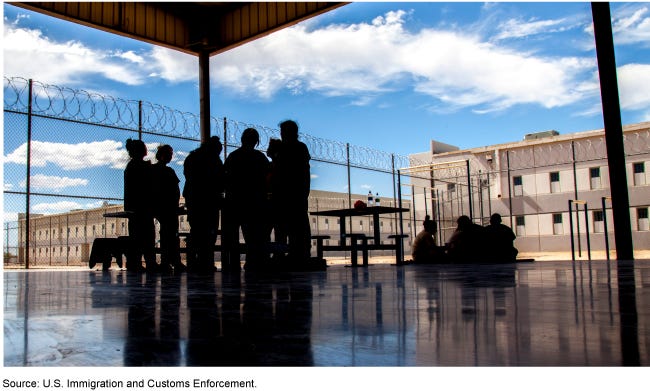
Homeland Security Secretary Markwayne Mullin testified before a Senate panel on June 2 as Senate Republicans continued to push for roughly $72 billion in additional immigration enforcement funding.
The package has not been enacted. The current development is a federal budget fight tied to testimony, detention capacity, and immigration enforcement operations. But the money being debated in Washington would not stay in Washington. Federal immigration detention depends on local beds, local transport, local guards, and local jail contracts.
Kentucky is already part of that detention network.
KyCIR and Kentucky Public Radio reported that ICE detained 9,335 people in Kentucky jails between October 2022 and early March 2026, with more than 60% of those detentions occurring after Trump returned to office in January 2025. Detainees were sent to Kentucky from dozens of states, which means Kentucky jails are not only holding people arrested in Kentucky. They are helping absorb national detention demand.
The Kentucky question is direct: if Congress sends billions more to ICE and DHS enforcement operations, will county jails here become even more financially tied to federal immigration detention?
The federal money under debate
On June 2, Reuters reported that Homeland Security Secretary Markwayne Mullin was testifying before a Senate panel amid immigration enforcement disputes, detention protests, and a Republican push for $72 billion more for President Trump’s deportation agenda over three years. Reuters reported that the new proposal would follow a prior $170 billion immigration enforcement package approved in 2025.
The same Reuters report said ICE was holding roughly 56,000 people in custody, above the approximately 40,000 detained when Trump returned to office in January 2025, though below a February 2026 high of about 68,000.
The Senate funding push has been delayed in part because of Republican disagreement over a separate $1.8 billion “anti-weaponization” fund. Reuters reported that the fund was controversial within the GOP and delayed passage of the broader immigration-enforcement bill.
The immigration funding package itself remains active. Reuters reported on May 19 that Senate Republicans advanced a major portion of the $72 billion enforcement bill and defeated all 57 Democratic amendments in committee. The American Action Forum, reviewing the Senate text, said the package included funding for ICE enforcement operations, personnel, transportation for removals, information technology, facility and fleet maintenance, and coordination with state and local authorities.
The development is limited in one important way: Congress has not yet enacted the full package. But the direction is clear enough for Kentucky counties to answer local questions now.
How ICE uses county jail beds
ICE does not detain people only in federally owned detention centers. It relies heavily on county jails, private detention facilities, transportation contractors, medical providers, and agreements with local law enforcement agencies.
One key tool is the 287(g) program, which allows ICE to enter into agreements with state and local law enforcement agencies. ICE says that as of June 1, 2026, it had signed 1,888 memorandums of agreement for 287(g) programs across 39 states and two U.S. territories.
Another tool is detention contracting. ICE maintains facility pages for Kentucky jails, including Boone County Jail, Oldham County Detention Center, and Kenton County Detention Center. Those pages confirm that Kentucky county jails are part of ICE’s detention network.
Federal funds reach local governments through per diem payments and reimbursements. KyCIR reported that the federal government pays Kentucky jails up to $100 per day to hold someone for ICE, with additional reimbursement for transportation and hospital guard duty.
Those payments create an incentive.
A county jail that receives more per person from ICE than from the state can treat federal detainees as a revenue source.
That does not mean every county official has the same motive or that every dollar becomes profit. Jails cost money to operate. Guards, medical care, transportation, insurance, food service, and facility maintenance all carry costs. But federal payments can become part of a jail budget, and once they are built in, ending the arrangement becomes harder.
Kentucky law places local jail budgeting in local hands. Under KRS 441.215, the county judge/executive, county treasurer, and jailer prepare a proposed line-item jail budget and revenue estimate for the fiscal court review. That gives county residents a specific venue to ask how much ICE revenue is expected, how much is being spent to support ICE detention, and whether county leaders are planning for expansion.
Kentucky’s local detention role
Kentucky county jails are not peripheral to this issue. They are operational partners in federal immigration detention.
KyCIR found that a dozen Kentucky county jails held people for ICE between October 2022 and early March 2026. Oldham County Detention Center held nearly 1,800 people for ICE during that period. Records obtained by KyCIR showed Oldham County invoiced ICE for about $3.7 million since Trump returned to office.
The people held in Kentucky are not all arrested here. KyCIR reported that nearly half of the people ICE held in Kentucky jails were transferred from 37 other states, including Illinois, Indiana, Wisconsin, Arizona, and New York.
That changes the local meaning of a county jail.
A jail built and funded as a county facility can become part of a national deportation operation.
The county jailer still answers locally. The fiscal court still approves local budgets. Local taxpayers still pay for the public building, local staffing demands, emergency costs, and jail oversight.
The detainees, however, may be far from their families, attorneys, churches, workplaces, and immigration courts. Immigration attorneys told KyCIR that detention far from home can make cases harder to fight. A person transferred to a Kentucky jail may need a new attorney or an attorney admitted in Kentucky federal court. Families may have to travel long distances for visits or legal coordination.
For Kentucky residents, the issue also affects county budgets. The Kentucky Association of Counties has reported that county jail costs are among the largest budget pressures for fiscal courts, with counties spending almost $350 million on jails in FY2023, excluding Fayette and Jefferson counties. When federal detention money enters that budget picture, local residents need to know whether their county is reducing pressure on the general fund or building dependency on ICE revenue.
The county budget incentive
The proposed federal package would send new money into agencies already expanding detention and removal operations.
Reuters reports that Senate Republicans are seeking an additional $72 billion for Trump’s deportation agenda over three years, following the prior $170 billion package. The American Action Forum’s review of the Senate proposal said the Homeland Security and Governmental Affairs Committee portion included $32.5 billion for DHS, while the Judiciary Committee portion included $39.2 billion, with money available through FY2029.
The Congressional Budget Office also reviewed the Senate Homeland Security and Governmental Affairs reconciliation legislation and said it would directly appropriate $32.5 billion to DHS in 2026, distributed among CBP, ICE, and other immigration enforcement and border-security activities.
At the Kentucky level, the funds appear in county jail invoices. KyCIR reported that Oldham County invoiced ICE for about $3.7 million since Trump returned to office. The Herald-Leader reported that Boone, Kenton, and Campbell counties billed ICE more than $10.4 million in 2025 for housing or transporting ICE detainees.
The Herald-Leader also reported that the federal rate in those Northern Kentucky counties was $88 per day, compared with about $35 per day for state inmates. That gap gives counties a financial reason to prefer federal detainees over lower-paying state inmates when beds are available.
A county may describe ICE detention as a source of revenue. Residents need to see the full ledger: revenue, staffing, overtime, medical care, transport, liability, facility wear, and administrative costs.
Questions fiscal courts should answer
You can ask specific questions at fiscal court meetings.
Ask the jailer and fiscal court how many ICE detainees the county held each month in 2025 and 2026. Ask how much ICE revenue the jail has received, how much it projects for the next fiscal year, and whether the county has budgeted for more detainees. Ask whether any jail expansion, vehicle purchase, staffing change, or medical contract is tied to ICE detention.
Request the documents. Ask for the ICE contract, U.S. Marshals, or intergovernmental service agreement if applicable, monthly invoices, transport reimbursement records, hospital guard-duty reimbursement records, medical-cost provisions, and any communications with ICE about bed capacity.
Compare the numbers. County residents should compare ICE revenue with jail costs, state prisoner reimbursement, local incarceration costs, overtime, medical expenses, and any capital purchases. A high federal per diem does not automatically mean the county is making money after costs.
Track the federal bill. Kentucky’s congressional delegation can be asked whether they support the new enforcement funding, whether they support limits on family separation and detention transfers, whether they support reporting requirements for county-jail detention contracts, and whether they will require public disclosure of federal payments to local jails.
Document the local effects. Families, attorneys, clergy, jail staff, and local advocates can track transfer patterns, visitation barriers, medical complaints, court-access problems, and open records denials. Federal enforcement funding becomes harder to evaluate when county residents cannot see the records.
The immediate vote is in Washington. The practical effects will be felt in county jails, fiscal court budgets, immigration cases, family visits, attorney access, and local decisions to accept federal detention money.
Further reading and sources
Primary and official sources
DHS, “U.S. Senate Confirms Markwayne Mullin as Secretary of Department of Homeland Security”
https://www.dhs.gov/news/2026/03/24/us-senate-confirms-markwayne-mullin-secretary-department-homeland-security
House Committee on Homeland Security, FY2027 DHS budget hearing advisory with Secretary Mullin
https://homeland.house.gov/2026/05/27/media-advisory-chairman-garbarino-announces-dhs-budget-hearing-with-secretary-mullin/
Senate Appropriations Committee, FY2026 Homeland Security report
https://www.appropriations.senate.gov/download/fy26-homeland-security-report
Congressional Budget Office, Reconciliation Legislation of the Senate Committee on Homeland Security and Governmental Affairs
https://www.cbo.gov/publication/62413
ICE, Delegation of Immigration Authority Section 287(g) Program
https://www.ice.gov/identify-and-arrest/287g
ICE, Boone County Jail detention facility page
https://www.ice.gov/detain/detention-facilities/boone-county-jail
ICE, Oldham County Detention Center facility page
https://www.ice.gov/detain/detention-facilities/oldham-county-detention-center
ICE, Kenton County Detention Center facility page
https://www.ice.gov/detain/detention-facilities/kenton-county-detention-center
Kentucky Revised Statutes, KRS Chapter 71, Jailer
https://apps.legislature.ky.gov/law/statutes/chapter.aspx?id=37411
Kentucky Revised Statutes, KRS 441.215, Jail budget preparation
https://apps.legislature.ky.gov/law/statutes/statute.aspx?id=19331
Kentucky Revised Statutes, KRS Chapter 441, Operation and Management of Local Correctional Facilities
https://apps.legislature.ky.gov/law/statutes/chapter.aspx?id=39333
Reporting and analysis
Reuters, “Trump homeland secretary testifies before Senate panel amid airport threats, detention protests”
https://www.reuters.com/legal/government/trump-homeland-secretary-testifies-before-senate-panel-amid-airport-threats-2026-06-02/
Reuters, “U.S. Senate Republicans advance major portion of $72 billion migrant enforcement bill”
https://www.reuters.com/legal/government/us-senate-republicans-advance-major-portion-72-billion-migrant-enforcement-bill-2026-05-19/
Reuters, “Senate Republicans face a political knife-edge over Trump’s anti-weaponization fund”
https://www.reuters.com/legal/government/senate-republicans-face-political-knife-edge-over-trumps-anti-weaponization-fund-2026-05-30/
KyCIR / Louisville Public Media, “Trump’s deportation machine sends thousands of immigrants to Kentucky jails”
https://www.lpm.org/investigate/2026-05-26/trumps-deportation-machine-sends-thousands-of-immigrants-to-kentucky-jails
Kentucky Center for Economic Policy, “ICE Arrests Are Surging in Kentucky as Local Law Enforcement Joins Troubling Mass Deportation Effort”
https://kypolicy.org/ice-arrests-in-kentucky/
Kentucky Center for Economic Policy, “Amid Mounting Harms, Kentucky Is Ramping Up Anti-Immigrant Enforcement”
https://kypolicy.org/ice-enforcement-in-kentucky/
Kentucky Association of Counties, County Jail Resources
https://kaco.org/county-information/county-jails/