
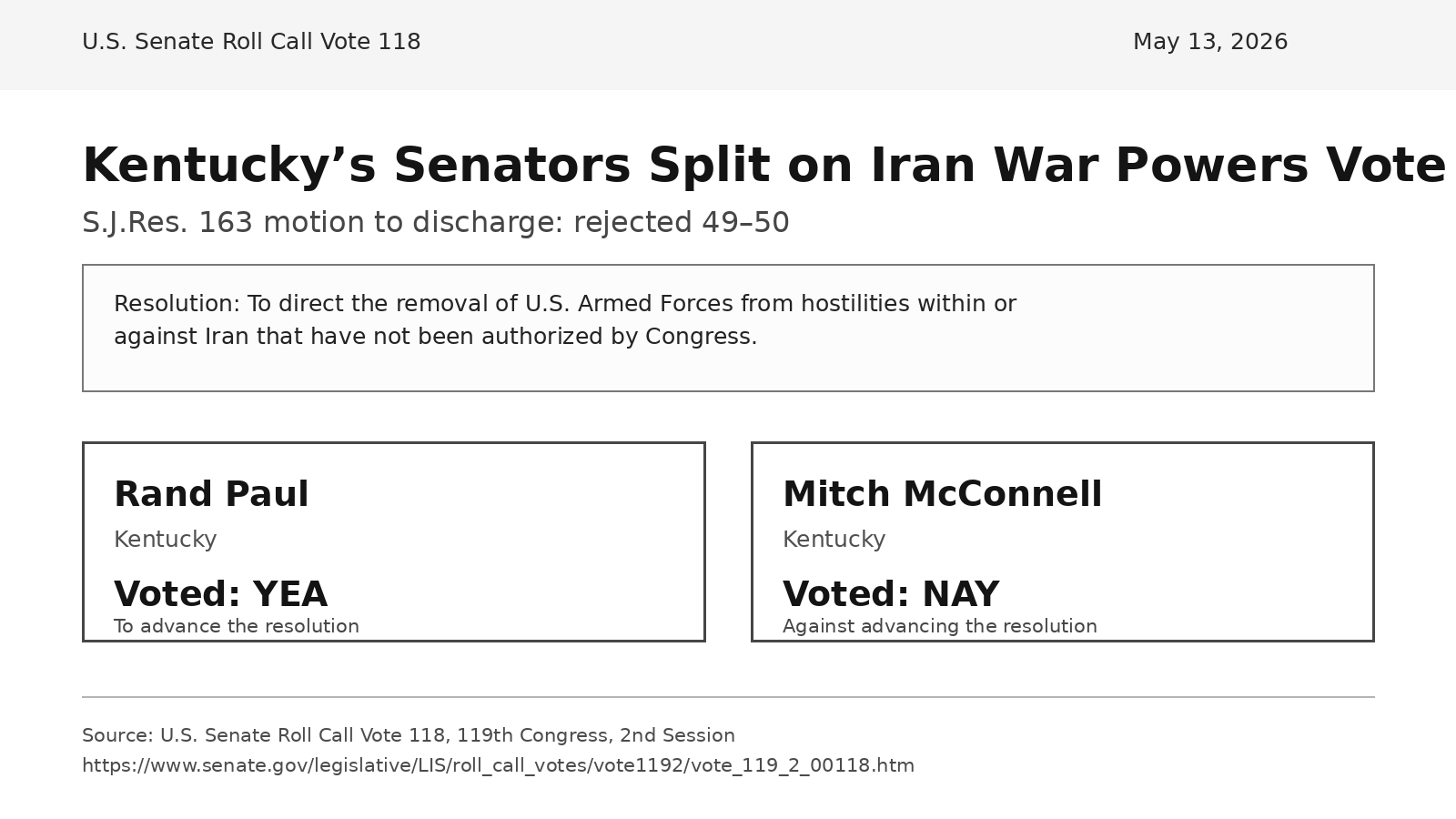
On Wednesday morning, Kentucky’s two senators took opposite sides on a question Congress has avoided for months: whether President Trump can continue military action against Iran without congressional authorization.
Rand Paul voted to advance a war powers resolution. Mitch McConnell voted no. The Senate rejected the motion 49 to 50, blocking another attempt to force a vote on removing U.S. forces from hostilities within or against Iran that Congress has not authorized.
In Washington, that may sound procedural. In Kentucky, it should not. This is a state with Fort Campbell, Fort Knox, Blue Grass Army Depot, National Guard families, veterans, defense workers, and communities whose daily lives are tied to military decisions made far from home.
A vote on war powers is not only a vote on foreign policy. It is a vote on whether Congress will take responsibility before more service members, families, and taxpayers are asked to carry the weight of a war.
The Senate blocked the question before it reached the floor
The measure before the Senate was S.J.Res. 163, a joint resolution directing the removal of U.S. Armed Forces from hostilities within or against Iran that have not been authorized by Congress.
The vote was not a final passage of the resolution. It was a motion to discharge the measure, which would have moved it forward instead of leaving it stalled in committee.
The Senate did not vote to end the war that morning. It voted on whether the Senate would even allow the resolution to advance.
The motion failed by one vote. Rand Paul joined most Democrats and Republican senators Susan Collins and Lisa Murkowski in voting yes. Mitch McConnell voted no. Democrat John Fetterman voted with most Republicans against it.
Reuters reported that this was the seventh similar Senate attempt blocked in 2026. Democrats have argued that the Constitution requires Congress to authorize war. The White House and most Senate Republicans have defended Trump’s use of military force as legal under his authority as commander-in-chief.
That repeated pattern is the story.
Congress keeps being given chances to decide whether this war should continue, and the Senate keeps refusing to take ownership.
Kentucky’s senators split on congressional responsibility
Kentucky’s Senate split gives this story a direct state angle.
Rand Paul voted to move the resolution forward. That vote fits his long-standing position that Congress should not surrender war-making authority to the president. Whatever one thinks of Paul’s broader politics, his vote on this question placed him on the side of requiring congressional accountability before continued military action.
Mitch McConnell voted the other way. His no vote aligned him with most Senate Republicans and with the administration’s position that the president has sufficient authority to continue the military posture around Iran without new congressional authorization.
That split should not be treated as political trivia.
Kentucky voters sent both men to the Senate, and both hold power over whether Congress asserts its constitutional role. One voted to force the question forward. The other voted to keep the resolution from advancing.
That gives Kentuckians a clear accountability question for each senator.
For Paul: What will he do next to keep forcing a public vote?
For McConnell: What standard would require Congress to authorize the war?
The 60-day clock is testing whether Congress still acts as a check
The War Powers Resolution was passed after Vietnam to limit a president’s ability to keep U.S. forces in hostilities without congressional authorization. Under the statute, U.S. forces generally must be removed after 60 days unless Congress has declared war, enacted a specific authorization, extended the period, or certain limited conditions apply.
The current fight turns on whether the Trump administration can avoid that requirement by saying hostilities have effectively ended.
The White House says it does not need congressional approval, citing a ceasefire. But reporting from Reuters and AP says the administration continues to maintain military deployments, while critics point to ongoing military tensions, naval blockades, and attacks on U.S. forces as reasons Congress still has a duty to act.
Defense Secretary Pete Hegseth has said the administration has “all the authorities necessary,” according to AP. Murkowski questioned that claim as she joined Paul and Collins in supporting the resolution.
That is the constitutional problem in plain language: the administration says it has enough authority. A growing number of senators say Congress still needs to vote.
For Kentucky, this is not a civics-class abstraction.
If Congress avoids the vote, Kentucky service members and military families are still subject to executive branch decisions without Congress fully exercising its oversight role.
Kentucky lives with the consequences of war decisions
Kentucky is not only represented in the Senate. Kentucky is tied to the military structure that carries out national security decisions.
Fort Campbell’s Q2 FY25 profile listed 30,113 active military personnel and roughly 51,480 family members, with many soldiers and families living in Kentucky and Tennessee communities off-post.
The Kentucky Commission on Military Affairs reported that military employment in Kentucky totaled 53,661 employees at the end of the federal fiscal year 2024. That includes active-duty personnel, National Guard and Reserve members, and Department of Defense civilian employees. More than half were active-duty Army personnel based at Fort Campbell and Fort Knox.
Those numbers do not mean Kentucky troops have been sent to Iran. That should not be assumed without documentation.
But they show why war powers reach Kentucky directly.
A state with major installations, military families, civilian defense workers, veterans, and defense-dependent local economies has a real stake in whether Congress authorizes or avoids responsibility for military action.
When the Senate blocks a vote like this, the decision impacts families waiting for deployment news, communities built around military installations, taxpayers funding military operations, and veterans who know what open-ended conflict can cost.
Funding may become the next pressure point
If the Senate keeps blocking war powers resolutions, the next pressure point may be money.
AP reported that Democrats plan to keep pushing war powers votes and use military funding legislation to limit Trump’s actions. Reuters also reported that Sen. Jeff Merkley plans to keep introducing new resolutions until the conflict ends or the president seeks formal authorization.
That is where Kentucky’s House delegation may become more important.
Earlier this year, the House rejected a related measure on Iran’s war powers. Kentucky’s delegation split there, too: Thomas Massie and Morgan McGarvey voted yes, while Andy Barr, James Comer, Brett Guthrie, and Hal Rogers voted no.
The House vote shows the divide is not simply Democrat versus Republican, and is not limited to the Senate.
Future funding votes could be more concrete than procedural motions. If Congress is asked to fund expanded military operations, members will have to decide whether to attach limits, demand authorization, or continue paying for military action without forcing a full debate.
For Kentuckians, that raises another clear accountability question: Will members of Congress fund an unauthorized war without a vote to authorize it?
Congress keeps avoiding ownership of the war
The central issue is not whether every senator shares the same view of Iran. They do not. Reasonable people can disagree over strategy, diplomacy, sanctions, deterrence, and military risk.
The deeper issue is whether Congress will take public responsibility for the decision.
The Constitution gives Congress the power to declare war. The War Powers Resolution was designed to prevent presidents from stretching military action beyond congressional control. Yet the repeated Senate votes show how easily that responsibility can be avoided when party loyalty, procedural control, and executive power all point in the same direction.
Kentucky voters do not need to master every foreign-policy detail to ask a basic question: if the war is justified, why won’t Congress authorize it?
That question should be especially urgent in a military state. Kentucky communities understand that war is not only a speech, a press conference, or a statement of support. It is deployment. It is family separation. It is risk. It is public money. It is long-term care for those who come home changed.
A Senate vote that blocks debate does not make those consequences disappear. It only keeps Congress from putting its name on them.
What to watch next
Watch whether Sen. Merkley and other senators continue forcing votes. Each vote will test whether Republican opposition continues to grow or remains locked in the same pattern.
Watch whether Murkowski’s vote signals a broader shift among Republicans. AP reported that her support marked growing Senate GOP resistance, with Paul and Collins already voting against the war effort.
Watch future military funding legislation. If Congress will not authorize the war directly, funding bills may become the next place where lawmakers either impose limits or allow the administration to continue.
And watch Kentucky’s delegation. Paul has voted to advance the war powers challenge. McConnell has voted against it. Massie and McGarvey voted yes on a related House measure earlier this year. Barr, Comer, Guthrie, and Rogers voted no.
That split gives Kentucky voters several clear places to press for answers.
What Kentuckians can do
Kentuckians can contact Sen. Rand Paul and ask him to continue pressing for a public vote on congressional authorization before continued military action against Iran.
They can contact Sen. Mitch McConnell and ask what standard he believes would require Congress to authorize the war.
They can contact their U.S. House member and ask whether they will vote to fund military operations against Iran without congressional authorization.
Kentuckians can also ask veteran organizations, faith communities, military-family networks, and civic groups to speak in constitutional terms. This should not be reduced to a partisan argument over one president.
Congress, not the president alone, is supposed to decide whether the country stays in a war.
The question now is whether Kentucky’s members of Congress are willing to put their votes behind that responsibility.
Direct sources
Primary vote and legislative sources
U.S. Senate Roll Call Vote 118, S.J.Res. 163
https://www.senate.gov/legislative/LIS/roll_call_votes/vote1192/vote_119_2_00118.htm
U.S. Senate roll call vote menu, 119th Congress, 2nd Session
https://www.senate.gov/legislative/LIS/roll_call_lists/vote_menu_119_2.htm
U.S. House Clerk, Roll Call 85, H.Con.Res. 38
https://clerk.house.gov/Votes/202685
50 U.S.C. § 1544, War Powers Resolution
https://uscode.house.gov/view.xhtml?req=%28title%3A50+section%3A1544+edition%3Aprelim%29
Reporting sources
Reuters, “US Senate blocks latest bid to rein in Trump Iran war powers, support grows”
https://www.reuters.com/legal/government/us-senate-blocks-latest-bid-rein-trump-iran-war-powers-support-grows-2026-05-13/
Associated Press, “Republican resistance to Iran war grows in the Senate as Murkowski flips”
https://apnews.com/article/3efd8b6bc1834a66eca8526a0a9b3ffe
The Guardian, “Senate fails to curb Trump’s war on Iran even as Republican opposition grows”
https://www.theguardian.com/us-news/2026/may/13/trump-iran-senate-war-powers
CBS News, “Senate defeats 7th Trump war powers resolution on Iran”
https://www.cbsnews.com/news/senate-defeats-7th-trump-war-powers-iran/
TIME, “Senate Vote on Iran War Powers Is Closest Yet as Murkowski Joins GOP Defectors”
https://time.com/article/2026/05/13/iran-war-vote-senate-murkowski-closest-vote-yet/
Kentucky and military-impact sources
Military OneSource, Fort Campbell installation profile
https://installations.militaryonesource.mil/in-depth-overview/fort-campbell
Kentucky Commission on Military Affairs, February 2026 Defense Activity Report
https://kcma.ky.gov/Documents/KCMA%20Defense%20Activity%20Report%20February%202026.pdf
DOD / REPI Kentucky State Fact Sheet
https://www.repi.mil/Portals/44/Documents/State_Packages/Kentucky_ALLFacts.pdf
Kentucky delegation context
Rep. Thomas Massie press release on bipartisan Iran war powers resolution
https://massie.house.gov/news/documentsingle.aspx?DocumentID=395731
Rep. Morgan McGarvey press release on Iran war powers resolution
https://mcgarvey.house.gov/media/press-releases/congressman-morgan-mcgarvey-cosponsors-war-powers-resolution
LEX18, Rand Paul comments on Iran war and negotiations
https://www.lex18.com/news/covering-kentucky/sooner-the-war-ends-the-better-sen-rand-paul-hopes-iran-war-ends-in-negotiated-peace
WVXU, Mitch McConnell support for Trump’s Iran policy
https://www.wvxu.org/politics/2026-04-07/mitch-mcconnell-support-iran-war-trump
WLKY, McConnell and Paul split on earlier war powers resolution
https://www.wlky.com/article/sen-mitch-mcconnell-war-powers-resolution-president-trump/70611707
Advocacy and action sources
Friends Committee on National Legislation, “Money for War, But…”
https://www.fcnl.org/updates/2026-04/money-war
Friends Committee on National Legislation, “No Funding for War with Iran”
https://www.fcnl.org/resources/no-funding-war-iran
Common Cause coalition letter to Congress on war powers
https://www.commoncause.org/wp-content/uploads/2026/04/War-Powers-Letter-to-Congress-April-13-2026.pdf
Win Without War action page
https://winwithoutwar.org/take-action/