

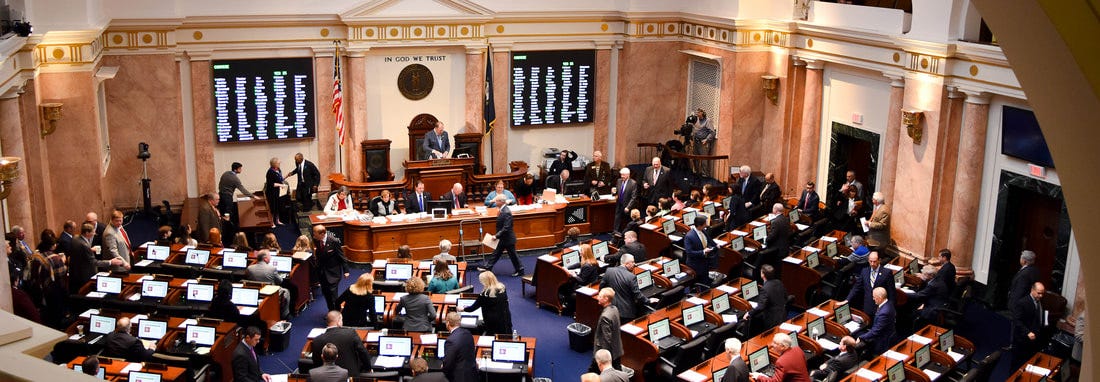
On a weekday afternoon in Frankfort, members of the Kentucky House of Representatives authorized subpoenas directed to the administration of Governor Andy Beshear. The subpoenas request detailed budget records and actuarial information related to the state employee health insurance plan. The documents were issued under the House’s investigative authority as legislators prepare for Kentucky’s next two-year budget.
The dispute has been building for months. Lawmakers have said they need updated cost projections, enrollment data, and long-range liability estimates to draft the executive branch’s operating and capital budget for fiscal years 2027 and 2028. Administration officials have responded that the requested materials either have already been provided, fall within protected categories, or are being prepared through existing reporting channels.
The escalation from written requests to formal subpoenas marks a procedural shift. It moves the disagreement from routine information exchange into compelled production governed by legislative rules and, if challenged, potentially by the courts.
The House’s Subpoena Authority Under KRS 6.140
The subpoenas were issued through the House’s standing committees pursuant to authority granted in Kentucky Revised Statutes. Under KRS 6.140, the General Assembly and its committees may compel testimony and the production of records in furtherance of legislative duties. That statute permits committees to administer oaths, issue subpoenas, and require documents relevant to matters within their jurisdiction.
In this instance, House leadership stated that budget drafting falls squarely within legislative authority under Section 230 of the Kentucky Constitution, which provides that no money shall be drawn from the state treasury except pursuant to appropriations made by law. To appropriate funds responsibly, legislators argue they require detailed data on projected health insurance claims, premium revenue, reserve balances, and cost-containment contracts.
The requested materials reportedly include actuarial analyses for the Kentucky Employees’ Health Plan, vendor contracts for third-party administrators, utilization trends for high-cost prescription drugs, and internal forecasts prepared by the Kentucky Personnel Cabinet, which oversees employee benefits. Lawmakers have said that summary reports are insufficient for evaluating long-term cost exposure.
When a legislative committee issues a subpoena, the recipient must either comply or assert legal grounds for withholding information. Failure to comply can trigger enforcement proceedings in Franklin Circuit Court. That step has not yet occurred, but the option exists under state law.
Data Requests Concerning the Kentucky Employees’ Health Plan
The focal point of the dispute is the Kentucky Employees’ Health Plan, administered by the Personnel Cabinet in coordination with the Kentucky Finance and Administration Cabinet. The plan covers tens of thousands of state employees, retirees, and dependents across Kentucky’s executive branch agencies, including the Kentucky Department of Education and the Kentucky Department of Corrections.
Health plan expenditures constitute one of the largest line items within the executive branch budget. In recent fiscal years, total benefit costs have exceeded $1.5 billion annually. Even modest percentage changes in claims growth translate into tens of millions of dollars in appropriations.
House budget writers have indicated that they are seeking detailed claims data segmented by plan tier, demographic cohort, and geographic region. They have also requested projections reflecting potential impacts from new pharmaceutical therapies and federal regulatory changes. Administration officials have maintained that actuarial consultants already provide annual rate-setting analyses, and that additional disclosure could implicate proprietary vendor information.
The disagreement therefore centers on the level of granularity legislators believe is necessary. Summary tables that appear in budget presentations may not provide the same analytical depth as the underlying actuarial spreadsheets and vendor contracts.
The Budget Timeline for Fiscal Years 2027–2028
Kentucky operates on a biennial budget cycle. The next comprehensive budget bill will be introduced during the 2026 regular session of the General Assembly. The budget drafting process begins months earlier, typically in late summer and fall, when the executive branch submits spending proposals to the legislature.
Under KRS Chapter 48, the Governor must present a proposed budget that includes estimated revenues, recommended appropriations, and financial plans for state agencies. Legislative leaders have stated that delays or gaps in underlying data hinder their ability to assess whether the Governor’s recommendations align with projected obligations.
The House Appropriations and Revenue Committee must reconcile executive proposals with independent revenue estimates prepared by the Kentucky Office of State Budget Director. Discrepancies in cost forecasts for health insurance, pension contributions, or Medicaid matching funds can alter reserve calculations and debt service planning.
The subpoenas therefore arrive at a point in the calendar when committees are preparing pre-session working drafts. Procedurally, the next step is document production. If the administration provides the requested records, staff analysts will incorporate them into fiscal models. If production is contested, enforcement hearings may follow.
Prior Public Exchanges Between House Leadership and the Administration
The dispute has unfolded through public letters, committee hearings, and press statements. House leaders have stated that repeated requests for data were either delayed or incomplete. Administration representatives have countered that statutory reporting obligations were met and that additional materials were outside customary practice.
Similar disagreements over access to executive-branch records have occurred in prior budget cycles. During earlier sessions, legislators sought detailed Medicaid enrollment forecasts from the Kentucky Cabinet for Health and Family Services and actuarial assumptions related to pension funding under the Kentucky Retirement Systems. In those instances, negotiated document exchanges eventually occurred without subpoenas.
The move to compulsory process distinguishes the current episode. It formalizes the disagreement and introduces potential judicial review if either branch challenges the scope of authority.
Effects on Inter-Branch Budget Coordination
Kentucky’s budget process requires coordination between the executive branch, which administers programs, and the legislative branch, which appropriates funds. Executive agencies collect operational data. Legislative committees review that data to set spending ceilings and conditions.
When information sharing becomes adversarial, committee schedules and drafting timelines can be affected. Staff attorneys may review confidentiality claims. Actuaries and financial consultants may be asked to provide testimony. Those steps consume time during a period when budget bills must be finalized before the constitutionally mandated adjournment of the regular session.
Counties and school districts monitor the state budget closely because state appropriations influence SEEK funding for public schools, per diem reimbursements for detention centers, and state-shared revenue distributions. Delays in finalizing the biennial budget can complicate local fiscal planning.
State employees also watch the health plan debate. Premium contribution rates and benefit design adjustments are typically announced following legislative appropriations. If actuarial projections remain unsettled late in the process, rate-setting decisions may compress into a shorter window.
What Happens if Compliance Is Challenged
Under Kentucky law, a subpoena recipient who declines to produce requested materials may assert privilege or confidentiality grounds. If the issuing committee disputes that claim, it may petition the Franklin Circuit Court for enforcement. The court would then examine statutory authority, separation-of-powers principles, and any applicable exemptions under the Kentucky Open Records Act.
Litigation of legislative subpoenas is uncommon but not unprecedented. Courts have previously evaluated disputes concerning access to executive communications and administrative records. The timeline for court review depends on filing dates and judicial scheduling.
If litigation occurs during the pre-session period, committees may proceed using available data while awaiting a ruling. Alternatively, the dispute could be resolved through negotiated production of redacted documents or in-camera review by a judge.
Suggested Actions for Readers
Readers who want to follow this issue closely can review the relevant statutes and committee agendas directly.
Monitoring the House Appropriations and Revenue Committee page on the General Assembly’s website provides notice of hearings and document releases.
Reviewing the Governor’s budget proposal when it is filed will allow comparison between executive estimates and legislative revisions.
State employees enrolled in the Kentucky Employees’ Health Plan may wish to attend public hearings or review actuarial summaries once they are posted.
County officials and school board members can track projected state allocations to assess potential downstream budget effects.
What Decision Point Is Approaching
The next procedural step is document production in response to the subpoenas. If records are delivered, legislative staff will analyze the data and incorporate it into draft budget language before the 2026 regular session convenes. If compliance is partial or contested, enforcement proceedings may begin in Franklin Circuit Court.
The Governor’s formal budget submission will trigger statutory deadlines for committee consideration and floor votes in both chambers of the General Assembly. Conference committee negotiations between the House and Senate will follow if differing versions of the budget bill are adopted. Final enactment requires passage before adjournment and presentation to the Governor for signature or veto under Section 88 of the Kentucky Constitution.
The present dispute centers on access to actuarial spreadsheets and internal cost projections. The outcome will determine whether the next biennial budget proceeds with negotiated data exchange or under court-supervised production.
Further Reading
Kentucky Revised Statutes 6.140 (Legislative subpoena authority)
https://apps.legislature.ky.gov/law/statutes/statute.aspx?id=19632Kentucky Revised Statutes Chapter 48 (State budget process)
https://apps.legislature.ky.gov/law/statutes/chapter.aspx?id=38857Kentucky Office of State Budget Director
https://osbd.ky.gov