

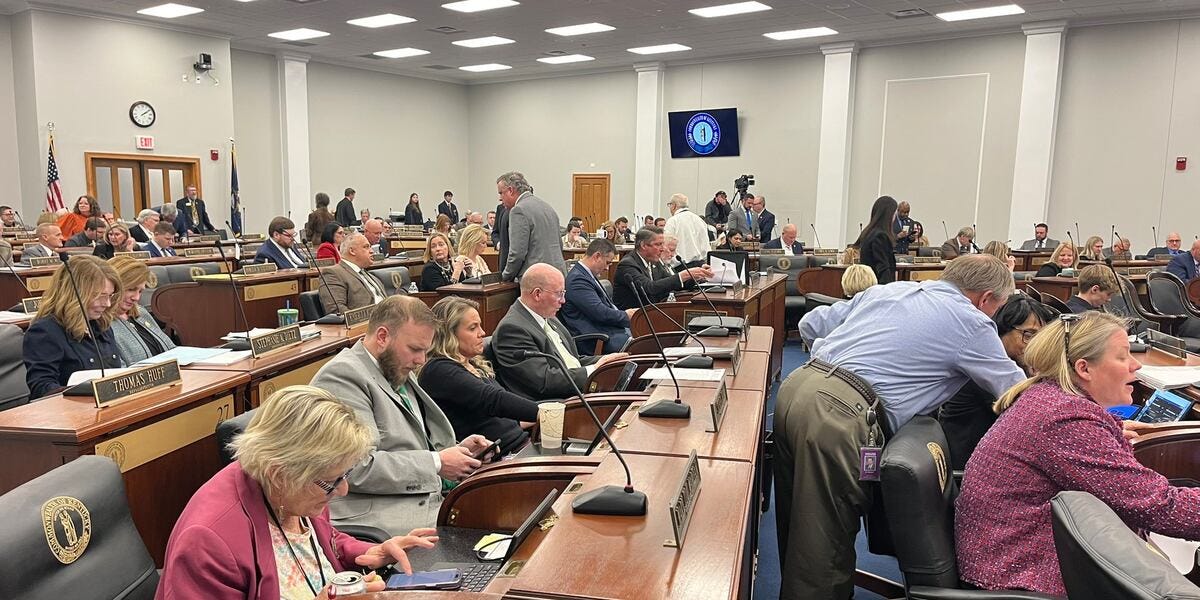
On a morning committee agenda posted to the Kentucky Legislative Research Commission website, members of the Kentucky House Appropriations and Revenue Committee convened to consider a revised version of the Commonwealth’s two-year executive branch budget bill. The measure, House Bill 6, carries a price tag of approximately $31 billion across fiscal years 2026 and 2027.
Before the full amended bill text was publicly accessible for line-by-line review on the Legislative Research Commission portal, the committee voted to advance the measure to the House floor.
The authority for that action lies in Section 46 of the Kentucky Constitution and the House Rules adopted at the beginning of the 2026 Regular Session of the Kentucky General Assembly. Under those rules, standing committees may adopt committee substitutes and amendments before a bill is posted in its final compiled form on the public website. The committee chair controls recognition and debate time. A majority vote is sufficient to report the bill favorably.
In this case, members were working from a committee substitute that revised prior budget language negotiated between House leadership and the office of Governor Andy Beshear. The substitute included updated revenue estimates and appropriations across cabinet agencies, including the Cabinet for Health and Family Services, the Kentucky Department of Education, and the Justice and Public Safety Cabinet.
The committee vote moved the bill from the Appropriations and Revenue Committee to the Rules Committee and then to the House calendar, accelerating its path toward a full House vote.
Committee Substitute Language and Access to Bill Text
Kentucky’s budget bills originate in the House and are typically introduced as shell bills that are later replaced with full appropriations language through committee substitutes. The Legislative Research Commission posts bill text at https://apps.legislature.ky.gov/record/26RS/HB6.html once filed or amended, but there can be intervals between committee distribution of substitute language and the public upload of a compiled, formatted version.
During the committee meeting in question, members referenced a revised budget draft that incorporated adjustments to revenue forecasts from the Consensus Forecasting Group and changes to line-item appropriations. Those changes reportedly addressed school SEEK funding allocations, Medicaid growth estimates, and capital construction authorizations.
The governing statute for state budgeting is KRS 48.010 through KRS 48.950, which outlines the executive branch budget submission process and the General Assembly’s authority to amend, reduce, or condition appropriations. The governor submits a proposed budget in even-numbered years under KRS 48.100. The House may adopt a substitute that alters those proposals before sending the bill to the Senate.
When substitute language circulates internally before a public posting, legislators and staff have access to draft documents distributed through committee packets. Members of the public rely on the LRC website and posted PDFs. The lag between committee consideration and full public upload reduces the window for outside review of specific line items, provisos, and fund transfers.
In practical terms, a county judge-executive, a school superintendent in Jefferson County Public Schools, or a hospital administrator in Oldham County would need the final text to evaluate appropriations affecting SEEK distributions, Medicaid reimbursement rates, or capital projects. If the committee vote occurs before that text is publicly searchable, those local officials have limited time to analyze changes before floor debate begins.
SEEK Formula Adjustments and Education Funding Lines
One of the central components of Kentucky’s biennial budget is the Support Education Excellence in Kentucky formula, known as SEEK. The formula is codified in KRS 157.310 through KRS 157.440 and determines per-pupil funding allocations to local school districts.
The revised budget reportedly adjusted the per-pupil base and incorporated updated attendance and property tax assessments affecting districts across the Commonwealth. Jefferson County Public Schools, Fayette County Public Schools, and smaller districts such as Oldham County Schools depend on those calculations to finalize their own budgets.
Under House procedures, committee members may adopt an amendment that changes SEEK appropriations by reference to updated revenue estimates. Those changes carry forward into the engrossed bill.
Without immediate public posting of the full substitute text, district finance officers and school board members lack the ability to verify how the adjustments affect their specific allocations. While committee summaries may describe overall increases or decreases, the detailed tables and formula adjustments determine district-level impacts.
Kentucky’s Constitution, Section 171, requires the General Assembly to provide for an efficient system of common schools. The annual appropriations for SEEK are the operational mechanism through which that constitutional duty is funded.
Medicaid Line Items and Cabinet for Health and Family Services Appropriations
The Cabinet for Health and Family Services administers Kentucky Medicaid under federal authority granted by Title XIX of the Social Security Act and state enabling statutes in KRS Chapter 205. Medicaid expenditures represent one of the largest portions of the state budget.
The revised $31 billion budget included updated projections for Medicaid enrollment, federal matching rates, and state general fund contributions. Those figures influence provider reimbursement, managed care contracts, and eligibility administration.
Changes to Medicaid line items can include adjustments to hospital reimbursement pools, behavioral health funding, and administrative staffing within the Department for Medicaid Services. Hospitals in Louisville, Lexington, and rural counties review those numbers to plan staffing and capital expenditures.
If the committee substitute adjusted the general fund contribution or assumed savings from policy changes, those details would appear in appropriation language and budget memoranda. Until the full text is publicly posted, stakeholders must rely on verbal summaries presented during committee proceedings.
The committee’s authority to amend those line items stems from its jurisdiction over revenue and appropriations under House Rule 52. The Senate later has authority to propose further changes through its own committee substitute.
Capital Construction Authorizations and Bonding Authority
Kentucky’s biennial budget includes capital construction projects funded through bonds or direct appropriations. Those projects may include university buildings at the University of Kentucky, improvements at Eastern Kentucky University, or state park upgrades managed by the Tourism, Arts and Heritage Cabinet.
Bonding authority is governed by KRS Chapter 56 and by specific appropriations language authorizing the State Property and Buildings Commission to issue bonds. Any changes to capital project authorizations alter debt service obligations in future fiscal years.
The revised committee substitute reportedly updated certain capital project lists and bonding caps. Such changes require detailed review by university boards of trustees, local contractors, and municipal bond analysts.
When a committee adopts revised capital language before public upload, outside analysts cannot immediately compare project lists to prior drafts. The difference between authorizing a project in fiscal year 2026 versus fiscal year 2027 affects bidding timelines and construction schedules.
The House vote does not finalize bonding authority. The Senate may revise the capital plan, and differences are resolved in conference committee. Still, the committee vote establishes the House’s official position.
Rules Committee Placement and Floor Vote Timeline
After the Appropriations and Revenue Committee reported House Bill 6 favorably, the measure moved to the House Rules Committee. The Rules Committee schedules floor consideration under House Rule 54.
Once placed on the Orders of the Day, the bill may receive three readings as required by Section 46 of the Kentucky Constitution. The House may adopt additional floor amendments before final passage.
The Senate then considers its own committee substitute through the Senate Appropriations and Revenue Committee. Differences between House and Senate versions are resolved in a conference committee, whose report must be adopted by both chambers.
Under Kentucky’s legislative calendar, the budget must pass before the end of the regular session to avoid the need for a special session called by the governor. The proximity of the committee vote to key legislative deadlines increases the pace of deliberation.
Prior Instances of Accelerated Budget Deliberation
Kentucky has seen compressed budget timelines in previous sessions. In 2022, the General Assembly advanced a budget bill during the final days of session with limited time for public review before conference committee adoption. In 2024, supplemental budget adjustments were adopted late in session following revenue forecast updates.
In each instance, the procedural mechanism was the same: committee substitutes adopted under House and Senate rules, followed by rapid floor action and conference committee reports.
The governing documents are publicly available on the Legislative Research Commission website, including House Rules, Senate Rules, and conference committee reports. The recurring feature in those sessions was limited time between substitute adoption and final votes.
What Happens Next in the Budget Process
The immediate next step is full House floor debate and vote. Amendments may be offered, and members may request division of questions on specific line items. Once passed by the House, the Senate will consider its own version.
If the Senate adopts changes, a conference committee will reconcile differences. The conference report must be posted and adopted by both chambers. The governor then has authority under Section 88 of the Kentucky Constitution to sign the bill, veto it in whole, or exercise line-item veto authority.
Local governments, school districts, and state agencies monitor each stage because final enactment sets their funding levels for the next two fiscal years.
Suggested Actions for Readers
Readers who wish to review the budget language can monitor the Legislative Research Commission website for the most recent version of House Bill 6 and committee substitutes. Watching archived committee meetings and floor sessions provides context for amendments and debate. Contacting local representatives and senators before final passage allows constituents to raise questions about specific appropriations.
County officials, school board members, and nonprofit leaders may request written fiscal notes or explanations from legislative staff once the full text is available.
Further Reading
Kentucky Legislative Research Commission – House Bill 6 (2026 Regular Session): https://apps.legislature.ky.gov/record/26RS/HB6.html
Kentucky Revised Statutes Chapter 48 (State Budget Act): https://apps.legislature.ky.gov/law/statutes/chapter.aspx?id=372
KRS 157.310–157.440 (SEEK formula statutes): https://apps.legislature.ky.gov/law/statutes/chapter.aspx?id=379
KRS Chapter 205 (Public Assistance and Medicaid): https://apps.legislature.ky.gov/law/statutes/chapter.aspx?id=381