
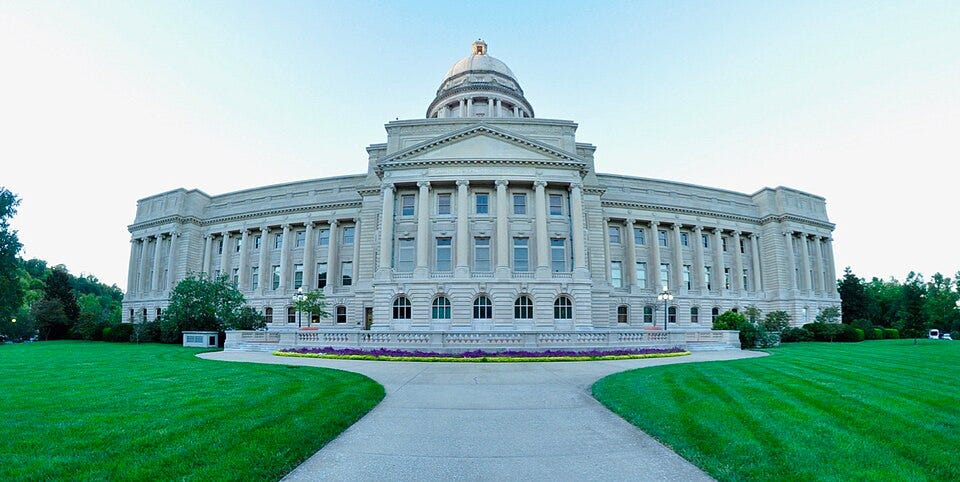
Two years ago, Kentucky voters rejected a constitutional amendment that would have given the General Assembly broader authority to provide financial support for the education of students outside the state’s common-school system. Now Kentucky is preparing to participate in a new federal scholarship tax-credit program that can help pay eligible K-12 educational expenses for students in public and nonpublic settings, including private, parochial, church and home-based schools.
The two mechanisms are not legally the same. But the sequence matters. After voters rejected one route for expanding state authority, Kentucky lawmakers affirmatively chose a different federal pathway.
Amendment 2 would have changed Kentucky’s Constitution to explicitly allow the General Assembly to provide financial support for students outside the common-school system. Voters rejected it decisively on Nov. 5, 2024, with 1,302,466 voting no and 707,819 voting yes.
That result did not prohibit every possible future form of support for nonpublic education. What voters refused was the proposed expansion of the legislature’s constitutional authority.
Then Congress changed the policy landscape.
In July 2025, Public Law 119-21 created Section 25F of the federal tax code. Beginning in 2027, eligible taxpayers may claim a nonrefundable federal income-tax credit of up to $1,700 a year for cash contributions to qualifying scholarship-granting organizations, commonly called SGOs. Those organizations distribute scholarship funds for eligible K-12 educational expenses under the federal program.
But Congress did not automatically enroll Kentucky. State participation is voluntary.
Kentucky’s General Assembly chose to participate through House Bill 1 during the 2026 legislative session, over Gov. Andy Beshear’s veto. Lawmakers did not recreate the same state tax-credit mechanism previously struck down by the courts. Nor did they obtain the constitutional authority proposed in Amendment 2.
They opted Kentucky into a new federal mechanism.
That distinction helps explain how Kentucky could act. It also shifts the public-interest question. If Kentucky chose to join the program, what rules did the state put around it? Who will control the scholarship money? What will the public be able to see?
The timing creates the political tension. Less than two years after Kentucky voters refused to expand the legislature’s constitutional authority to support education outside the common-school system, lawmakers approved participation in a program capable of supporting many of those same educational choices.
Beshear criticized HB 1 as contrary to the political message voters had sent through Amendment 2. That is a political and democratic-accountability argument, not an established legal conclusion.
Supporters of HB 1 have a substantive answer to that comparison: this is not Kentucky spending state tax dollars on private schools.
The transaction begins with a taxpayer who makes a cash contribution to an eligible scholarship organization. If the contribution and organization satisfy federal requirements, the taxpayer may claim a nonrefundable federal income-tax credit of up to $1,700. The scholarship organization then distributes qualifying funds to eligible students for approved educational expenses.
The distinction is real.
Section 25F reduces federal income-tax liability, not Kentucky income-tax liability. Kentucky is not appropriating General Fund money to pay the credit, and legislative fiscal staff concluded that HB 1 is not expected to reduce Kentucky General Fund revenue.
Kentucky’s earlier constitutional decisions do not, by themselves, resolve the legality of this federal-credit structure.
In 2022, the Kentucky Supreme Court invalidated the state’s Education Opportunity Account program, which used a Kentucky income-tax credit, under Section 184 of the state Constitution. The court again enforced constitutional restrictions involving the common-school system in a February 2026 charter-school funding case.
Those decisions show the limits Kentucky courts have placed on state financing outside the common-school system. They do not establish that HB 1 is unconstitutional. Section 25F works differently because the tax credit is federal.
That legal difference does not make the 2024 vote politically irrelevant.
Scholarships under the federal program can support qualifying educational expenses in settings outside Kentucky’s traditional public-school system. Kentucky’s proposed implementation rule recognizes educational settings that include private, parochial, church and home-based schools, along with public common schools and other qualifying settings, subject to federal requirements.
The legal route changed. The broader school-choice debate did not.
That is the democratic-accountability question at the center of Kentucky’s decision. Lawmakers may have the authority to opt into a federal program that did not exist when voters considered Amendment 2. But when government adopts a new mechanism that advances a related policy objective after voters rejected a broader grant of authority, the public has reason to ask how that power is being used and what protections come with it.
There is no ambiguity about Kentucky’s role.
The General Assembly enacted HB 1 and elected the Commonwealth into the federal program. The law designates the Kentucky Secretary of State as the sole state official responsible for reporting that election and submitting Kentucky’s list of scholarship-granting organizations to the federal government.
Secretary of State Michael Adams executed Kentucky’s advance election for 2027 on July 22, and the IRS now identifies Kentucky as a participating state.
Congress created the opportunity. Kentucky government opened the door.
Kentucky also runs the process for deciding which organizations make it onto the state’s list.
Proposed regulation 30 KAR 1:060 would require an organization seeking inclusion to provide an IRS determination letter, a sworn declaration, and a $15 filing fee. But making the state list would not, by itself, establish that the organization satisfies every federal Section 25F requirement.
And the rule is still proposed. Its requirements could change before becoming final.
The organizations ultimately included on Kentucky’s submitted list will play a significant role in the program.
Federal law sets rules for how SGOs must operate, how they distribute scholarships and which students may receive them. They are private organizations, not state agencies. But they will serve as intermediaries between contributors and scholarship recipients.
That makes oversight more than a paperwork issue.
Congress created the tax benefit. Kentucky opted in. Private organizations will handle the scholarship stage.
The question is no longer simply whether Kentucky could participate. It is what Kentucky requires of the organizations through which the program will operate.
Some safeguards are already part of Kentucky’s proposed approach.
Organizations seeking participation would make sworn eligibility declarations. Participating organizations would later be required to obtain annual compliance audits from certified public accountants addressing core federal requirements.
The proposed rule also makes those compliance audits subject to the Kentucky Open Records Act, while protecting personally identifiable student information.
Those provisions create identifiable ways for the public to examine the program. But the Kentucky rule is not final, and federal regulations remain pending.
Lawmakers also considered safeguards that did not become part of enacted HB 1.
Legislative proposals included requirements concerning an in-state office for scholarship organizations, nondiscrimination protections for participating schools, and annual demographic and financial reporting to the Legislative Research Commission.
Their absence does not prove the program will discriminate, hide information or operate improperly. It does show that Kentucky had choices about what accountability to require, and not every proposed safeguard became law.
That makes implementation the next test.
How much will Kentuckians be able to learn about the organizations on the state’s list? How much scholarship money will they distribute? Which schools and services will benefit? What will the audits show? Will the public have enough information to judge whether the safeguards are working?
The answers will depend on final federal rules, Kentucky’s final regulation, public records, future audits and any additional reporting requirements lawmakers or regulators put in place.
There are also consequences that cannot yet responsibly be claimed.
Kentucky’s SEEK funding formula is sensitive to student attendance, so future enrollment changes could eventually affect school-district funding. But Section 25F scholarships have not begun.
There is no evidence yet that the program has caused Kentucky public schools to lose students, reduced SEEK funding, increased private-school enrollment or produced any particular geographic or demographic pattern.
Those are questions to investigate once evidence exists, not conclusions to write in advance.
Kentuckians do not have to wait until 2027 to pay attention.
The proposed 30 KAR 1:060 rule is scheduled for a public hearing on Oct. 27, with written comments accepted through Oct. 31. Readers can follow the final regulation, watch the Secretary of State’s list of scholarship organizations, seek public records and, when available, compliance audits created through the process.
They can also compare what eventually happens with the safeguards lawmakers chose to require and the ones they left out.
Amendment 2 did not legally settle every future question about education funding. Section 25F did not erase the political significance of what Kentucky voters decided.
The more immediate question now is what Kentucky does with the authority it chose to exercise.
Kentucky chose this program. Kentuckians should be able to see who benefits, how the money moves, and whether the safeguards work.
Sources
Kentucky General Assembly — House Bill 1, 2026 Regular Session
Legislative history, enacted legislation, veto and veto override, fiscal materials, and proposed amendments.
https://apps.legislature.ky.gov/record/26rs/hb1.html
Kentucky Legislative Research Commission — Proposed 30 KAR 1:060
Kentucky’s proposed rules for Scholarship Granting Organization filings, annual listings, compliance audits, public-record requirements, and the public-comment process.
https://apps.legislature.ky.gov/law/kar/titles/030/001/060/
Internal Revenue Service — Federal Scholarship Tax Credit
Federal information on Section 25F, participating states, taxpayer eligibility, Scholarship Granting Organizations, and Kentucky’s participation.
https://www.irs.gov/government-entities/federal-state-local-governments/federal-scholarship-tax-credit-fstc
U.S. Congress — Public Law 119-21
Federal law establishing Section 25F and the federal scholarship tax credit.
https://www.congress.gov/119/plaws/publ21/PLAW-119publ21.pdf
U.S. Department of the Treasury — Federal Scholarship Tax Credit implementation
Treasury information concerning implementation of Section 25F and forthcoming federal regulations.
https://home.treasury.gov/news/press-releases/sb0527
Kentucky State Board of Elections — 2024 General Election Results
Official Kentucky election results for Constitutional Amendment 2.
https://elect.ky.gov/results/2020-2029/Pages/2024.aspx
Kentucky Supreme Court — Commonwealth ex rel. Cameron v. Johnson, Education Opportunity Account litigation
Kentucky Supreme Court decision concerning the Education Opportunity Account tax-credit program and Section 184 of the Kentucky Constitution.
https://apps.courts.ky.gov/Supreme/SC_Opinions.shtm
Kentucky Court of Justice — Kentucky Supreme Court opinions
Official source for Kentucky Supreme Court decisions, including the February 2026 charter-school funding decision discussed in this article.
https://apps.courts.ky.gov/Supreme/SC_Opinions.shtm