
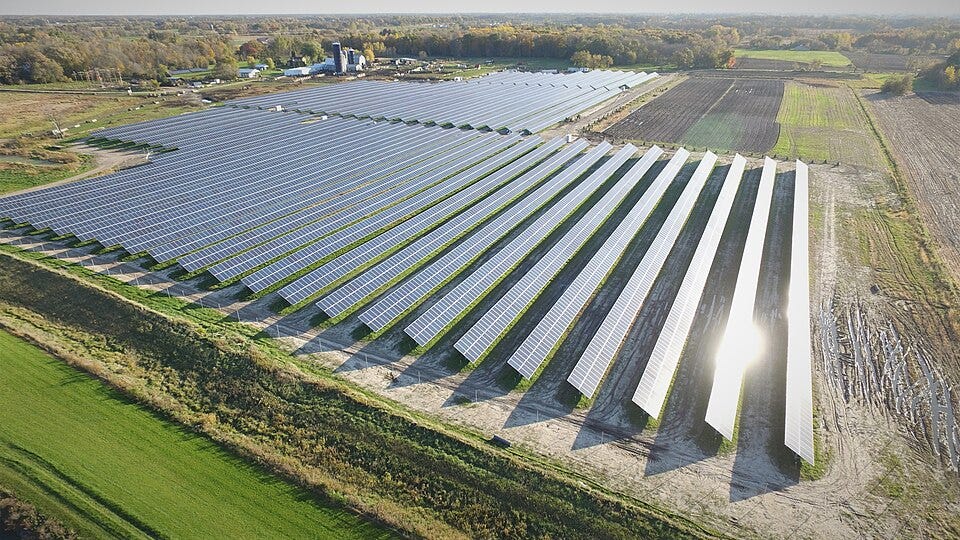
On May 29, 2026, the Kentucky Court of Appeals reversed a Breckinridge Circuit Court ruling and invalidated two Breckinridge Fiscal Court ordinances aimed at regulating the Clover Creek Solar Project, also known as New Frontiers Solar Park. The appellate court said the county could not use its general fiscal court authority to impose land-use rules on the project without complying with Kentucky’s planning and zoning statutes.
The ruling clears the way for Clover Creek Solar Project LLC and participating landowners to proceed under a construction certificate issued by the Kentucky State Board on Electric Generation and Transmission Siting.
That certificate allows an approximately 100-megawatt merchant solar facility in Breckinridge County, along with an approximately 460-foot nonregulated transmission line, subject to mitigation measures ordered by the Siting Board.
For my Kentucky readers, the important lesson goes beyond a single solar project.
A fiscal court can pass an ordinance. A county can object to a project. Residents can speak at public meetings.
But when Kentucky law assigns authority to a state siting board and gives special priority only to local planning and zoning rules adopted through the proper channel, a county ordinance may not carry the legal force local residents expect.
The ruling turned on planning and zoning
Clover Creek Solar Project LLC, doing business as New Frontiers Solar Park, sought state approval to build a large solar project near Hardinsburg in Breckinridge County. EDP Renewables describes New Frontiers Solar Park as its first solar park in Kentucky, located on privately owned land that has historically been used for farming or cattle grazing.
Breckinridge Fiscal Court had already adopted a solar ordinance in 2022. In early 2025, while the state siting case was pending, the Fiscal Court adopted Ordinance 2025-0121, which repealed and replaced the earlier ordinance with more detailed local requirements. The 2025 ordinance included site-plan approval by the Fiscal Court, public-hearing requirements, setback rules, screening, lighting restrictions, road-maintenance provisions, decommissioning requirements, compliance with airport approach zones, and other controls.
The county argued that its ordinance had priority over the state siting certificate. The Breckinridge Circuit Court agreed in July 2025 and ruled that Clover Creek had to comply with the county ordinance to build the project.
The Court of Appeals disagreed. It held that the county’s solar ordinances operated as zoning regulations, even though the county had not created or used the planning-and-zoning process required by KRS Chapter 100. The court emphasized that KRS 278.704 gives priority to setback and decommissioning rules established by a planning-and-zoning commission, not to any ordinance a fiscal court chooses to pass under general home-rule authority.
Breckinridge County’s own ordinances page notes that the county does not have planning and zoning, whereas Cloverport, Hardinsburg, and Irvington do within their city limits.
The Siting Board certificate now carries the project
Kentucky has a state board for merchant electric generating facilities. The Kentucky State Board on Electric Generation and Transmission Siting reviews projects like this one under KRS 278.700 and related statutes. The board’s role includes reviewing applications, holding hearings, setting mitigation measures, and issuing or denying construction certificates.
Clover Creek filed its application in Case No. 2024-00253. The Siting Board held a local public comment meeting in Breckinridge County on December 9, 2024, and a formal hearing on March 20, 2025. The board issued its final order on May 2, 2025.
The Siting Board conditionally granted the certificate. Its order required compliance with mitigation measures, including status reports every six months until the project begins generating electricity. The order also included conditions tied to road repairs, complaint resolution, setbacks, decommissioning, construction management, and notice before construction.
Kentucky law does leave room for local rules. The Court of Appeals did not say counties have no role. The court said the legal route matters. Under KRS 278.704, local setback and decommissioning requirements take priority when established by a planning and zoning commission. Under KRS 67.083, fiscal courts have broad home-rule authority, but planning, zoning, and subdivision control are governed by KRS Chapter 100.
Breckinridge Fiscal Court tried to regulate the project without that planning-and-zoning structure in place. The Court of Appeals treated that choice as a legal defect.
Fiscal Court acted, but state law controlled
Before the Court of Appeals’ ruling, the county had a circuit court order stating that its 2025 ordinance controlled. After the appellate ruling, that protection is gone unless further review changes the outcome.
Clover Creek and participating landowners may proceed under the Siting Board certificate rather than the county’s stricter ordinance. Local residents who oppose the project or want stronger conditions now have to look to the Siting Board certificate, any future court action, and any lawful county planning and zoning steps that Breckinridge County may take.
The project itself is large enough to affect local roads, nearby properties, emergency planning, land-use expectations, and county politics. The Siting Board order identifies two residential neighborhoods within 2,000 feet of project facilities and eight churches within two miles. The approved project is expected to involve roughly 12 to 18 months of construction.
That does not mean every local concern was ignored. The state certificate includes mitigation measures. But the Court of Appeals ruling means Breckinridge Fiscal Court cannot enforce these particular solar ordinances against the project as if they were valid planning-and-zoning rules.
Local control depends on the legal route
Kentucky counties are facing more land-use conflicts tied to energy, data centers, industrial development, agriculture, roads, utilities, and private investment. The Clover Creek ruling gives those disputes a sharper legal question: did the local government use the authority Kentucky law actually recognizes?
A fiscal court is an elected county body. Residents often look to the fiscal court first when a development project affects farmland, traffic, drainage, views, noise, property values, local tax revenue, or emergency services. But fiscal courts do not automatically have unlimited land-use authority.
The Breckinridge case shows the gap between political authority and legal authority.
The Fiscal Court had the political role of responding to local concerns. The Siting Board had statutory authority over the merchant solar certificate. A planning-and-zoning commission would have been the local body Kentucky law specifically recognizes for setback and decommissioning rules, but Breckinridge County did not have one.
That distinction matters for any Kentucky county trying to regulate solar. A county may be able to write local rules, but the timing, legal authority, ordinance language, public process, and planning-and-zoning framework can determine whether those rules survive in court.
The money is visible, but some terms remain confidential
EDP Renewables says New Frontiers Solar Park represents more than $200 million in capital investment. The company’s project page estimates approximately $7 million in payments to local governments, $35 million to landowners, 250 to 300 construction jobs, multiple permanent jobs, and millions in local spending. Those are company-provided estimates and have not been confirmed by independent public records.
The financial benefits are not evenly distributed.
Participating landowners may receive lease payments. The company may profit from electricity generation and power sales. Local governments may receive tax revenue. Construction workers and local vendors may see short-term economic activity.
Nonparticipating neighbors may incur different costs: altered rural views, construction disruption, road concerns, uncertainty about decommissioning, and reduced confidence in county officials’ ability to enforce local restrictions. The Siting Board certificate attempts to address some of those concerns through mitigation conditions, but local residents will need to monitor compliance rather than assume the county ordinance will do the work.
The PSC docket also shows confidential treatment orders tied to lease terms and to the material terms of power purchase agreements. That limits what the public can see without further disclosures, court filings, or public records work.
What you can do next
Ask the Fiscal Court whether the county will seek discretionary review from the Kentucky Supreme Court. Also, ask whether the county plans to create a lawful planning and zoning process for future projects.
Read the Siting Board docket for Case No. 2024-00253 and track post-case correspondence. Clover Creek must file status reports every six months until the project begins generating electricity, and those reports should show whether the project is moving toward construction.
Compare the Siting Board’s mitigation measures with what you observe on the ground. Document road conditions before construction, keep records of complaints, and ask how the complaint-resolution program will work once construction begins.
Ask your fiscal court a specific question before the next major solar, battery, data center, or industrial project appears: Does the county have planning and zoning, and are local land-use rules adopted under KRS Chapter 100?
County officials can review model solar zoning resources before conflict reaches litigation.
Kentucky Resources Council has published solar policy resources, including a model solar zoning ordinance intended to help localities regulate siting through the correct local framework.
Sources
Kentucky Court of Appeals, Clover Creek Solar Project LLC d/b/a New Frontiers Solar Park v. Breckinridge County Fiscal Court, May 29, 2026
https://law.justia.com/cases/kentucky/court-of-appeals/2026/2025-ca-0983-mr.html
Kentucky Public Service Commission / Siting Board docket, Case No. 2024-00253
https://psc.ky.gov/Case/ViewCaseFilings/2024-00253
Kentucky Siting Board final order, Case No. 2024-00253, May 2, 2025
https://psc.ky.gov/pscscf/2024%20Cases/2024-00253//20250502_PSC_ORDER.pdf
Breckinridge County, Ordinance 2025-0121, Solar Energy Systems
https://breckinridgeky.com/wp-content/uploads/2025/12/Solar-Energy-Systems-Ordinance-2025-0121.pdf
Breckinridge County, Ordinance 2022-0321, Solar Energy Systems
https://breckinridgeky.com/wp-content/uploads/2023/07/Ordinance-2022-0321-Solar-Energy-Systems.pdf
Breckinridge County ordinances page
https://breckinridgeky.com/ordinances/
Kentucky Revised Statutes, KRS 278.704
https://apps.legislature.ky.gov/law/statutes/statute.aspx?id=54023
Kentucky Revised Statutes, KRS 278.718
https://apps.legislature.ky.gov/law/statutes/statute.aspx?id=54027
Kentucky Revised Statutes, KRS 67.083
https://apps.legislature.ky.gov/law/statutes/statute.aspx?id=23691
Kentucky Revised Statutes, KRS 278.702
https://apps.legislature.ky.gov/law/statutes/statute.aspx?id=54022
EDP Renewables, New Frontiers Solar Park
https://edp.com/en/north-america/na/projects/new-frontiers-solar-park
Kentucky Resources Council, Solar policy resources
https://kyrc.org/policy/solar/