
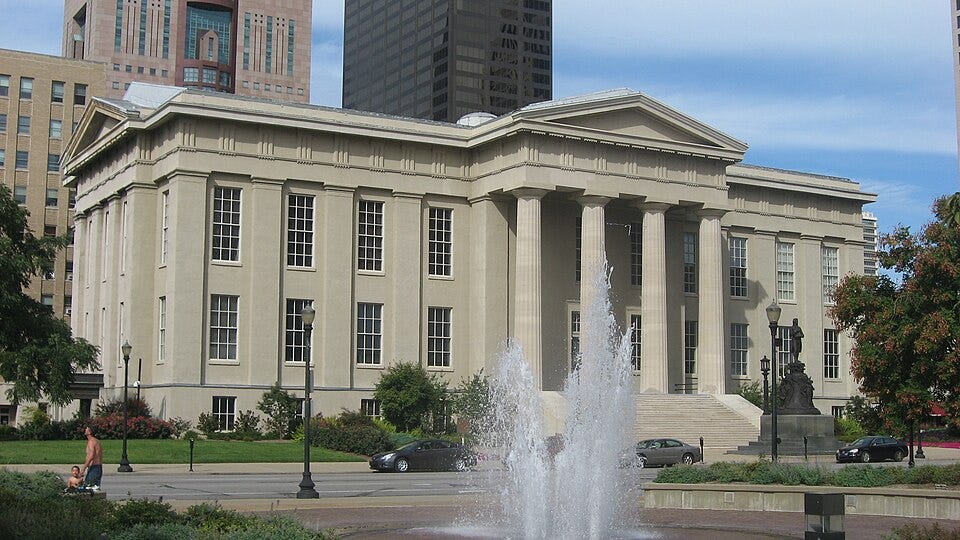
A Jefferson County judge has ruled that Kentucky’s unlawful camping law is unconstitutional.
The ruling came in the case of Michael Williams, a 33-year-old man cited under the law after Louisville Metro Police officers found him lying on a sidewalk under an overpass. According to Louisville Public Media, Jefferson County District Judge Stephanie Burke dismissed the charge with prejudice, which means the Jefferson County Attorney’s Office cannot refile that citation against him.
The ruling does not automatically strike the law down statewide. It does not bind every judge in Kentucky. It does not erase every unlawful camping citation already pending in district court.
But it changes the public conversation around the law.
Kentucky’s unlawful camping statute is no longer only a debate over homelessness policy, public space, or the Safer Kentucky Act. It is now a constitutional question: can the state use police and courts to punish people for sleeping outside when homelessness leaves them with no clear lawful place to sleep?
This case shows how the statute works in practice
Kentucky’s unlawful camping statute was created through House Bill 5, the 2024 law widely known as the Safer Kentucky Act.
The statute, now KRS 511.110, says a person commits unlawful camping when they knowingly enter or remain on a street, sidewalk, area under a bridge or underpass, path, park, cemetery, or other public pedestrian or vehicle area with the intent to sleep or camp there, unless the area has been designated for that purpose or the person has authorization.
A first offense is a violation. A second or later offense, or refusing to stop during a first offense, can become a Class B misdemeanor.
That is the formal legal language. The case before Judge Burke showed what that language can mean in practice.
Williams was not accused of violence. He was not accused of damaging property.
He was cited because police believed he was sleeping in a place where Kentucky law said he could not sleep.
Louisville Public Media reported that Williams’ public defender argued the law is vague, gives police too much discretion, and punishes people for being homeless. Judge Burke agreed, finding constitutional problems under both the Kentucky Constitution and the U.S. Constitution.
The constitutional question begins with a basic human need
At the center of the ruling is a direct question: can Kentucky punish a person for sleeping outside when that person has nowhere else to go?
Sleep is not optional. A person can be told to move from one sidewalk, one underpass, one park, or one public space. But if there is no available shelter, no lawful place to rest, and no private space to enter, the person does not stop needing sleep.
Louisville Public Media reported that Judge Burke found the law effectively punishes the status of being homeless when it criminalizes involuntary conduct necessary to sustain human life.
That is why this case carries significance beyond one citation.
The law is not limited to tents or campsites. It can apply to a person lying under an overpass or resting on a sidewalk because there is nowhere else to go. In practice, it can make visible poverty, exhaustion, and homelessness the starting point for police intervention.
The ruling also questioned the amount of discretion the law gives police. That is where the legal problem becomes sharper.
A person walking on a sidewalk may be allowed to remain. A person lying on that same sidewalk may be cited.
The difference can turn on an officer’s interpretation of intent.
This law turns homelessness into a criminal enforcement issue
This issue is often described as a homelessness story. It is that, but it is also a policing and courts story because Kentucky is using citations, court dates, and possible misdemeanor charges to address where people sleep when they have no housing.
The chain is straightforward: state law, police discretion, citation, court involvement, and possible misdemeanor consequences.
That means the law can pull people experiencing homelessness into the criminal legal system for conduct tied directly to survival.
The question is not whether cities can manage public space. Cities do have legitimate public-health, safety, sanitation, and access concerns. The question is whether criminal punishment becomes the default tool when housing, shelter, and services are inadequate.
Kentucky does not create housing by criminalizing sleep.
It creates a legal pathway that can leave people with citations, court dates, fines, warrants, and criminal records while they remain unhoused.
Vague enforcement weakens public accountability
Laws should be clear enough that people know what is prohibited. Enforcement should have visible limits. Police power should not depend on vague assumptions about who someone is, why they are in public, or whether their exhaustion looks like criminal intent.
When a statute gives officers broad room to infer that someone intends to sleep or camp, enforcement can become uneven.
One person may be told to move along. Another may be cited. Another may miss court and face a warrant. The public may not know whether shelter was available, whether alternatives were offered, or whether enforcement differed by neighborhood.
That is how a vague law weakens accountability. It becomes harder to see who is being targeted, why they were cited, and whether enforcement is being applied consistently.
Judge Burke’s ruling does not answer every statewide question. But it does place a warning marker on the statute: if the law gives police too much discretion and punishes people for unavoidable conduct, the legal problem cannot be brushed aside as a technicality.
Kentucky has already used this law across the state
The Kentucky Center for Economic Policy reported that from July 15, 2024, to July 2, 2025, there were 425 unlawful camping citations in district court across 30 Kentucky counties. Those included 393 first offenses, 27 second or subsequent offenses, and five refusal-to-cease cases.
KyPolicy also reported that first-offense charges were concentrated in Jefferson County, followed by Fayette, Boyd, and Daviess counties.
That means Kentucky’s unlawful camping law has already become part of local enforcement across the Commonwealth. The ruling in Jefferson County applies to one case for now, but the underlying constitutional question sits beneath every similar citation.
If this law remains in force, local governments and courts will continue facing the same basic question: what happens when a person is cited for sleeping outside because there is no place else to go?
Shelter capacity is part of the legal and moral question
Any serious discussion of the camping ban has to include shelter availability.
The Homeless and Housing Coalition of Kentucky has warned that HB 5 makes sleeping and camping in public areas illegal even when there are no shelter beds available, or no shelters at all.
That point is especially important outside Kentucky’s largest cities. Louisville and Lexington have more visible homelessness systems, even when those systems are strained. Smaller counties may have fewer shelter options, fewer outreach teams, less transportation, and fewer service providers.
In some communities, “go to a shelter” may not be a real option.
Even in Louisville, the system is under pressure. Louisville Public Media reported that Louisville’s 2025 point-in-time count identified 633 people not living in housing or temporary shelter, up from 595 the year before. LPM also reported that nearly 1,300 people across Kentucky were unsheltered during that period, based on Kentucky Housing Corporation data, a 25% year-over-year increase.
Those numbers show why enforcement cannot be separated from capacity.
A citation does not create a shelter bed.
A court date does not create a housing voucher.
A misdemeanor does not make someone safer, healthier, or housed.
The Attorney General has the next major decision
The next major decision belongs to the Kentucky Attorney General’s Office.
Louisville Public Media reported that the Attorney General’s Office defended the law in court and said it is determining next steps. The office did not specifically answer whether it plans to appeal.
That decision could determine whether this ruling remains a limited Jefferson County decision or becomes part of a broader appellate fight.
If the Attorney General appeals, the constitutional question could move to a higher court. A ruling from the Kentucky Court of Appeals or Kentucky Supreme Court could shape enforcement beyond one case.
If the Attorney General does not appeal, Judge Burke’s ruling remains important but limited. Other judges may find it persuasive, but they are not automatically bound by it.
That makes the next step legal, political, and public.
Kentuckians can ask whether the state should keep defending a law that allows police to cite people for sleeping outside when they have nowhere else to go.
Local governments do not have to wait for an appeal
The Attorney General is not the only decision-maker.
Local police departments decide whether to issue citations. County attorneys decide how to handle cases. District judges decide individual outcomes. Mayors, metro councils, city councils, and fiscal courts decide how much money goes toward shelter, outreach, housing, and enforcement.
Every local government that enforces this law should now be asked what it plans to do after Judge Burke’s ruling.
Will police departments pause citations?
Will prosecutors continue pursuing cases?
Will courts review pending cases differently?
Will local officials document whether shelter was available before someone was cited?
Will cities and counties fund housing and services at the level the problem requires?
Those are practical questions. They do not require waiting for a statewide appellate ruling.
A law can remain on the books while local officials still choose how aggressively to use it.
Actions readers can take
Ask the Attorney General whether he will appeal.
The direct question is: “Will the Attorney General appeal Judge Stephanie Burke’s ruling that Kentucky’s unlawful camping law is unconstitutional?”
Ask your local police department whether it is still enforcing KRS 511.110.
Request any updated enforcement guidance issued after the Jefferson County ruling.
Ask your county attorney or local prosecutor how unlawful camping cases will be handled.
The key question is whether pending cases will continue while the statute is under constitutional challenge.
Ask your city council, metro council, or fiscal court for local citation data.
Request the number of unlawful camping citations, repeat citations, failures to appear, bench warrants, dismissals, fines, and referrals to services.
Ask whether shelter availability is checked before someone is cited.
If no bed is available, residents should ask why criminal enforcement is still being used.
Ask local officials what housing or service option exists instead of citation.
That should include emergency shelter, permanent supportive housing, outreach teams, transportation, ID support, mental-health care, addiction treatment, and case management.
Support organizations doing direct work.
Groups such as the Coalition for the Homeless Louisville, Homeless and Housing Coalition of Kentucky, St. John Center, VOCAL-KY, ACLU of Kentucky, and local shelters or outreach teams are already working where policy becomes lived reality.
File open records requests.
Useful records include citation data, police enforcement guidance, encampment-clearing policies, body-camera footage, communications about sweeps, shelter-referral policies, court outcomes, and contracts or grants tied to diversion programs.
The question Kentucky has to answer
Judge Burke’s ruling does not end the debate over Kentucky’s unlawful camping law.
It makes the debate more concrete.
Kentucky lawmakers wrote a statute that allows police to cite people for sleeping or camping in public places. Local officers have enforced it. Public defenders have challenged it. A Jefferson County judge has now ruled that, at least in one case, the law crossed a constitutional line.
The state can appeal. The legislature can revisit the statute. Local governments can change enforcement practices. Courts can continue to test the law case by case.
But the basic question will remain.
If a person has no home, no shelter bed, and no lawful place to sleep, what exactly does Kentucky expect that person to do?
Direct sources
Louisville Public Media: “Jefferson County judge’s ruling challenges constitutionality of unlawful camping ban”
https://www.lpm.org/news/2026-05-05/jefferson-county-judge-challenges-constitutionality-of-unlawful-camping-ban
Kentucky Revised Statutes: KRS 511.110, “Unlawful camping”
https://apps.legislature.ky.gov/law/statutes/statute.aspx?id=55449
Kentucky Legislative Research Commission: 2024 Regular Session, House Bill 5
https://apps.legislature.ky.gov/record/24rs/hb5.html
Kentucky Center for Economic Policy: “One Year Of House Bill 5: Hundreds of Unhoused Kentuckians Have Been Cited for ‘Unlawful Camping’”
https://kypolicy.org/house-bill-five-unlawful-camping/
Kentucky Housing Corporation: K-Count Results
https://www.kyhousing.org/Data-Library/Pages/K-Count-Results.aspx
Louisville Public Media: “Federal funding shift threatens to increase homelessness in Kentucky”
https://www.lpm.org/news/2025-11-24/federal-funding-shift-threatens-to-increase-homelessness-in-kentucky
Homeless and Housing Coalition of Kentucky: State Priorities
https://www.hhck.org/state-priorities
ACLU of Kentucky: “HB 5 - ‘Safer’ Kentucky Act”
https://www.aclu-ky.org/legislation/hb-5-safer-kentucky-act/
Coalition for the Homeless Louisville: Street Tips and resource guide
https://louhomeless.org/current-street-tips/