
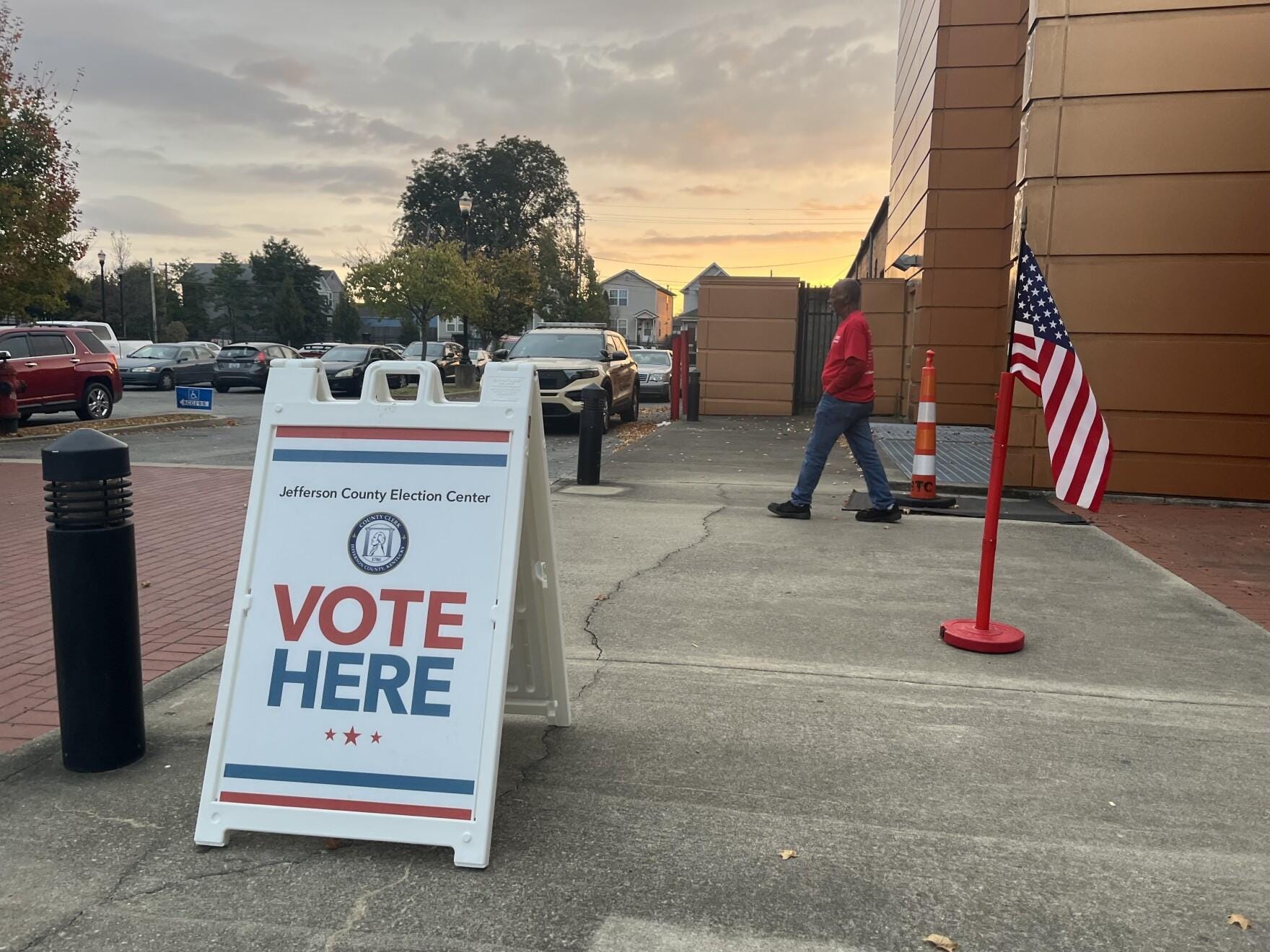
In February, ICE said it would not be in Kentucky polling places. Other states got the same answer.
Kentucky Secretary of State Michael Adams was among the election officials to confirm this on Twitter. Based on information the Department of Homeland Security gave to state election officials, suggestions to the contrary were “disinformation.”
Seven months later, the answer was different.
On September 1, however, Attorney General Markwayne Mullin said ICE would not conduct “polling place” evacuations and patrols, but ICE could respond to incidents or distress signals from polling places, or serve process in an absconder case.
“If we’re serving a warrant,” Mullin said, ICE “will be where we need to be.”
DHS said it had no plans to implement operations to investigate or assess polling place activities. It said it could conduct enforcement and/or response activities based on the threat or risk posed to personnel or the polling place.
So far, the U.S. Government has not undertaken a plan to carry out nationwide polling place enforcement activities or to send ICE personnel to polling places to conduct citizenship voter inspections. No ICE operations are known to target polling places in Kentucky.
The U.S. Government has changed its position regarding ICE’s presence at polling places.
A categorical assurance that ICE would not be at polling locations has given way to an assertion that ordinary federal enforcement authority can, under certain circumstances, follow agents to an active voting location.
A federal law restricts the presence of armed federal personnel at elections.
A law designed to keep armed federal officers away from elections
This controversy is principally tied to 18 U.S.C. § 592.
This statute prohibits any federal employee, whether civilian or military, from ordering, disposing of, or having custody of any ‘troops’ or ‘armed men’ in the place of any election. The exceptions to this rule are if the troops are needed to subdue armed enemies of the United States.
This statute applies only to ordinary process.
Other challenges to this administration’s interpretation of the statute exist. The Justice Department’s regulations, policies, and practices have often strictly construed this statute.
One regulation states that, in general, no federal law enforcement personnel, including members of the FBI and U.S. Marshals may carry weapons and/or conduct law enforcement activities within a polling place. This regulation has been revised and is currently contained in the Justice Department’s internal regulations (the Justice Manual). The Manual directs that a representative of the Public Integrity Section be consulted if the issue involves permitting armed federal law enforcement personnel.
The law was once broader in what it permitted. It previously contained an exception allowing federal forces to “keep the peace at the polls.” Congress removed that exception in 1909.
That history creates a sharp legal question around DHS’s new position. Mullin acknowledges that immigration officers can serve warrants and effect arrests at polling places for reasons other than those enumerated in the exception in section 592 and what has traditionally been the Justice Department’s position.
Courts have not determined that DHS’s position is unlawful.
A complaint, filed on September 10, by LULAC and other organizations, requests that a federal district court in Washington, D.C., prohibit what the organizations consider to be DHS’s policy concerning activities of armed DHS personnel at polling places, and enjoin DHS from taking certain law enforcement actions within a specified distance of a polling place. The complaint does not state that DHS has adopted a specific position concerning polling places. DHS’s statements are firmly grounded in the law. In interpreting Section 592, the plaintiffs’ views have not been judicially considered and therefore carry no legal weight.
Important boundaries are also unsettled. The available record does not answer precisely what it means under § 592 for armed officers to be “at” a place where an election is being held, or how the law applies when an enforcement action unexpectedly moves into a polling-place parking lot.
Events during the 2026 election cycle illustrate how different interactions between Immigration and Customs Enforcement (ICE) personnel and polling locations can be.
Three polling sites, three different circumstances
On three separate occasions during the same election, ICE and the Texas Department of Public Safety responded to situations in polling-location parking lots.
A person drove to a Bexar County library polling location, parked, and left their vehicle. There is no evidence the person attempted to enter the polling place or otherwise interfered with election activities. Neither Bexar County officials nor Sheriff Salazar said this person was being investigated for any voter- or election-related offenses. According to Salazar, federal authorities were not directed to Bexar County libraries. The presence of an ICE officer near a polling location does not, by itself, indicate that ICE is conducting election-related activities.
ICE’s activities in Simi Valley, California, are unexplained. On June 2, 2022, media reports confirmed ICE activity at a vote center. ICE activities at the vote center, and the reason for ICE’s presence, remain unexplained. Other states have also documented ICE at polling locations.
One of the more egregious examples was documented in New York during that state’s primary election, when two ICE officers entered a polling location to question a poll worker about a social media post. No disruption was ongoing at the polling location when the two ICE officers entered. DHS has provided no evidence of a nationwide initiative to deploy ICE to polling locations during the primary elections.
Those incidents do not demonstrate a coordinated national program to deploy ICE at polling places. DHS denies planning operations targeting polling sites, and a senior department official said ICE officers had received no special Election Day instructions beyond their ordinary duties.
DHS says those ordinary duties can sometimes extend to a place where people are actively voting.
The missing rules
What remains unknown is how that authority would work in practice.
Again, policy documents describing these “other duties” and how ICE/DHS personnel would be instructed to act if they find themselves at a polling location are lacking.
The available record does not establish how DHS defines a polling place for enforcement purposes, what type of warrant could justify entry, what supervisory approval would be required, whether election officials would receive advance notice, how close armed agents could operate to voters, or whether legal review under § 592 must occur before an operation proceeds.
Those missing details matter because DHS’s public description is broader than the exception written into § 592, while the Justice Department’s own guidance has historically treated armed federal presence at open polls as restricted.
An unanswered Freedom of Information Act lawsuit could provide additional information on DHS’s plans to expand its law enforcement authority. Democracy Forward Foundation sued DHS to obtain records describing any plans or directives by DHS/ICE to deploy officers to polling locations, to determine whether DHS/ICE produced the records as required.
The lawsuit does not describe an existing directive. Records responsive to the request could describe the DHS/ICE’s interpretation of the law and the extent of the direction it has provided its personnel.
The Sept. 10 federal lawsuit provides another route to an answer. The plaintiffs are seeking declaratory and injunctive relief under the Administrative Procedure Act and § 592. A court could eventually determine whether the authority DHS has claimed is compatible with the federal restriction on armed officials at elections.
For now, that legal question remains open.
Kentucky was part of the first assurance—not the later implementation
Kentucky played a role in the earliest stages of the described events, but the record has a gap as to whether Kentucky election officials received any directions about ICE’s activities.
Adams, Kentucky’s Secretary of State, participated in the federal election-official briefing and publicly confirmed the February assurance that ICE would not be present at voting locations.
Kentucky election officials do not have documented procedures addressing the presence of, or cooperation with, federal law enforcement officers in enforcing civil immigration warrants. Therefore, it is unclear what, if anything, Kentucky election officials would do in response to the service of a civil immigration warrant on a person located in a voting room.
Kentucky law does, however, give election officials responsibility for controlling voting rooms and maintaining order.
KRS 117.235 generally restricts who may enter a voting room while voting is underway. It also gives election officials authority over access for purposes including maintaining order and enforcing the law, while precinct officers, county clerks and law-enforcement officials have responsibilities for election law and order around polling places.
That leaves Kentucky with a practical question that neither the state materials nor the federal government’s public statements answer: What happens if armed federal immigration agents seek to enter an active Kentucky voting room to execute a civil immigration warrant?
The reporting does not answer it.
Nor does it establish that Kentucky officials have received instructions for such an encounter since DHS changed its public position.
Preparation is already happening. Suppression has not been established.
The possibility of encounters with federal agents has already changed election preparation in some places.
The Denver election administration has revised its training and created a response plan to potentially encounter federal law enforcement officers. Change in Election Protection resources and training, as well as changes in election observer behavior have all been alluded to in the lawsuit filed by Common Cause, LULAC, and UnidosUS.
Those organizational claims remain allegations in the litigation where they have not been independently corroborated.
The potential effect on voters requires another distinction.
An armed immigration-enforcement action at an active polling site could cause confusion, interrupt normal election administration, and frighten some eligible voters, particularly people with personal or family exposure to immigration enforcement. The actual encounters and contingency planning make that a foreseeable concern rather than a purely abstract one.
But the available evidence does not establish how many eligible voters, if any, have stayed home because of ICE. It does not establish measurable turnout suppression in the 2026 election. And it does not establish that DHS adopted its policy to intimidate voters.
What has been established is a change in federal policy position at a place where Congress imposed an unusually specific safeguard.
In February, state election officials were told there would be no ICE presence at polling locations. In September, the DHS secretary said they could be targeted in deportation efforts.
Now, courts will decide how broad that power can be. Public records requests may help determine whether DHS has established regulations for that power. Public-records litigation may reveal whether DHS has written rules governing how it is supposed to be used.
Election officials in Kentucky have different questions. They want to know whether any federal officials have told them what happens if that power is exercised in a Kentucky voting location.
So far, no records or other communications from the feds have been located.
DHS has publicly preserved an enforcement power at polling places without publicly establishing the operational boundaries that would reconcile it with a federal law designed to restrict armed federal presence where Americans vote.
Sources
League of United Latin American Citizens v. U.S. Department of Homeland Security, No. 1:26-cv-03157 (D.D.C.)
Public Rights Project case page and complaint materials:
https://www.publicrightsproject.org/what-we-do/legal-advocacy/lulac-v-dhs-2/
Litigation Tracker: Legal Challenges to Trump Administration Actions
Just Security. Includes the Sept. 10, 2026 filing in League of United Latin American Citizens v. U.S. Department of Homeland Security, the plaintiffs’ claims under 18 U.S.C. § 592 and the Administrative Procedure Act, and the relief requested.
https://www.justsecurity.org/107087/tracker-litigation-legal-challenges-trump-administration/
18 U.S.C. § 592 — Troops at Polls
U.S. House of Representatives, Office of the Law Revision Counsel, U.S. Code:
https://uscode.house.gov/view.xhtml?req=granuleid:USC-prelim-title18-section592
Democracy Forward Foundation v. U.S. Department of Homeland Security et al., No. 1:26-cv-02624 (D.D.C.)
Federal docket listing for the FOIA litigation seeking records concerning potential ICE presence at polling places:
https://dockets.justia.com/docket/district-of-columbia/dcdce/1%3A2026cv02624/294872
ICE’s Presence at Polls Records Challenge
Democracy Docket case page summarizing the Democracy Forward FOIA litigation and providing the complaint:
https://www.democracydocket.com/cases/ices-presence-at-polls-records-challenge/
Justice Department to Conduct Election Monitoring for Massachusetts Primary Election
U.S. Department of Justice, Sept. 1, 2026. Describes the Civil Rights Division’s election-monitoring program and its deployment of DOJ personnel to polling locations:
https://www.justice.gov/opa/pr/justice-department-conduct-election-monitoring-massachusetts-primary-election
Justice Department to Conduct Election Monitoring in New Hampshire Primary Election
U.S. Department of Justice, Sept. 8, 2026. Describes DOJ monitoring and preparations for monitoring during the 2026 midterm general election:
https://www.justice.gov/opa/pr/justice-department-conduct-election-monitoring-new-hampshire-primary-election
Justice Department to Conduct Election Monitoring in Rhode Island Primary Election
U.S. Department of Justice, Sept. 9, 2026. Describes the department’s primary-election monitoring and its intention to continue monitoring through the midterm general election:
https://www.justice.gov/opa/pr/justice-department-conduct-election-monitoring-rhode-island-primary-election
Voting Section
U.S. Department of Justice, Civil Rights Division. Describes the Voting Section’s authority and federal voting-rights statutes it enforces:
https://www.justice.gov/crt/voting-section
Trump administration sued over threat to deploy federal law enforcement at voting sites
The Guardian, Sept. 18, 2026. Reports DHS’s post-Sept. 10 statement that ICE was not planning operations targeting polling locations, the circumstances DHS said could lead to enforcement at a polling location, and DOJ’s statement concerning federal law enforcement at polling locations:
https://www.theguardian.com/us-news/2026/sep/18/trump-administration-sued-federal-law-enforcement-voting
Election officials prepare for chaos as Trump seeks to tilt the midterms to Republicans
Reuters, Sept. 15, 2026. Reporting on election officials’ preparations for possible federal activity and other disruptions surrounding the 2026 midterm elections:
https://www.reuters.com/investigations/election-officials-prepare-chaos-trump-seeks-tilt-midterms-republicans-2026-09-15/