
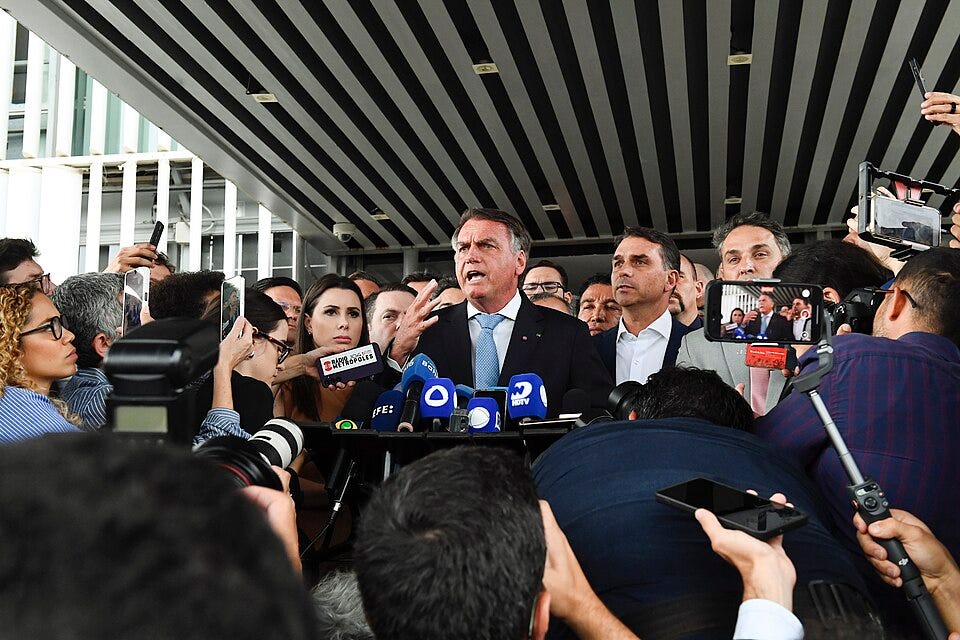
On Saturday, Reuters revealed that two senior State Department officials had reportedly spent more than a year trying to help Jair Bolsonaro’s family regain political power in Brazil.
They weren’t merely expressing support for a foreign political leader. According to the investigation, they used their government positions to push for American sanctions and other measures intended to weaken Brazilian President Luiz Inácio Lula da Silva and strengthen the Bolsonaro family.
The investigation, published October 24, was based on interviews with 10 current and former U.S. officials with direct knowledge of the effort.
A day later, Brazilians went to the polls. On Sunday, October 25, Brazil’s electoral authority declared Lula the winner of the presidential runoff against Jair Bolsonaro’s son, Flávio.
The election is over. But the American government’s role in trying to influence it remains a serious question.
What the State Department officials reportedly did
The two officials identified by Reuters are Darren Beattie, a senior adviser overseeing Brazil policy, and Ricardo Pita, another State Department adviser who was promoted to deputy assistant secretary for North America.
Both were political appointees in President Donald Trump’s administration.
According to Reuters, Beattie and Pita told American diplomats in Brazil that U.S. policy was to restore Jair Bolsonaro to the presidency.
That was an extraordinary position for American officials to take.
Bolsonaro had lost Brazil’s 2022 presidential election to Lula. He subsequently faced prosecution for attempting to overturn that result and was sentenced in September 2025 to 27 years in prison for plotting a coup.
Once his return to office became impossible, Reuters reported, the two American officials shifted their efforts toward his son, Senator Flávio Bolsonaro.
They reportedly instructed embassy personnel not to engage with other conservative presidential contenders who might compete with Flávio.
That detail is particularly revealing. American diplomats routinely maintain relationships with politicians across the political spectrum in another country. Directing them to avoid potential rivals of a favored candidate would serve a political objective rather than ordinary diplomatic engagement.
But the reported campaign went beyond diplomatic contacts.
American sanctions became part of the effort
In July 2025, the Treasury Department imposed sanctions on Brazilian Supreme Court Justice Alexandre de Moraes under the Global Magnitsky sanctions program.
The program allows the United States to impose financial restrictions on foreign officials implicated in serious human-rights abuses or corruption.
Moraes oversaw investigations into Jair Bolsonaro. The Trump administration accused him of suppressing free speech and censoring political expression.
The administration cited those allegations as its justification for the sanctions.
Reuters, however, reported that Beattie had contacted Treasury officials to advocate sanctions against Moraes while the Bolsonaro family was lobbying Washington for precisely that result.
In another episode, Pita encouraged officials to explore designating two powerful Brazilian criminal organizations, Primeiro Comando da Capital and Comando Vermelho, as foreign terrorist organizations.
The Bolsonaro family supported those designations, believing they would damage Lula politically by drawing attention to violent crime.
In May 2026, Flávio Bolsonaro met with Beattie and Deputy Secretary of State Christopher Landau in Washington to press for the designations. The State Department announced them the following day.
The two gangs are genuine criminal organizations, and the United States has legitimate interests in combating international crime. The administration also has the authority to impose sanctions on foreign officials when it meets legal requirements.
The question is whether officials exercised those powers for their stated purposes or because they believed the decisions would help their preferred candidate win an election.
Reuters could not determine precisely how much influence Beattie or Pita had over the final terrorist-designation decision.
It also could not establish whether President Trump or Secretary of State Marco Rubio had directed their reported political effort.
Those distinctions matter. The investigation provides substantial evidence of a political campaign inside the State Department, but it does not establish who approved every decision or whether any law was violated.
Some of the pressure failed
The American government’s actions did not produce all the results its reported advocates wanted.
Brazil’s Supreme Court continued prosecuting Jair Bolsonaro despite the sanctions and other American pressure.
The Trump administration also imposed sweeping tariffs on Brazilian goods and revoked visas for several Supreme Court justices. Reuters could not establish what role, if any, Beattie or Pita played in those additional measures.
The tariffs drew opposition from businesses that depend on trade between the two countries. Washington eventually reduced some of them.
According to political analysts cited by Reuters, the economic pressure also strengthened Lula’s domestic political standing rather than weakening it.
In December 2025, the United States removed Moraes from its sanctions list without a public explanation.
And in March 2026, Brazil barred Beattie from entering the country to visit Jair Bolsonaro in prison.
Those were meaningful developments.
The Brazilian court continued exercising its authority. Brazil prevented the American official from making the proposed visit. Economic opposition helped reduce tariffs.
None of those actions, however, answered the underlying question of why American officials had advocated the measures in the first place.
Now Lula’s reelection adds another result: the Bolsonaro family did not return to the presidency.
That does not prove the American effort had no effect on voters, or that every Brazilian institution successfully resisted political pressure. The election result establishes something narrower but important. The reported attempt to help Flávio Bolsonaro win did not achieve that outcome.
Congress had already started asking questions
American lawmakers were questioning the administration’s Brazil policy before Reuters published its investigation.
On October 7, Representative Gregory Meeks, the senior Democrat on the House Foreign Affairs Committee, and Representative Sydney Kamlager-Dove announced that they and 10 other lawmakers had asked Secretary of State Marco Rubio to explain the administration’s actions toward Brazil.
Their letter focused partly on the State Department’s decision to revoke the Brazilian ambassador’s diplomatic visa.
But it also raised broader questions about sanctions, contacts with the Bolsonaro family, and American officials’ efforts to question Brazil’s electoral system.
The lawmakers specifically asked whether senior State Department officials had authorized contacts with the Bolsonaro family about the ambassador’s visa and whether the White House was involved.
They requested written answers by October 20.
That deadline has passed.
As of October 25, I could not verify a public State Department response to the letter.
The congressional inquiry is a genuine accountability effort, but its results remain unestablished.
The lawmakers have formally requested information. There is not yet evidence that this inquiry has produced the internal records needed to explain the decisions.
The House Foreign Affairs Committee has jurisdiction over American foreign policy and can oversee the State Department. Its members can seek documents, question officials, and pursue hearings.
But Meeks is the ranking Democrat, not the committee chairman. He cannot independently compel every response or schedule a committee hearing. The Republican majority controls the committee’s formal proceedings.
That makes the next stage of congressional scrutiny especially important.
Will lawmakers obtain the communications showing why the sanctions were recommended, who approved them, and whether the administration considered their effects on Brazil’s election?
Or will the questions remain unanswered?
Why this matters in Kentucky, too
Kentucky has a connection to the congressional oversight.
Representative Andy Barr of Kentucky’s Sixth Congressional District serves on the House Foreign Affairs Committee.
As a committee member, Barr is positioned to examine the administration’s Brazil policy and participate in oversight proceedings.
I found no verified evidence that Barr has taken a position on the specific conduct described in Reuters’ October 24 investigation.
The issue is not whether an American official may favor a foreign political party or disagree with another country’s court.
Government officials have political beliefs, and American administrations regularly pursue policies that foreign governments oppose.
The concern is what happens when an official uses powers entrusted to the government for a different purpose.
Financial sanctions can isolate foreign officials from the American banking system. Terrorist designations can trigger serious financial and legal restrictions. Tariffs can disrupt businesses and national economies.
Those are substantial powers.
If officials recommend using them because they believe the consequences will help a particular politician win an election, the public has reason to ask whose interests the government is serving.
The question is not whether American officials may have political preferences. The question is whether they can turn government power into a tool for advancing those preferences.
What happens next
Americans can take one specific step.
The Democratic staff of the House Foreign Affairs Committee can be reached at (202) 225-5021.
Readers can ask whether the State Department responded to the October 20 deadline and whether the committee’s existing inquiry will now seek records concerning Beattie, Pita, and the sanctions decisions documented by Reuters.
The purpose is not simply to register disapproval. It is to encourage a committee already examining the matter to pursue specific evidence that could establish who authorized the decisions.
A phone call cannot force the release of documents or guarantee a congressional investigation.
But it can direct attention to a concrete oversight question that remains unanswered.
Brazil’s voters have made their decision. Lula will remain president, and the Bolsonaro family has not regained power.
What remains unresolved is the conduct of the American officials who reportedly tried to influence that outcome.
The administration has defended the sanctions as legitimate policy. Reuters has reported evidence of a different political purpose. Congress now has an opportunity to examine the records that could establish which explanation the evidence supports.
The election result cannot answer that question.
Only the government’s decision-making records, and the officials responsible for them, can.
Sources
Reuters, October 24, 2026. Inside the Trump-administration campaign to return Brazil’s Bolsonaro clan to power
Reuters, October 25, 2026, published October 26 UTC. Brazil’s Lula reelected president in runoff vote
House Foreign Affairs Committee Democrats, October 7, 2026. Meeks, Kamlager-Dove Push State Department for Answers on Brazil
Members of Congress, letter dated October 6, 2026. Letter to Secretary Rubio requesting answers by October 20
Members of Congress, September 24, 2026. Letter concerning U.S. actions toward Brazil’s elections
Office of the Clerk, U.S. House of Representatives. House Foreign Affairs Committee membership
House Foreign Affairs Committee Democrats. Official committee contact information