
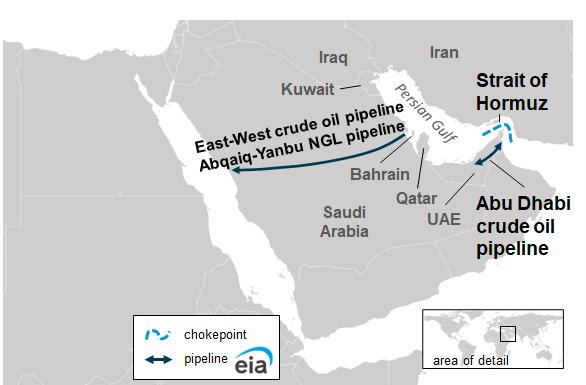
On Sunday, U.S. Central Command announced that it would begin enforcing a blockade of all maritime traffic entering and exiting Iranian ports at 10 a.m. Eastern on April 13. The order did not shut down all shipping through the Strait of Hormuz. CENTCOM said ships headed to and from non-Iranian ports would still be allowed to pass through the strait. But it was still a sharp escalation by the United States, issued after talks with Iran failed, and markets reacted immediately.
A military order with a price tag
The Strait of Hormuz is one of the most important oil chokepoints in the world. The U.S. Energy Information Administration says oil flow through the strait averaged 20 million barrels per day in 2024, equal to about 20 percent of global petroleum liquids consumption. So even a narrower U.S. action aimed at Iranian shipping can rattle global prices fast. Reuters reported that Brent crude jumped 7.4 percent to $102.23 a barrel and U.S. crude rose 7.6 percent to $103.88 after the announcement.
The narrow passage that moves the world
Kentucky is not making this decision, but Kentucky will feel it.
AAA’s Kentucky price tracker showed regular gas at $4.140 in Louisville, $4.050 in Bowling Green, and $4.007 in Elizabethtown-Fort Knox on April 13. Those are not abstract numbers. They show how quickly a military decision thousands of miles away can turn into higher commuting costs, higher delivery costs, and another squeeze on household budgets here at home.
The most direct reason is simple. Kentucky moves by truck. The Kentucky Trucking Association says the trucking industry supports 109,000 jobs in the state, carries 76 percent of total manufactured tonnage, and that 89.2 percent of Kentucky communities depend solely on trucks to deliver and move goods.
When fuel rises, the impact does not stop at the pump. It moves into food prices, retail costs, freight bills, and business expenses across the state.
The shock arrives at the pump
The pressure is even harder on households that were already stretched before this weekend. The Kentucky Energy and Environment Cabinet says the state’s average energy burden is 3 percent, but for low-income and disadvantaged communities it can be as high as 18 percent. In other words, many Kentuckians were already spending a large share of their income on energy before oil prices surged again. A jump in gasoline and diesel prices lands on top of rent, groceries, utilities, and child care, not in isolation.
The United States is not as directly dependent on Middle East Gulf crude as it once was. The Energy Information Administration says the region supplied 490,000 barrels per day of U.S. crude imports in 2025, about 8 percent of the national total. But that does not insulate Kentucky from the shock. Oil is priced in a global market. Even when the physical barrels are headed elsewhere, the price signal travels fast.
So who holds power here?
The people who can stop this from widening
President Donald Trump is the decision-maker who ordered the action, and CENTCOM is carrying it out. But Congress still holds the clearest constitutional check. The Senate’s own institutional guidance says the Constitution gives Congress the sole power to declare war, and that Congress continues to shape military policy through appropriations and oversight. That means the Kentucky pressure point is not Frankfort first. It is Kentucky’s congressional delegation, because those are the officials with authority to demand answers, hold hearings, challenge escalation, and shape whether this action expands further.
This is how a military escalation abroad turns into a cost-of-living problem at home. The market reaction has already begun. If this action stays in place or expands, the first effects are likely to show up in Kentucky through higher fuel prices, more expensive freight, and added pressure on households that were already stretched. What happens next depends on whether this remains a limited action against Iranian port traffic or becomes something broader, with even greater consequences for shipping, energy, and daily life.
What Kentuckians can do now
Call Kentucky’s U.S. senators and your House member and ask three direct questions: Do they support this action, what oversight are they demanding, and what limits do they believe Congress should impose on further escalation. The relevant power is federal, so that is the cleanest public pressure point.
Watch Kentucky gas prices over the next several days rather than treating this as a one-day spike. AAA’s state tracker is one of the simplest public tools for showing whether the effect is temporary or sustained.
If you work in trucking, farming, local retail, or community assistance, document what changes first. Fuel surcharges, delivery cost increases, canceled trips, and household hardship reports are often visible locally before they show up in official political language. The Kentucky trucking and energy-burden figures give a clear baseline for why those local observations matter.
Sources / Further Reading
U.S. Central Command, “U.S. to Blockade Ships Entering or Exiting Iranian Ports”
https://www.centcom.mil/MEDIA/PRESS-RELEASES/Press-Release-View/Article/4457255/us-to-blockade-ships-entering-or-exiting-iranian-ports/Reuters, “US military says it will start blockade of all ships going to and from Iran on Monday”
https://www.reuters.com/world/middle-east/us-military-says-it-will-start-blockade-all-ships-going-iran-monday-2026-04-12/Reuters, “Oil jumps more than 7% to above $102 ahead of US blockade on Iran”
https://www.reuters.com/business/energy/oil-bounces-back-above-100-after-us-iran-talks-end-stalemate-2026-04-12/U.S. Energy Information Administration, “Amid regional conflict, the Strait of Hormuz remains critical oil chokepoint”
https://www.eia.gov/todayinenergy/detail.php?id=65504U.S. Energy Information Administration, “The Middle East Gulf was source for 8% of 2025 U.S. crude oil imports”
https://www.eia.gov/todayinenergy/detail.php?id=67407AAA Kentucky gas prices
https://gasprices.aaa.com/?state=KYKentucky Trucking Association, advocacy facts
https://kytrucking.net/advocacy2Kentucky Energy and Environment Cabinet, Energy Affordability
https://eec.ky.gov/Energy/Programs/EnergyAffordability/Pages/default.aspxU.S. Senate, “About Declarations of War by Congress”
https://www.senate.gov/about/powers-procedures/declarations-of-war.htm