
I have been working on building a Resistance Effectiveness Framework - a structured way to evaluate different resistance tactics based on effectiveness, feasibility, risk level, and historical precedent. The idea being “Given a Trump action, what resistance action would be most effective against it?”
First, what does effective resistance mean in this context? Broadly, I decided to measure success by whether a strategy:
Prevents further authoritarian consolidation (e.g., stopping unconstitutional actions, preserving democratic processes).
Creates institutional pushback (e.g., courts, Congress, local governments refusing to comply).
Engages and mobilizes the public (e.g., increasing mass participation, ensuring protests aren’t easily ignored).
Weakens Trumpist power structures (e.g., economic pressure, factional splits, loss of key allies).
Builds alternative power structures (e.g., independent media, grassroots networks, underground organizing).
Next, I created a matrix where each resistance strategy is scored based on:
Effectiveness (1-10) – Does this action create a tangible impact?
Feasibility (1-10) – How easy is it to organize and execute?
Risk Level (1-10, inverted) – The higher the risk, the lower the score.
Historical Precedent (1-10) – Has this worked before under similar regimes?
Speed of Impact (1-10) – How quickly can it create meaningful resistance?
I assigned a weight to each category to reflect real-world importance. Weights can be adjusted based on strategic goals. For example, some actions are high-risk but high-impact, while others might be slow but foundational.
Next I tested several scenarios and came up with the following scoring system:
Resistance Strategy Scoring System
Each strategy will be evaluated on a 100-point scale, broken down as follows:
Effectiveness (35 points) – How much real-world impact does the action have in resisting authoritarianism?
Feasibility (25 points) – How easily can this strategy be organized and executed by individuals or groups?
Risk Level (15 points, inverted) – Higher risk lowers the score (e.g., violent crackdowns, legal retaliation).
Historical Precedent (15 points) – Have similar actions worked in comparable situations?
Speed of Impact (10 points) – Does it generate immediate effects, or does it take months/years to show results?
Weighting Rationale:
Effectiveness is weighted highest (35%) since real impact is the goal.
Feasibility (25%) ensures I can prioritize actions that can actually be implemented.
Risk (15%) prevents strategies that are too dangerous or self-defeating.
Historical Precedent (15%) helps me learn from past authoritarian resistance.
Speed (10%) accounts for urgency, but isn’t the main deciding factor.
I then ran the scoring system against a specific scenario:
Scenario Analysis: Trump's "Ensuring Accountability for All Agencies" Executive Order
Trump issued an executive order granting himself unprecedented authority over federal agencies—effectively bypassing Congress and the judiciary—this is a direct step toward authoritarian rule. The success or failure of resistance efforts depends on how key institutions, state governments, and the public respond.
Phase 1: Immediate Impact and Risks
What This Order Would Enable
Centralized Executive Power: Trump could override agency decisions, enforce loyalty, and dictate policy without legal oversight.
Purging Federal Employees: Bureaucrats who resist could be fired or replaced by loyalists.
Selective Law Enforcement: Agencies (DOJ, IRS, DHS, etc.) could be forced to investigate or ignore cases based on Trump’s political interests.
Judicial Bypass: By controlling compliance, the executive branch could effectively ignore court rulings, rendering legal challenges less effective.
State Pressure: Federal funds could be withheld from states resisting enforcement, coercing compliance.
Resistance Challenges
Speed of Impact: This order takes effect immediately, requiring a swift response.
Legal Roadblocks: While unconstitutional, legal challenges might be slow and unenforceable if Trump disregards the courts.
Federal Employee Risk: Resistance within agencies could result in mass firings.
State vs. Federal Power Struggles: Red states may comply, while blue states resist, creating a fragmented response.
Phase 2: Resistance Strategy Assessment
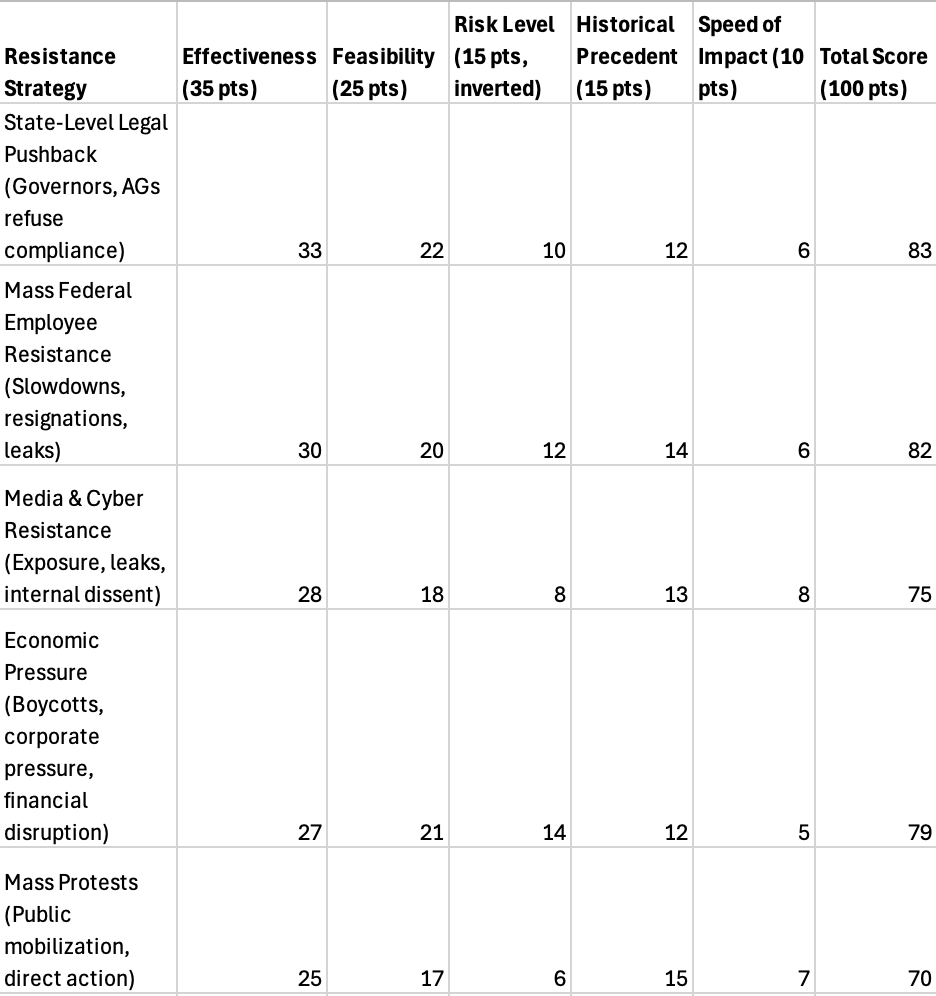
Using my resistance framework, I evaluated the most effective strategies under these conditions.
Top Resistance Strategies
Phase 3: Resistance Plan
Given these scores, the most effective resistance actions would be:
1. State-Level Legal & Institutional Resistance (Score: 83)
Governors & Attorneys General (AGs) challenge the order:
Democratic state AGs sue immediately and refuse to comply with any agency actions that bypass legal oversight.
State legislatures pass emergency laws refusing to cooperate with unconstitutional federal actions.
Refusal to enforce directives at the state and local level (e.g., refusing to comply with federal investigations or arrests).
Coalitions between blue states create a unified legal blockade.
Potential Weakness: If Trump refuses to recognize legal rulings, lawsuits alone may be insufficient.
2. Mass Federal Employee Resistance (Score: 82)
Key federal employees slow down enforcement through bureaucratic resistance (delaying orders, stalling paperwork).
Leaks and whistleblower reports flood media exposing corruption and authoritarian actions.
Coordinated resignations of high-profile officials to make the takeover highly visible.
Potential Weakness: Employees who resist could be fired, and Trump could replace them with loyalists.
3. Economic & Corporate Pressure (Score: 79)
Targeted economic boycotts against businesses supporting Trump's power grab.
Corporate lobbying against the order due to instability and risk to financial markets.
State-level economic pushback, such as divesting from federal contracts.
Potential Weakness: Corporate pushback is only effective if financial interests are threatened.
4. Media & Cyber Resistance (Score: 75)
Mass exposure of the executive order’s consequences through independent media.
Encryption & underground communications to protect organizers from surveillance.
Exposing corruption by leaking insider documents and agency dissent.
Potential Weakness: Trump could attempt to crack down on dissent by restricting press freedoms.
5. Mass Protests & Public Mobilization (Score: 70)
Nationwide strikes and civil disobedience to disrupt daily operations.
Occupation of government buildings and mass demonstrations.
Coordinated campaigns similar to the Women’s March or BLM protests.
Potential Weakness: Protests are powerful but risk violent repression if Trump orders militarized crackdowns.
Phase 4: Execution Plan – Best Resistance Path
If this scenario unfolds, the most effective course of action would be a two-pronged approach:
Institutional Resistance (Governors, AGs, federal employees, and corporations refusing compliance).
Public Resistance (Protests, economic boycotts, media exposure, and underground organizing).
Critical First Moves (First 72 Hours)
✅ State governors and AGs issue immediate statements rejecting the order
✅ Federal employees start leaking internal communications and delaying enforcement
✅ Corporate allies are pressured to denounce the move
✅ Mass protests are organized, but strategically, to avoid violent crackdowns
✅ Cyber networks are established to protect dissenting voices
If legal institutions fail, economic and underground resistance must intensify. The goal would be to create a constitutional crisis that forces a reckoning before authoritarian rule is cemented.
Final Assessment
🚨 Chance of Successfully Resisting the Executive Order?
➡ HIGH if legal institutions hold.
➡ MEDIUM if legal challenges fail but resistance escalates.
➡ LOW if Trump consolidates power before resistance builds.
🚨 Most Immediate Threat?
➡ Federal purges and mass firings before resistance organizes.
🚨 Best Hope for Long-Term Resistance?
➡ Institutional defiance + economic pressure + mass public mobilization.
I also wanted to do a historical comparison to past authoritarian takeovers.
Historical Comparisons: Executive Power Grabs & Resistance Efforts
Trump’s "Ensuring Accountability for All Agencies" executive order would mark a major shift toward authoritarianism, but similar power grabs have occurred in other countries. Below are historical case studies where leaders expanded executive power, how resistance movements responded, and the effectiveness of those efforts.
1. Adolf Hitler – Germany (1933-1945)
Power Grab: The Reichstag Fire & The Enabling Act
After the Reichstag Fire (1933), Hitler declared a national emergency, blaming communists.
Passed the Enabling Act, allowing him to rule by decree, bypassing the Reichstag (parliament).
Purged opposition politicians, silenced courts, and replaced civil servants with loyalists.
Resistance & Effectiveness
✅ Legal Pushback: Some political parties and civil servants initially resisted but were quickly suppressed.
✅ Public Protests: Early dissent (e.g., student-led White Rose movement) was brutally crushed.
✅ Underground Organizing: Anti-Nazi networks (e.g., the German resistance, churches, unions) had limited success due to fear and surveillance.
✅ Military & Internal Defections: The July 20, 1944 assassination attempt on Hitler failed due to poor coordination.
🚨 Why Resistance Failed
Too slow to organize: By the time mass resistance formed, Hitler had full control of institutions.
Judiciary was neutered: Courts complied, eliminating legal challenges.
Brutal repression: Dissenters were executed or sent to concentration camps.
🔴 LESSON: If opposition doesn’t act quickly, authoritarianism can solidify before resistance builds.
2. Viktor Orbán – Hungary (2010-Present)
Power Grab: Erosion of Democratic Institutions
Orbán’s Fidesz party gained control in 2010, rewrote Hungary’s constitution to weaken checks and balances.
Took over media, courts, and electoral commissions to ensure long-term dominance.
Used economic leverage to suppress opposition (e.g., blocking funding for universities and media).
Resistance & Effectiveness
✅ Legal Challenges: Courts tried to push back, but judicial independence was dismantled.
✅ State-Level Pushback: Local governments (Budapest) resisted, but national power overwhelmed them.
✅ Public Protests: The 2018 mass protests against judicial takeovers had little impact.
✅ International Pressure: EU sanctions and economic penalties have slowed authoritarian expansion, but not reversed it.
🚨 Why Resistance Struggled
Fidesz controlled the courts, making legal challenges ineffective.
Media captured early, preventing mass awareness of authoritarianism.
Opposition fragmented, allowing Orbán to divide and conquer.
🟠 LESSON: State-level pushback can slow authoritarianism, but not stop it alone. Resistance must be coordinated.
3. Augusto Pinochet – Chile (1973-1990)
Power Grab: Military Coup & Dictatorship
Overthrew elected President Salvador Allende in a military coup.
Suspended the constitution, dissolved Congress, and ruled by decree.
Used extreme state violence (mass arrests, torture, disappearances).
Resistance & Effectiveness
✅ International Pressure: The U.S. (later) and the UN condemned the dictatorship, leading to sanctions.
✅ Grassroots Organizing: Trade unions, churches, and students built underground resistance.
✅ Economic Pressure: Strikes and boycotts weakened Pinochet’s economic model.
✅ Mass Protests: 1983-88 saw increasingly large protests, forcing him to hold a referendum.
✅ Legal & Electoral Pushback: 1988 plebiscite voted Pinochet out, forcing a return to democracy.
🚨 Why Resistance Worked
Broad, coordinated movement: Labor unions, churches, and youth movements united.
Global attention & economic pressure hurt the regime’s ability to govern.
Organized underground resistance ensured continued pushback.
🟢 LESSON: A combination of economic pressure, public protests, and legal defiance can be effective against authoritarian rule—but only if the movement is well-organized.
4. The United States – Nixon’s Power Grab (1970s)
Power Grab: Abuse of Federal Agencies
Nixon used federal agencies (FBI, IRS) against political opponents.
Created "enemies lists" to target dissenters.
Ordered illegal wiretaps on journalists and activists.
Resistance & Effectiveness
✅ Congressional Investigations: The Watergate scandal led to impeachment proceedings.
✅ Media Exposure: Journalists (Woodward & Bernstein) exposed corruption, turning public opinion.
✅ Internal Leaks: Deep Throat (Mark Felt) leaked critical information, undermining Nixon’s power.
✅ Legal Pressure: Courts upheld subpoenas, forcing Nixon to hand over evidence.
✅ Mass Public Backlash: Polls turned against Nixon, leading to his resignation in 1974.
🚨 Why Resistance Worked
Institutions still functioned: Courts and Congress remained independent.
Internal dissent: Even Republicans abandoned Nixon once public pressure mounted.
Media had freedom: Investigative journalism kept the public informed.
🟢 LESSON: Authoritarian power grabs can be reversed if institutions hold and public pressure builds quickly.
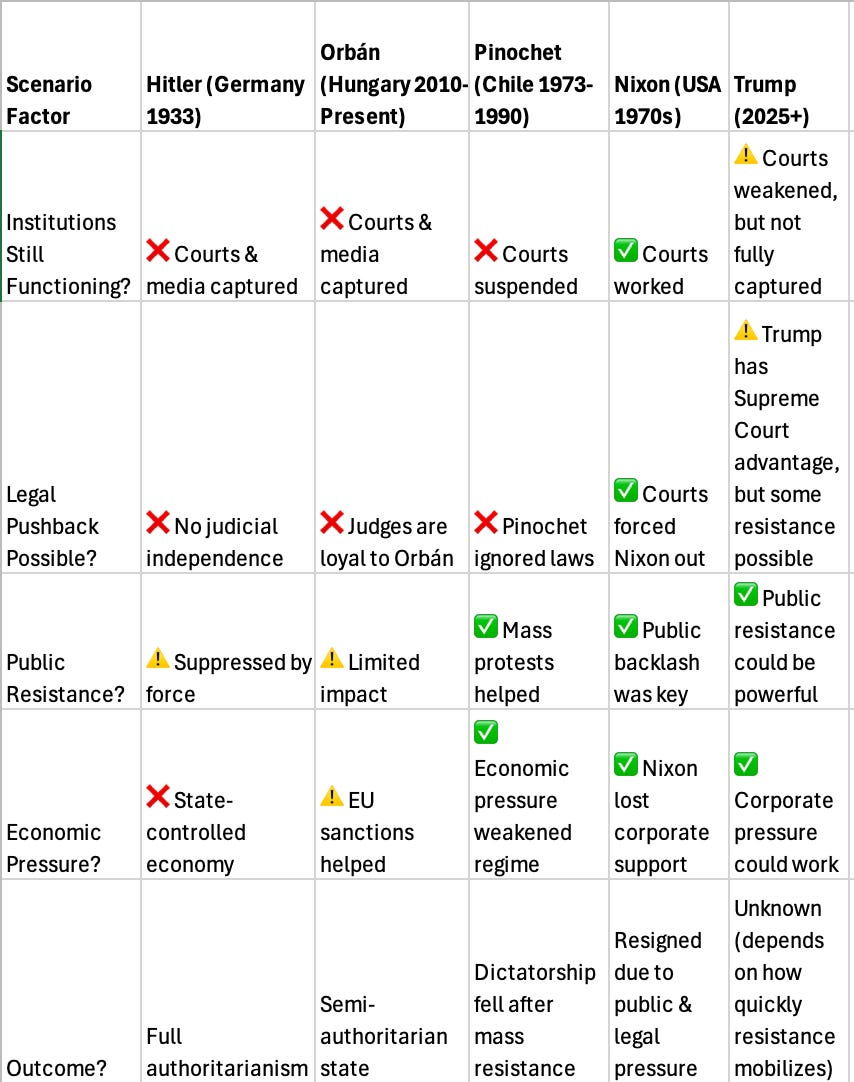
Comparative Analysis: Trump's Power Grab vs. Historical Cases
Final Takeaways for Resisting Trump's Power Grab
🔴 If resistance is too slow, U.S. institutions could be permanently altered (Germany, Hungary).
🟠 If opposition is fragmented, authoritarianism will be difficult to reverse (Hungary, early Chile).
🟢 If resistance mobilizes quickly through multiple channels, authoritarian rule can be weakened (Chile, Nixon).
📌 Key Actions for Effective Resistance:
Legal challenges must be immediate and highly visible.
Public pressure must escalate rapidly through mass protests and economic action.
Institutional actors (governors, courts, corporations) must refuse compliance early.
Leaks, media exposure, and international pressure must be used strategically.
If federal power becomes absolute, underground organizing will be necessary.
What do you think of this analysis? Any suggestions for improvement?