
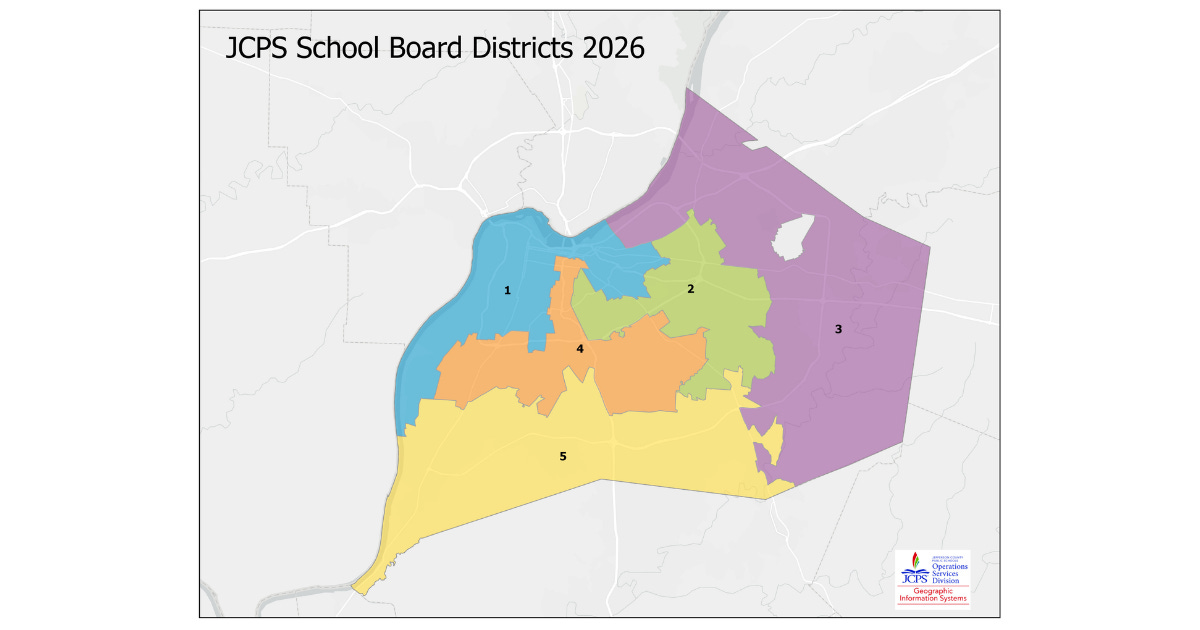
On May 27, WDRB reported that three current Jefferson County Board of Education members do not plan to seek reelection after the Kentucky General Assembly changed the board’s districts, reduced the board from seven members to five, and required every seat to appear on the November 2026 ballot. Gail Logan Strange and Taylor Everett confirmed they plan to run again. Tricia Lister, James Craig, and Linda Duncan said they do not plan to seek reelection.
That is the first visible election-level result of Senate Bill 4, a state law passed in April over Gov. Andy Beshear’s veto. SB 4 changed how Kentucky’s largest school district is governed locally. It changed the number of elected board seats, changed the district lines, ended the current seven-member board’s terms at the end of 2026, and created a transition process that JCPS had to carry out by drawing lots.
The board changed before voters cast a ballot
The current JCPS board had seven members. Under SB 4, the Jefferson County Board of Education will have five elected members beginning in January 2027. The bill defines a “large school district” as one with more than 300,000 inhabitants and changes board membership rules for those districts. In practice, that applies to Jefferson County Public Schools.
SB 4 does more than reduce the number of seats. It creates five Jefferson County board divisions, requires all five seats to appear on the November 2026 ballot, and sets different first-term lengths so the new board can return to staggered elections later. Winners in Divisions 1, 2, and 3 will serve four-year terms. Winners in Divisions 4 and 5 will serve two-year terms.
The transition has already changed the current board’s practical operation. JCPS says that, during a May 12 work session, board members in overlapping districts drew lots to determine temporary representation. The district now lists Tricia Lister in District 1, Corrie Shull in District 2, James Craig in District 3, Trevin Bass in District 4, Gail Logan Strange in District 5, and Linda Duncan and Taylor Everett as at-large members for the remainder of 2026.
That drawing of lots is a useful detail because it shows how state legislation becomes local administration.
A statute passed in Frankfort created new district boundaries.
JCPS then had to assign current board members to those districts, including cases where more than one member lived in the same new district and where no current board member lived in one district.
How SB 4 reached this point
SB 4 did not start as a bill focused mainly on the Jefferson County Board of Education. The original version dealt with principal leadership development and the Kentucky Department of Education. The major JCPS governance provisions appeared later, after House committee and floor changes, then a free conference committee report near the end of the legislative session.
The legislative record shows the Senate passed the bill 38-0 on February 9. The House passed a changed version 74-15 on March 20. After the Senate refused to concur and the House refused to recede, a conference committee was appointed. On April 1, a free conference committee report was adopted, and the final version passed the House 72-21 and the Senate 28-7.
Gov. Andy Beshear vetoed SB 4 on April 13. His veto message said the bill violated Sections 59 and 60 of the Kentucky Constitution, targeted Jefferson and Fayette County school boards by defining large public school districts, and would reduce voter representation on the Jefferson County Board of Education. The General Assembly overrode the veto on April 14, with the Senate voting 30-8 and the House voting 78-19.
The timing deserves attention. A bill that began with principal training became a late-session vehicle for changing the elected board governing JCPS. That does not make the law invalid by itself. It does mean Jefferson County voters are now dealing with a major local governance change that developed through late amendments and conference committee work, rather than a long local process centered on JCPS families, employees, and voters.
What Frankfort changed inside local school governance
The Kentucky General Assembly holds the formal authority here. Lawmakers amended state education statutes that govern local boards of education. Jefferson County voters did not choose a five-member board through a local referendum, and the current JCPS board did not voluntarily reduce itself from seven districts to five.
The state’s stated rationale has centered on scale, governance, financial risk, and treating JCPS like other Kentucky districts. Louisville Public Media reported that Rep. Jason Nemes said the Kentucky Supreme Court had recently said JCPS must be treated the same. In the same report, Sen. Karen Berg said the fast timeline limited a deeper public inquiry into the changes.
The Supreme Court reference comes from an earlier fight over JCPS governance. In 2025, the Kentucky Supreme Court addressed a prior state law that treated Jefferson County differently. Greater Louisville Inc., which supported the 2026 version of SB 1, framed the newer language as an attempt to address the Court’s concerns about special legislation.
SB 4 works alongside SB 1, another 2026 bill aimed at JCPS governance. SB 1 gives the superintendent more authority over daily operations in large districts, including budget implementation, personnel matters, contracts related to daily operations, pupil transportation, and administrative staff organization. SB 1’s opening findings cite JCPS’s size, budget, student population, transportation demands, and operational complexity.
Read together, SB 4 and SB 1 changed both sides of JCPS governance. SB 4 reduces and redraws the elected board. SB 1 shifts more operational authority to the superintendent. Jefferson County residents will still elect board members, but those members will serve under a new state-created map, with fewer elected seats and a strengthened superintendent role under state law.
Why does this reach families, schools, and voters?
JCPS is not a small public body. SB 1’s legislative findings state that JCPS serves approximately 95,000 students across 168 schools, educates students who speak more than 139 languages, manages an annual district budget of approximately $1.9 billion, and operates a transportation network serving approximately 60,000 riders. Those numbers explain why JCPS decisions affect daily life across Louisville.
The board’s role is governance: hiring and evaluating the superintendent, approving budgets, setting policy, voting on major district plans, and giving parents, teachers, students, and taxpayers an elected channel into JCPS decision-making.
Reducing seven districts to five changes the scale of representation for each board member.
For voters, the immediate effect is the November 2026 election. Every seat will be on the ballot. Some current members will run again; others will not; and new candidates will campaign in districts created by state law. WDRB’s May 27 report shows that the candidate field is already changing due to the new boundaries and the reduced number of seats.
For families and school staff, the effect will be felt through representation. A parent trying to reach a board member over transportation, special education, school closures, student assignment, discipline, curriculum, safety, or budget priorities will be dealing with a smaller board. The new board will also take office while the district faces major fiscal and operational questions that lawmakers cited as reasons for state intervention.
Representation is now the central test
Beshear’s veto message put the local-control argument plainly. He wrote that decisions on reorganizing these boards should be made locally by the people who live there, not by the General Assembly in Frankfort. Lawmakers rejected that argument when they overrode the veto.
That disagreement now has practical consequences. Jefferson County residents will not vote on whether the board should have seven or five members. They will vote for candidates within the five-division arrangement created by SB 4.
The state has already made the representation decision. The local election will decide who serves in that position.
There are fair questions to ask on both sides of the governance argument. JCPS has real problems, including transportation failures, budget strain, school closures, and public frustration with decision-making. State lawmakers have authority over Kentucky education law. The central accountability issue is whether changing local representation from Frankfort gives Jefferson County families more effective governance, or whether it reduces the public’s ability to reach and influence the board that governs their schools.
That is the part voters can test now. Candidate forums, board meetings, campaign finance reports, public statements, district maps, and policy votes will show whether the new arrangement improves public access or concentrates more decision-making among fewer elected representatives and a stronger superintendent.
What readers can do next
Check your new JCPS board district using the “Find a Board District” tool on the JCPS Board of Education page. Write down your current board representative, your new district number, and whether your board contact changed under SB 4.
Track who files to run in each of the five divisions. Compare the candidate list with the current board roster so you can see which members are leaving, which members are running again, and which districts will have no incumbent on the ballot.
Look closely at the new district map. Identify which neighborhoods are grouped together, which communities were separated, and whether your area lost direct representation compared with the prior seven-member board.
Attend JCPS board meetings and candidate forums before the November election. Ask candidates how they will represent a larger district, how they will handle public comment, how they will oversee the superintendent under SB 1, and how they will keep families connected to board decisions.
Read the documents behind the change. Start with SB 4, SB 1, the May 12 JCPS work session materials, the new district map, candidate filing records, campaign finance reports, and public statements from current board members who are not seeking reelection.
Ask direct accountability questions:
How will five board members provide stronger representation than seven?
How will the new board oversee the superintendent’s expanded authority under SB 1?
Which neighborhoods gained or lost representation under the new map?
How will candidates make themselves accessible to families in larger districts?
What public reporting will JCPS provide during the transition to the new board?
The question for Jefferson County now is specific enough to take into every board meeting and candidate forum: How will a five-member board give families stronger representation than the seven-member board it replaced?
Further reading and sources
Kentucky General Assembly, SB 4 bill page, including actions, amendments, veto, and vote history.
https://apps.legislature.ky.gov/record/26rs/sb4.html
SB 4 Free Conference Committee Report, including the five-member board language and large school district definition.
https://apps.legislature.ky.gov/recorddocuments/bill/26RS/SB4/FCCR1.pdf
Gov. Andy Beshear’s SB 4 veto message.
https://apps.legislature.ky.gov/record/26rs/sb4/veto.pdf
Jefferson County Public Schools Board of Education page, including temporary assignments and district lookup.
https://www.jefferson.kyschools.us/page/board-of-education
WDRB, “Multiple JCPS board members won’t seek re-election after redistricting changes.”
https://www.wdrb.com/news/education/multiple-jcps-board-members-wont-seek-re-election-after-redistricting-changes/article_b967c9f7-9fd5-451e-a32e-e270e0e277d0.html
Louisville Public Media, “Kentucky legislature passes bill slimming JCPS board, calls for new election.”
https://www.lpm.org/news/2026-04-02/kentucky-legislature-passes-bill-slimming-jcps-board-calls-for-new-election
Kentucky General Assembly, SB 1 bill text, including superintendent authority and legislative findings on JCPS.
https://apps.legislature.ky.gov/recorddocuments/bill/26RS/sb1/bill.pdf
Greater Louisville Inc. statement on SB 1.
https://www.greaterlouisville.com/advocacy-and-legislation/gli-issues-statement-on-ky-senate-bill-1/