
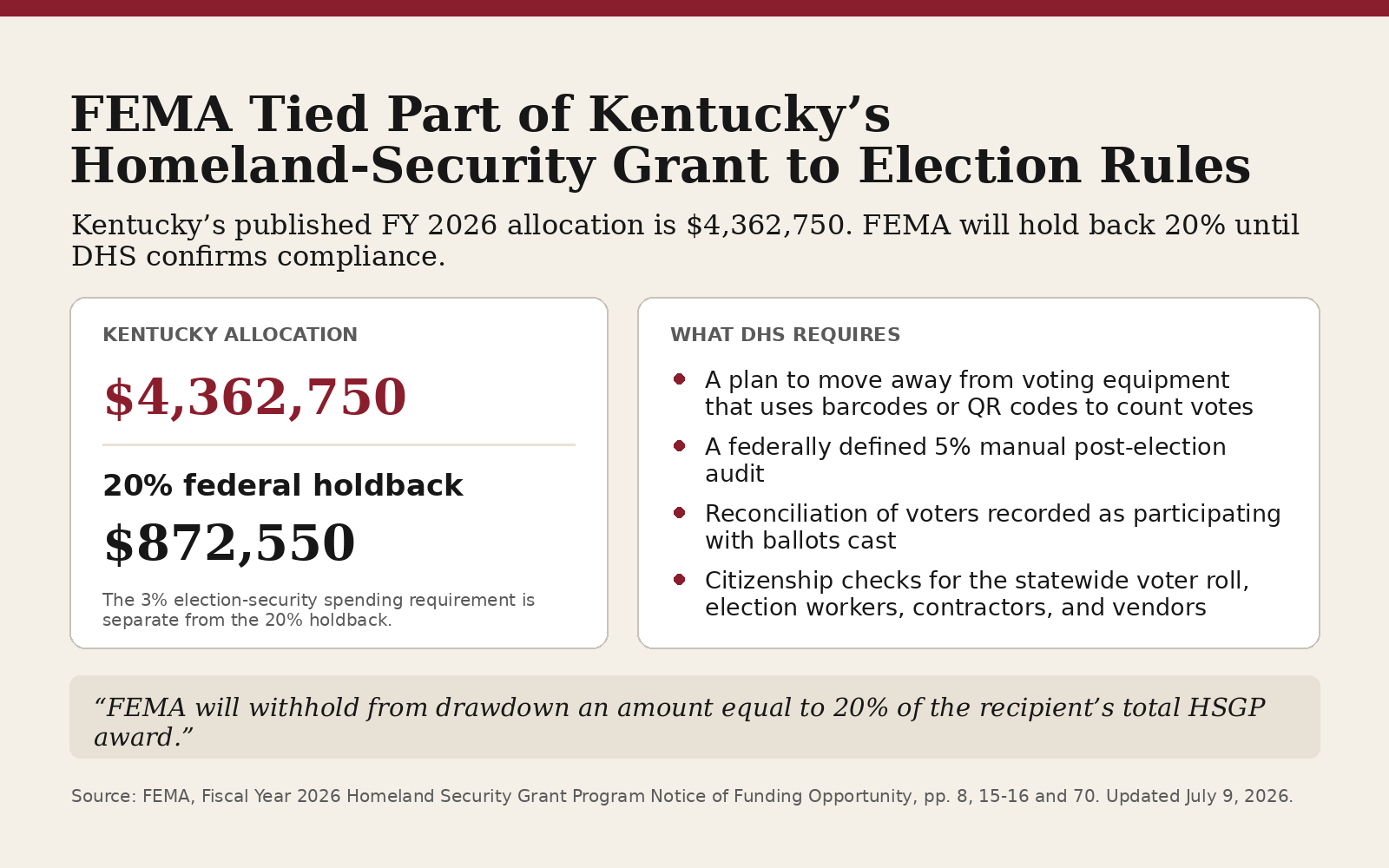
On June 24, the Federal Emergency Management Agency opened applications for the 2026 Homeland Security Grant Program. Kentucky’s designated allocation is $4,362,750, but FEMA will withhold 20 percent until the Department of Homeland Security confirms that Kentucky has met a new set of federal election requirements. That withheld amount comes to $872,550.
FEMA’s grant notice puts $872,550 of Kentucky’s homeland-security allocation behind a federal election-compliance gate.
Kentucky has not lost that money, and the state has not yet accepted an award. The immediate change is that Kentucky cannot draw the full allocation unless state and county election offices carry out procedures established or approved by DHS.
The Kentucky Office of Homeland Security must submit the state’s federal application by July 24. At the same time, the office is accepting grant requests from Kentucky local governments through July 31 for projects funded through the 2025 and 2026 programs.
FEMA Added Election Conditions to Kentucky’s Homeland Security Grant
DHS announced the election conditions on July 10, calling them common-sense security measures tied to federal homeland-security funding. The requirements appear in FEMA’s official 2026 grant notice rather than in a new election law passed by Congress or a proposed federal regulation opened for public comment.
The policy follows President Donald Trump’s March 25, 2025, executive order on election administration. That order directed DHS to expand state access to federal citizenship records, promote voting methods that do not rely on barcodes or QR codes for tabulation, and use homeland-security grants to encourage compliance with federal election priorities.
Under the 2026 grant notice, Kentucky must submit a plan for replacing voting equipment that uses barcodes or QR codes to count votes with equipment that accepts hand-marked paper ballots. The plan must include a timeline and may include a request for federal money to help pay for the transition.
Kentucky must also demonstrate compliance with a 5 percent manual post-election audit conducted under guidelines established by the DHS secretary. The state must reconcile the number of voters recorded as participating in each federal election with the number of ballots cast, using a methodology that the DHS secretary will establish.
A third set of conditions concerns citizenship verification. Within 120 days after accepting the grant, Kentucky must use the federal Systematic Alien Verification for Entitlements program, commonly called SAVE, to check everyone in the statewide voter-registration database. Kentucky’s chief election official must take timely corrective action against people verified as noncitizens, subject to federal and state election law.
Kentucky must also verify the citizenship of people who work at polling places or operate election equipment. The grant notice extends that requirement to temporary workers, contractors, and vendor employees who work with election equipment or election administration.
These conditions are separate from FEMA’s requirement that Kentucky dedicate at least 3 percent of its grant to eligible election-security projects. Kentucky must spend at least $130,882.50 on election security, but meeting that spending requirement alone will not release the $872,550 holdback.
DHS Controls When Kentucky Receives the Final 20 Percent
The Kentucky Office of Homeland Security, led by Executive Director Amy Hess, is the Commonwealth’s State Administrative Agency for federal homeland-security grants. It is the only Kentucky entity authorized to submit the state application to FEMA, accept the award, manage grant funds, and distribute subawards to local governments.
Kentucky’s homeland security office can apply for the grant, but it cannot rewrite Kentucky election law by itself.
The State Board of Elections maintains the statewide voter-registration database, supervises county election administration, trains county clerks and county election boards, and adopts election regulations within the authority provided by Kentucky law. Secretary of State Michael Adams serves as Kentucky’s chief election official and chairs the board.
County clerks and county boards of elections would perform much of the local work. They administer polling places, handle voting equipment, recruit and train poll workers, secure ballots, conduct post-election procedures, and report election results across Kentucky’s 120 counties.
FEMA will retain the final 20 percent until Kentucky submits evidence of compliance and DHS verifies or confirms that evidence. The grant notice does not provide an independent review body or a detailed appeal procedure for a state that disagrees with DHS’s decision. It also leaves several important standards for the DHS secretary to establish later.
Kentucky already audits elections, but the federal notice does not explain whether its 5 percent requirement measures ballots, precincts, scanners, races, or counties.
Kentucky’s current law requires officials to select one voting scanner and one race in every county for a bipartisan hand-to-eye audit. County election boards compare the manual count with the scanner count and investigate discrepancies.
Kentucky law also requires county boards to compare the number of ballots with voter sign-in records. If the number of ballots exceeds the number of recorded voters, county officials must investigate and report the discrepancy. Kentucky, therefore, has an audit and reconciliation procedure, but DHS has not provided sufficient detail to determine whether the existing procedure meets the new federal standards.
If DHS requires an audit larger than Kentucky law currently provides, the State Board of Elections may need to adopt new regulations or ask the General Assembly to amend state law. Counties could need additional workers, secure work areas, ballot transportation, video recording, training, and funding.
The Federal Voter-Verification Program Has Already Been Blocked in Court
The citizenship-verification condition depends heavily on the federal SAVE program. On June 22, U.S. District Judge Sparkle L. Sooknanan vacated an expanded version of the program that allowed federal agencies to combine immigration and Social Security records for large voter-database searches.
The court concluded that DHS and the Social Security Administration had violated the Social Security Act, the Privacy Act, and the Administrative Procedure Act when they created the expanded arrangement. The opinion documented concerns that federal citizenship information can be incomplete or outdated, particularly for naturalized citizens whose Social Security records were never updated after naturalization.
The federal government appealed. On July 8, the district court refused to suspend its ruling while the appeal proceeds. FEMA’s current grant notice still requires states to use SAVE or an authorized federal verification method, leaving Kentucky to plan a statewide voter check while the legality and operation of the underlying federal data arrangement remain unsettled.
A federal database match is not the same as a final determination that someone registered unlawfully. Kentucky would need procedures for human review, voter notice, correction of inaccurate federal records, appeal, record retention, and protection against removal based solely on an automated result.
The FEMA notice does not establish those safeguards. It directs the state’s chief election official to remove verified noncitizens through timely corrective action consistent with applicable law, but it does not define how a disputed record becomes verified or what opportunity a Kentucky voter receives to correct an error.
Kentucky Election Offices Would Carry Out the Federal Requirements
Kentucky reported 3,372,528 registered voters and 3,190 precincts in June 2026. The State Board of Elections would have 120 days after grant acceptance to determine how millions of voter records will be checked, what personal information will be transferred, how possible matches will be reviewed, and how affected voters will be contacted.
Naturalized citizens face a particular risk when federal records have not been updated. A person can be a United States citizen and still have an older Social Security record that reflects a previous immigration status. Kentucky would need a correction procedure that gives the voter enough time, information, and assistance to resolve the discrepancy before any adverse action occurs.
County clerks would also need to determine which voting machines use barcodes or QR codes in vote tabulation and what replacement would require. Costs could include new equipment, software, storage, training, testing, accessibility services, vendor support, and voter education. FEMA’s notice allows states to request funding for a transition, but no public Kentucky cost estimate has been identified.
Federal law requires every polling place to offer a voting method that allows voters with disabilities to mark, verify, and cast a ballot privately and independently. A Kentucky transition toward hand-marked paper ballots would still have to preserve an accessible option for voters who cannot independently mark a paper ballot.
The grant condition also reaches beyond election offices. Federal law generally requires Kentucky to pass at least 80 percent of State Homeland Security Program funding to local governments. Based on Kentucky’s published allocation, that local share would total at least $3,490,200.
Kentucky uses this grant program for emergency communications, cybersecurity, protective equipment, training, intelligence analysis, and other public-safety work. The Kentucky Office of Homeland Security reported that the program covers approximately 90 percent of the Kentucky Intelligence Fusion Center’s operating costs.
The grant condition ties money used by local public-safety agencies to decisions controlled by state and county election administrators.
A county fire department, emergency management office, police agency, or communications center may have no role in voter-list verification, but could still experience uncertainty or delay if Kentucky cannot satisfy DHS.
Kentucky has dealt with federal grant uncertainty before. The Kentucky Office of Homeland Security’s 2025 annual report described funding holds and litigation that disrupted the previous grant cycle and delayed the local application process. The report does not establish that election conditions alone caused those earlier disruptions, but it shows that federal disputes can interfere with local planning before a final legal decision is reached.
What You Can Request Before the July 24 Deadline
Request Kentucky’s grant records. Ask KOHS for the 2026 federal application, election-security investment justification, grant assurances, correspondence with FEMA, legal reviews, implementation plans, cost estimates, and any agreement governing use of SAVE.
Track the State Board of Elections. Read meeting agendas and minutes for discussions of the FEMA grant, voter-data transfers, citizenship verification, audit changes, voting equipment, poll-worker requirements, and county instructions. Ask the board to discuss those decisions in public before the state transfers data or changes election procedures.
Ask Secretary Adams for the voter-protection plan. Request the data fields Kentucky would send to USCIS, the standard for confirming a match, the notice given to voters, the correction and appeal procedure, and the number of records referred for further review.
Contact your county clerk. Ask which voting equipment your county uses, whether barcodes or QR codes affect tabulation, what replacement would cost, and how a 5 percent manual audit would change staffing and ballot-security requirements.
Track both July deadlines. Kentucky’s federal application is due July 24. Local homeland-security grant applications are due to KOHS on July 31. Those records can reveal whether election compliance is already affecting public-safety projects or local funding decisions.
Check your voter registration. Kentucky voters can review their registration through the State Board of Elections voter portal. Naturalized citizens who encounter an incorrect record should document communications and seek qualified legal assistance before submitting sensitive personal information.
Before Kentucky transfers millions of voter records or changes county election procedures, the public should see the application, the legal analysis, and the correction rules.
The first decision comes by July 24, when KOHS must determine what Kentucky will promise to FEMA.
Further reading and sources
Primary federal sources
FEMA: Fiscal Year 2026 Homeland Security Grant Program Notice of Funding Opportunity
DHS: Election conditions for federal homeland-security grants
White House: Executive Order 14248, Preserving and Protecting the Integrity of American Elections
52 U.S.C. § 21081: Federal voting-system accessibility standards
League of Women Voters v. DHS: June 22, 2026, district court opinion
League of Women Voters v. DHS: July 8, 2026, order denying a stay
Kentucky primary sources
Kentucky Office of Homeland Security: Grant information and current application deadlines
Kentucky State Board of Elections: Board membership and duties