
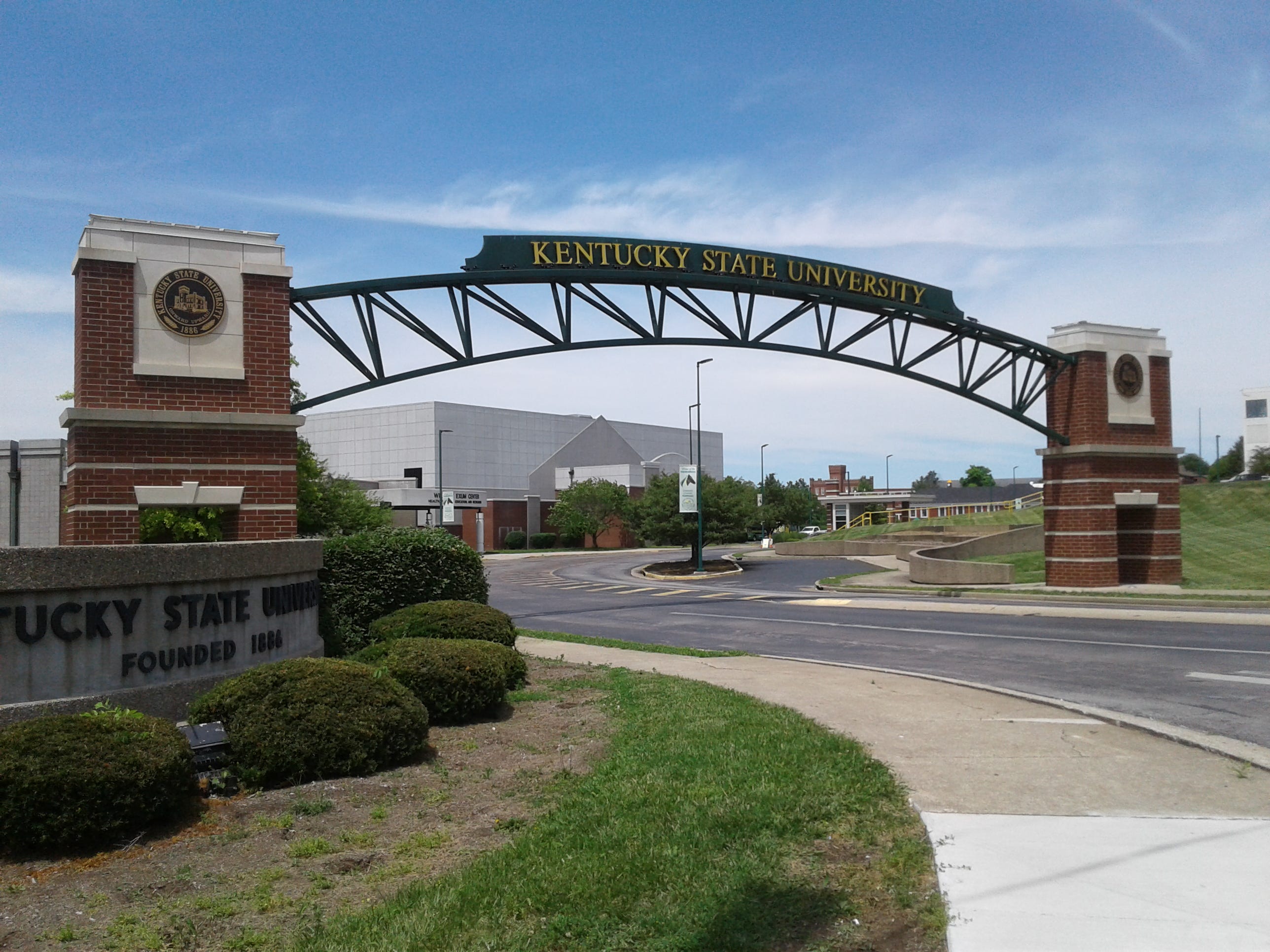
A federal lawsuit filed this week has turned Kentucky’s restructuring of Kentucky State University into something larger than a debate over university finances.
The case challenges Senate Bill 185, the new state law that places Kentucky State University under a five-year financial emergency structure, gives the Council on Postsecondary Education new oversight authority, limits the university’s in-person academic offerings, and requires a fast review of programs that could be closed or changed. The lawsuit was filed by KSU students, alums, and prospective students, who argue that Kentucky’s actions violate federal civil-rights protections and threaten the future of the Commonwealth’s only public Historically Black College or University.
That is the center of the story now.
Kentucky officials have described SB 185 as an effort to stabilize a financially troubled institution. The plaintiffs are making a different argument. They argue that the state cannot underfund Kentucky State University for decades, cite the resulting financial distress as justification for intervention, and then use state power to narrow the mission and structure of the state’s only public HBCU.
The lawsuit does not mean the plaintiffs have proven their claims. It means a federal court is now being asked to decide whether Kentucky’s rescue plan crosses a legal line.
The law gives the state new control over KSU
SB 185 changes how Kentucky State University will be governed, reviewed, and constrained.
The official bill record says Gov. Andy Beshear signed SB 185 on April 13, 2026, and it became Acts Chapter 120. The law is titled “AN ACT relating to Kentucky State University and declaring an emergency.”
The bill text recognizes KSU as Kentucky’s only public HBCU and an 1890 land-grant university. It also redefines the university as a four-year residential polytechnic institution focused on technical, industry-based applied learning and workforce needs.
The law declares a five-year state of financial exigency at KSU unless the General Assembly ends it earlier based on a recommendation from the Council on Postsecondary Education. During that period, KSU faces special oversight. The university may not enter into certain obligations or make expenditures of $20,000 or more without CPE approval.
The law also requires KSU’s Board of Regents, in consultation with CPE, to review academic programs and submit lists of programs to maintain, close, or substantially change. The bill sets a June 1, 2026, deadline for that submission and a July 1, 2026, deadline for any required substantive-change request to the university’s accreditor, SACSCOC.
Beginning with the 2026-2027 academic year, SB 185 requires KSU to offer no more than 10 academic areas of study for five academic years, with exceptions for online programs, the College of Education, and programs that CPE determines are necessary to the university’s polytechnic mission.
This is not a slow, open-ended study. The law creates a compressed implementation timeline.
The case turns a budget fight into a civil-rights question
Before the lawsuit, the public debate centered mostly on whether KSU needed stronger oversight.
That is still part of the story. KSU has faced serious financial problems, and public institutions should be accountable for how they spend public money. Oversight is not automatically wrong.
But the lawsuit asks a sharper question: what kind of oversight is this, and who gets harmed by it?
According to local reporting, the lawsuit alleges that SB 185 violates federal civil-rights laws and KSU’s status as Kentucky’s only public HBCU. The plaintiffs are asking the court to block the law while the case moves forward.
WDRB reported that the plaintiffs argue that the law violates federal civil rights protections and longstanding desegregation agreements related to higher education in Kentucky.
That framing matters because it moves the issue beyond ordinary budget oversight. The lawsuit places SB 185 in the context of race, higher-education access, land-grant equity, and the state’s long-term obligations to Kentucky’s only public HBCU.
The legal claims still have to be tested. But the filing changes the public question from “Does KSU need help?” to “Is Kentucky using help as the justification for state control?”
The $172 million question sits underneath the lawsuit
The lawsuit also lands against a documented funding history.
In 2023, federal officials called on Kentucky to address a funding disparity involving Kentucky State University. Louisville Public Media reported that federal officials calculated a $172 million funding gap by comparing per-pupil funding between KSU and the University of Kentucky from 1987 to 2020. Both institutions are land-grant universities.
The Kentucky Lantern reported that Kentucky’s land-grant HBCU had been underfunded by $172 million compared with the University of Kentucky, and that Kentucky was one of 16 states that received federal letters regarding land-grant HBCU funding disparities.
That number should sit at the center of the public conversation.
If a university has been denied equitable support for decades, its financial condition cannot be evaluated as though it developed in a vacuum.
A budget problem may still be real. Management failures may still be real. But a state cannot honestly discuss financial distress without also discussing the conditions that helped produce it.
That is why this lawsuit has a broader civic meaning. It asks whether Kentucky is responding to KSU’s financial condition by repairing harm or by reducing the institution’s independence, academic breadth, and future capacity.
The university is implementing the law, while others challenge it
Kentucky State University has not joined the lawsuit.
In a May 11 statement, KSU said it was aware of the court filing, was not involved in it, did not coordinate with the people who filed it, and was reviewing more than 1,000 pages of materials.
The university has also presented SB 185 implementation as a structured review process. In an April update, KSU said its academic review was already underway before SB 185 and described the work through a “start, stop, or grow” framework.
That distinction matters. KSU’s public posture is cautious and institutional.
The university is operating under the law while reviewing the lawsuit. Students, alumni, and prospective students are using the court system to challenge the law itself.
Both realities can be true at once.
KSU leadership may be trying to preserve stability. Students and alums may believe the law threatens the institution’s future. The state may argue that it is imposing necessary discipline. The plaintiffs may argue that the state is imposing discipline after decades of inequity.
The Dispatch question is not whether every party uses the same language. The question is where the power sits.
The deeper question is whether Kentucky strengthens KSU or shrinks it
This case matters because Kentucky State University is not just another line item in the state budget.
It is Kentucky’s only public HBCU. It is an 1890 land-grant institution. It sits in Frankfort, at the center of state government, and has served generations of students who deserved full public investment, not conditional support after a crisis.
The state may have legitimate reasons to demand accountability from KSU. But accountability should not become a substitute for repair.
If Kentucky underfunded KSU for decades, then the remedy should strengthen the institution, not shrink its future. If KSU needs fiscal discipline, that discipline should be transparent, equitable, and designed to protect students. If programs must change, the public should be able to see who made those decisions, what criteria were used, and how students, faculty, alums, and the broader community were heard.
The danger is not only that one law restructures one university.
The danger is that Kentucky normalizes a pattern: public institutions serving historically marginalized communities are allowed to weaken, then placed under state control once the damage becomes undeniable.
That is why the lawsuit matters. It forces Kentucky to answer a question that cannot be solved with a budget spreadsheet alone.
Was SB 185 a rescue plan?
Or was it the state’s latest decision about how much independence Kentucky State University is allowed to have?
Actions readers can take
Follow the federal court case.
Watch for any ruling on the plaintiffs’ request to block SB 185 while the lawsuit proceeds.Watch the June 1 program deadline.
KSU’s Board of Regents must submit proposed academic program decisions by June 1. That list deserves public attention.Track CPE meetings and documents.
The Council on Postsecondary Education now has significant oversight power. Its agendas, minutes, and materials can show how SB 185 is being implemented.Contact state legislators.
Ask whether they support revisiting SB 185, addressing the documented land-grant funding gap, and requiring stronger transparency around program closures and student protections.Support students’ and alums’s voices.
Students, alums, faculty, staff, and prospective students are the people most directly affected by this restructuring. Their accounts should not be treated as side commentary.Ask for public records.
Useful records include communications among CPE, KSU, the Governor’s office, legislative leaders, and SACSCOC; program review criteria; financial oversight guidance; and any analysis of accreditation risk or civil rights obligations.
Direct Sources
Federal lawsuit coverage, WKYT
WKYT reported that KSU students, alums, and prospective students filed a federal lawsuit challenging SB 185 and asked the court to block the law while the case proceeds.
https://www.wkyt.com/2026/05/11/federal-lawsuit-filed-block-state-takeover-kentucky-state-university/
Federal lawsuit coverage, WDRB
WDRB reported that the plaintiffs argue that SB 185 violates federal civil rights protections and longstanding desegregation agreements related to higher education in Kentucky.
https://www.wdrb.com/news/federal-lawsuit-challenges-kentucky-law-targeting-kentucky-state-university/article_923c2f5e-c073-4b1e-b77e-0f1e402ca0c8.html
SB 185 official bill record, Kentucky Legislative Research Commission
The LRC bill record shows Gov. Andy Beshear signed SB 185 on April 13, 2026, and identifies the bill sponsors and official status.
https://apps.legislature.ky.gov/record/26rs/sb185.html
SB 185 enrolled bill text
The bill text contains the five-year financial exigency declaration, CPE oversight provisions, academic program review deadlines, and limits on academic areas of study.
https://apps.legislature.ky.gov/recorddocuments/bill/26RS/sb185/bill.pdf
KSU statement on May 11 court filing
KSU said it was not involved in the lawsuit, did not coordinate with the individuals who filed it, and was reviewing the filing package.
https://www.kysu.edu/news/2026/5/kentucky-state-university-statement-on-may-11-court-filing.php
KSU Senate Bill 185 legislative update
KSU described the amended bill as preserving the university’s identity as a four-year institution, an 1890 land-grant university, and Kentucky’s only public HBCU.
https://www.kysu.edu/president/messages/2026/4/senate-bill-185-legislative-update.php
Louisville Public Media on federal underfunding letter
LPM reported that federal officials calculated a $172 million funding gap between KSU and the University of Kentucky from 1987 to 2020.
https://www.lpm.org/news/2023-09-20/feds-call-on-state-to-address-172m-underfunding-of-kentucky-state-university
Kentucky Lantern on land-grant HBCU underfunding
Kentucky Lantern reported that KSU was underfunded by $172 million compared with the University of Kentucky and that Kentucky was among 16 states receiving federal letters.
https://kentuckylantern.com/2023/09/18/states-urged-by-biden-administration-to-rectify-underfunding-of-land-grant-hbcus/