
Since his inauguration on January 20, 2025, President Trump has issued a series of executive orders that range from routine policy shifts to actions that could have long-term consequences for democracy and governance in the United States. I have taken a stab at evaluating these executive actions through the lens of constitutional authority, civil liberties, and the checks and balances available to counter executive overreach.
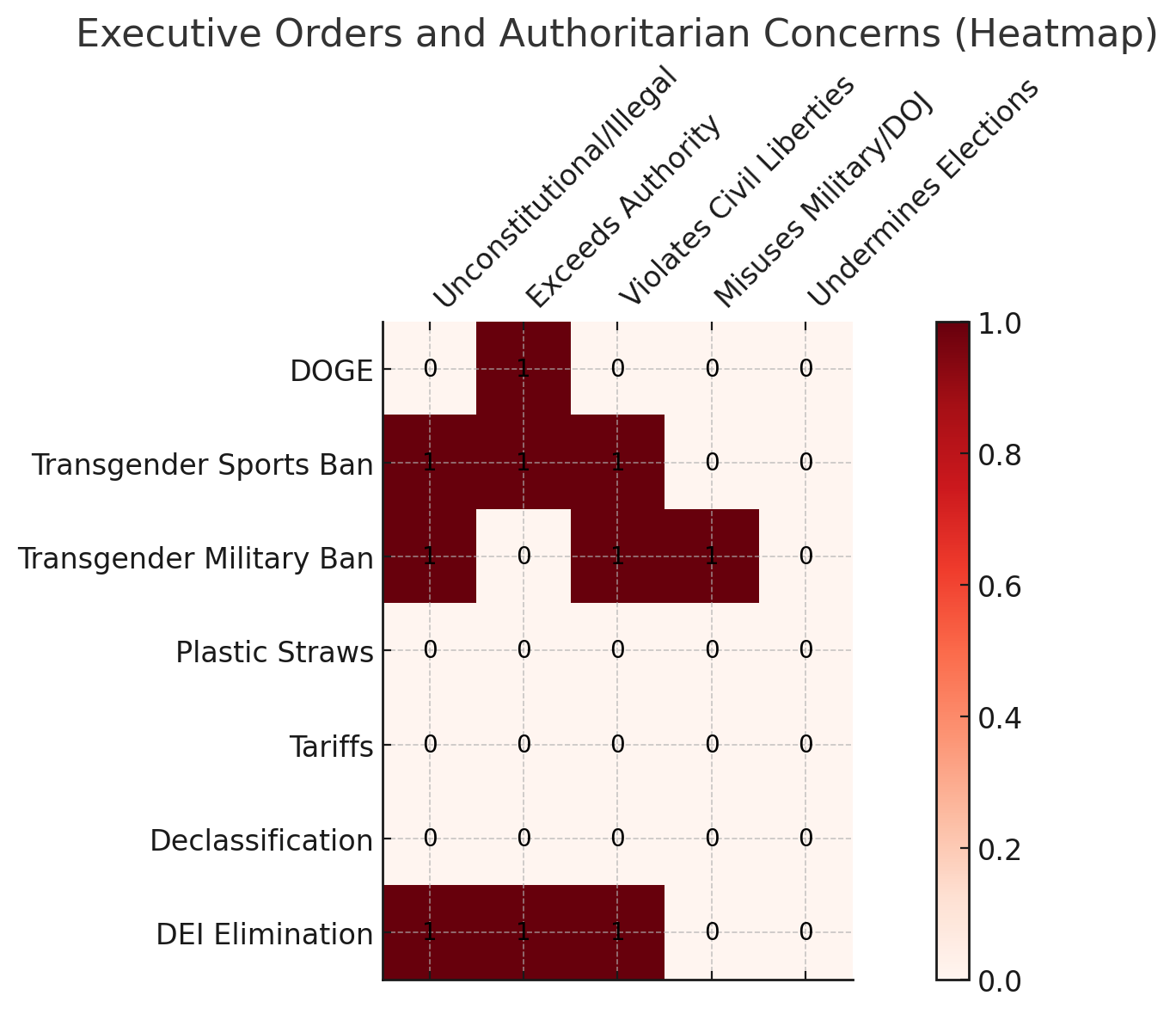
To do this, I examined each major executive order through five key questions:
Is it unconstitutional or illegal?
Does it exceed presidential authority?
Does it violate civil liberties or democratic norms?
Does it involve misuse of the military, DOJ, or law enforcement?
Is it being enforced in a way that undermines free elections?
Below is a heatmap that visually represents my evaluation. Darker red indicates areas of significant concern, while lighter shades show less pressing issues. This allows us to quickly identify the most problematic executive actions.
Breaking Down the Executive Orders
1. Department of Government Efficiency (DOGE)***
At first glance, the creation of the Department of Government Efficiency (DOGE) might seem like a harmless bureaucratic reorganization. However, its implementation has revealed a dangerous power grab. DOGE has exceeded its intended mandate by dismantling federal agencies, unlawfully accessing Treasury payment systems, and executing mass layoffs of federal employees. These actions raise serious legal and constitutional questions:
Potential violation of separation of powers by overriding congressional authority on agency funding.
Due process concerns related to mass terminations without proper procedures.
Ongoing legal challenges questioning its legitimacy and scope.
Action Needed: Congress must immediately investigate DOGE, block funding for its operations, and states must challenge its overreach in court. You can support lawsuits challenging unconstitutional DOGE actions, and amplify media attention on how DOGE is harming governance.
2. Transgender Participation in Sports Ban
This executive order prohibits transgender girls and women from participating in female-designated sports in schools and universities, under threat of funding cuts. While framed as an issue of "fairness," the policy is a clear overreach of executive authority in education policy, which is typically governed by Title IX and state-level regulations.
Potentially unconstitutional under equal protection principles.
Congress did not authorize this restriction, making its enforcement legally dubious.
Action Needed: Congress must introduce legislation to reinforce Title IX protections, while civil rights groups should challenge the order in court.
Trump signs executive order intended to bar transgender athletes from girls’ and women’s sports
3. Transgender Military Service Ban
The reinstatement of a ban on transgender individuals serving in the military echoes policies previously struck down. Courts have ruled in the past that arbitrary discrimination against service members violates equal protection. Furthermore, this executive order interferes with military readiness and personnel policies in a way that exceeds the normal discretion of the executive branch.
Likely unconstitutional under prior rulings.
Misuses military policy for ideological rather than strategic purposes.
Action Needed: Lawsuits should be filed immediately, and Congress must legislate to protect military service rights for all qualified individuals.
Prioritizing Military Excellence and Readiness - The White House
Servicemembers Seek Immediate Block of Transgender Military Ban
4. Encouragement of Plastic Straws
This order, which reverses federal agency guidance on reducing single-use plastics, is not unconstitutional but is a step backward in environmental policy. It does not require immediate legal intervention but reflects a broader rollback of environmental regulations that should be monitored.
Action Needed: Public advocacy and state-led environmental regulations should counteract this policy shift.
ENDING PROCUREMENT AND FORCED USE OF PAPER STRAWS
Trump signs executive order on plastic drinking straws
5. Tariffs on Imports
A new 25% tariff on steel and aluminum imports is a major trade policy shift. While the president has broad authority over tariffs, these measures could harm international relations and economic stability. Unlike other executive orders, this move does not raise direct constitutional issues but should be evaluated for its economic impact.
Action Needed: Monitor trade negotiations and push for Congressional oversight over tariff decisions.
Fact Sheet: President Donald J. Trump Restores Section 232 Tariffs
US is biggest loser from Trump's metals tariffs
6. Declassification of Assassination Records
Trump’s executive order mandating the release of previously classified records on the assassinations of JFK, RFK, and MLK is within his authority and has been demanded by transparency advocates for years. There is no immediate concern from a constitutional perspective, though security agencies may review and redact sensitive information.
Action Needed: Ensure the release process is transparent and not selectively edited for political gain.
FBI discovers new JFK files weeks after Trump order
King family responds to Trump's order to declassify assassination files
Trump orders release of JFK, RFK and MLK assassination records
7. Elimination of Diversity, Equity, and Inclusion (DEI) Programs
Through executive order, Trump has dismantled federal DEI initiatives, paused funding for related grants, and ended diversity training programs in government agencies. This action raises major concerns about equal opportunity in hiring and civil rights compliance:
Potentially illegal if it violates existing workplace anti-discrimination laws.
Executive overreach by reversing congressional allocations without approval.
Contradicts federal obligations under established anti-discrimination laws.
Action Needed: Legal challenges should be launched to determine whether these actions violate federal hiring laws and civil rights protections.
Trump’s January 2025 Executive Orders: Implications for Employers
What This Means for Democracy
Evaluating these executive orders is not just about policy disagreements—it’s about ensuring that democratic checks and balances function properly. Some of these orders, like the DOGE power grab, the transgender bans, and the elimination of DEI programs, strike at the heart of constitutional protections and must be challenged immediately. Others, like the plastic straw directive or tariffs, do not pose immediate threats to democracy but should be monitored.
Congress, state governments, and the judiciary all have roles to play in pushing back against executive overreach. The question is: Will they act?
What You Can Do
Call your representatives – Demand investigations into DOGE and legislative protections for civil rights.
Support legal challenges – Organizations like the ACLU and NAACP are leading the fight against these executive orders.
Stay informed and engaged – Share this analysis, participate in protests, and advocate for checks on executive power.
Trump’s executive orders are a test of our democratic resilience. The time to act is now.
***DOGE Warrants A Deeper Action Plan
If the Department of Government Efficiency (DOGE) is being used in a way that consolidates power, weakens oversight, or dismantles critical government functions, there are several ways to challenge and dismantle it through the legislative and judicial branches.
1. Legislative Actions (Congress)
A. Pass a Law to Defund or Abolish the DOGE
Congress controls the budget for all federal departments.
A bill could be introduced to cut funding to DOGE or eliminate it entirely.
Action: Pressure lawmakers to sponsor and pass a bill to defund DOGE.
B. Congressional Oversight and Investigations
Committees can subpoena records, demand testimony, and investigate the impact of DOGE policies.
If DOGE is violating existing laws, Congress can expose the harm publicly.
Action: Demand hearings to examine whether DOGE is dismantling necessary government functions.
C. Use the Congressional Review Act (CRA)
Congress can override recent executive actions through a joint resolution of disapproval under the CRA.
This applies if DOGE was created through an executive action and has issued regulations.
Action: Push for a resolution to nullify DOGE actions under the CRA.
2. Judicial Challenges (Courts)
A. Challenge the Constitutionality of DOGE
If DOGE is exceeding executive authority by eliminating jobs, dissolving agencies, or overriding laws passed by Congress, it can be challenged in federal court.
Potential legal grounds:
Separation of Powers: If DOGE is taking over Congress’s legislative role.
Due Process Violations: If employees are fired without legal protections.
Administrative Procedure Act (APA) Violations: If DOGE bypasses required procedures.
Action: Support lawsuits from affected employees, unions, or advocacy groups.
B. File Injunctions Against Specific DOGE Actions
Courts can block enforcement of any executive orders or policies that violate existing laws.
If DOGE is dismantling regulations without proper legal authority, lawsuits can stop it.
Action: Demand state attorneys general, watchdog groups, and unions file lawsuits.
3. State-Level Resistance
A. State Governments Can Refuse to Cooperate
If DOGE is dismantling federally funded programs, states can refuse to comply and challenge the cuts in court.
Example: If DOGE eliminates environmental enforcement, states can pass state-level protections.
Action: Pressure state legislatures to resist DOGE-driven cuts.
B. Attorneys General Can Sue
State attorneys general can challenge the legality of DOGE if it disrupts public services.
Action: Call for state AGs to file lawsuits against DOGE policies.
4. Public and Media Pressure
A. Expose DOGE's Harmful Impact
If DOGE is cutting vital services, the public needs to see the real-world consequences.
Media coverage and public backlash can force Congress to act.
Action: Amplify cases where DOGE cuts are harming workers, veterans, seniors, or critical agencies.
B. Union and Worker Protests
If federal employees are losing jobs unfairly, unions can organize strikes, protests, and legal action.
Action: Support federal workers’ unions in resisting DOGE policies.
Most Effective Immediate Actions
Pressure Congress to investigate and defund DOGE.
Support lawsuits challenging unconstitutional DOGE actions.
Push for state-level resistance to DOGE-driven federal cuts.
Amplify media attention on how DOGE is harming governance.
If DOGE is being used as a tool for executive overreach, these steps can help dismantle it before it causes lasting damage.