
Kentucky has already said no.
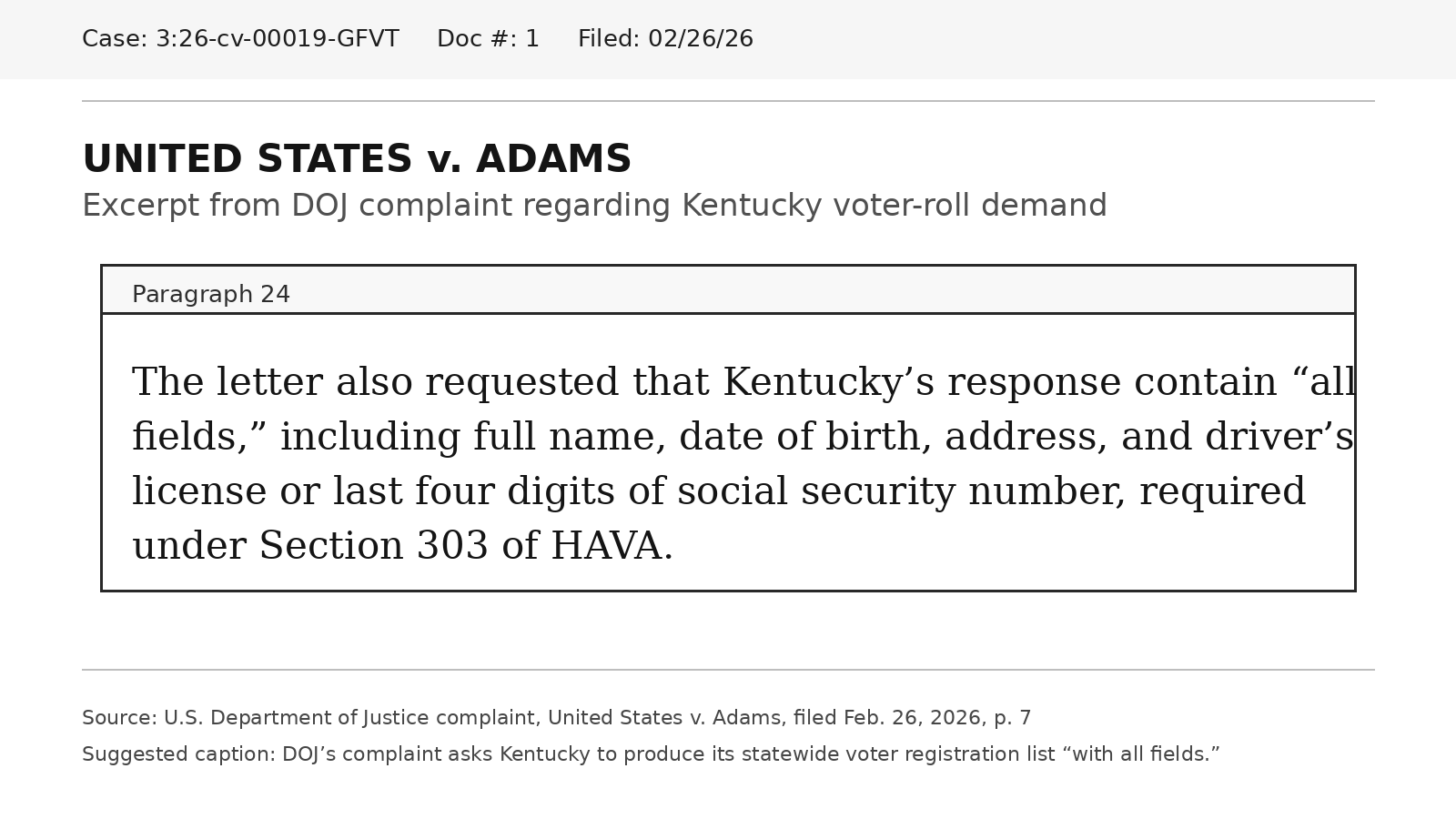
When the U.S. Department of Justice sued Kentucky earlier this year, it asked a federal court to force the state to turn over its statewide voter registration list “with all fields.”
DOJ was not asking only for names and addresses. In its own complaint, the department said it wanted each voter’s full name, date of birth, address, driver’s license number, the last 4 digits of a Social Security number, or a HAVA unique identifier.
Kentucky officials resisted.
Secretary of State Michael Adams said he would not voluntarily commit a data breach by handing over the information. Gov. Andy Beshear also said Kentucky would fight the demand for sensitive voter data.
Now the fight has escalated.
On May 12, the Justice Department’s Office of Legal Counsel issued a formal opinion saying the DOJ has the authority to compel states to produce unredacted statewide voter registration lists. Reuters reported that the opinion backs the DOJ’s demands for sensitive data, including partial Social Security numbers and driver’s license numbers, and says the DOJ may share that data with the Department of Homeland Security.
Kentucky’s pending lawsuit is more than a fight over one records request.
It raises a larger question: Who controls Kentucky’s voter data, and how far can the federal government go in demanding private information from state election systems?
“With all fields” means private voter information
The phrase “voter roll” can make this sound like a simple records request. Every state keeps voter-registration records. Election officials need accurate lists to administer elections.
But the DOJ’s demand in Kentucky goes much further than a public voter list.
The department’s lawsuit asks for Kentucky’s statewide voter registration list “with all fields.” According to the DOJ’s complaint, it includes full names, dates of birth, addresses, driver’s license numbers, last four digits of Social Security numbers, or HAVA identifiers.
Public voter files are subject to state rules. They are usually limited, regulated, and subject to restrictions on use. An unredacted statewide voter database is different. It contains private identifying information tied to millions of people.
Kentucky had more than 3.3 million registered voters in April 2026, according to State Board of Elections data.
So this is not a narrow request for records tied to a specific investigation. It is a demand for sensitive data connected to nearly the entire voting population of Kentucky.
The Kentucky State Board of Elections argues that federal law does not give the DOJ that power. In its motion to dismiss, the Board said the law allows the Attorney General to access records that election officials receive during voter registration. It does not, the Board argued, allow the DOJ to demand production of the statewide voter registration list itself, which the Board described as a state-created administrative compilation containing sensitive personally identifiable information.
That is the legal fight in plain terms.
The DOJ says federal election law gives it broad access to voter-roll data.
Kentucky says the DOJ is stretching the law beyond what Congress authorized.
The DOJ’s new memo points toward federal data matching
The May 12 Office of Legal Counsel opinion is not a court ruling. It does not settle the Kentucky case.
But it matters because it shows how the federal government intends to defend its position.
Reuters reported that the DOJ has sued 30 states and the District of Columbia to obtain unredacted voter rolls. Several federal courts have already rejected similar demands in other states.
Instead of backing down, the DOJ produced a legal opinion supporting its own authority.
The opinion says the DOJ’s Civil Rights Division can compel states to produce statewide voter registration lists under federal law. It also says the DOJ may share those lists with Homeland Security Investigations or another DHS component to check voter data against federal databases.
That is the key shift.
This is no longer only a question of whether Kentucky must produce election records to the DOJ. It is also a question of whether Kentucky voter data could be moved into a federal cross-agency screening system.
The DOJ frames that as election integrity. The stated purpose is to identify people who may be ineligible to vote.
But voting-rights groups warn that data matching across government systems can produce false positives, especially for naturalized citizens whose names, records, or citizenship status may not match cleanly across databases.
A mistaken match is not a small thing.
For a voter, it can mean being wrongly flagged as ineligible. For a naturalized citizen, it can carry a deeper threat: the fear that ordinary civic participation could draw federal scrutiny.
Kentucky is not a bystander in this national fight
Kentucky is not watching this happen from the sidelines.
The lawsuit is already here.
The DOJ sued Secretary of State Michael Adams and members of the Kentucky State Board of Elections in federal court. The complaint identifies Adams as Kentucky’s chief election official and says the State Board controls the statewide voter registration list.
That makes Kentucky one of the states where the administration’s theory of federal election authority is being tested.
There is also a local layer.
Jefferson County Clerk David Yates moved to intervene in the case, arguing that disclosure would put voters’ privacy at risk and undermine confidence in election administration. Jefferson County is Kentucky’s largest county, so that intervention gives the case a direct local dimension of election administration. It brings the issue down from federal agencies and state officials to the county offices that administer elections on the ground.
Civil-rights groups have also moved to intervene.
The League of Women Voters of Kentucky, the New Americans Initiative, and two individual Kentucky voters are represented by the ACLU of Kentucky and the ACLU Voting Rights Project. Their goal is to prevent the DOJ from accessing private voter data from Kentucky’s registration database.
The people most likely to feel the chilling effect are voters who may wonder whether registering, updating a record, or casting a ballot could expose their private information to federal enforcement systems.
This is a voter privacy fight and a power fight
American elections are decentralized by design.
States administer elections. Counties do much of the practical work. Federal law sets important protections and requirements, but state and local officials run the systems voters actually use.
The DOJ’s new legal position pushes in the other direction.
It asserts a stronger federal role in obtaining statewide voter data and using that data for eligibility checks. The Office of Legal Counsel opinion specifically discusses sharing voter registration lists with DHS for law-enforcement purposes.
That raises several questions Kentucky voters have a right to ask.
What safeguards would protect the data?
Who would have access to it?
How would errors be corrected?
Would voters be notified if they were flagged?
Could state election officials stop misuse once the data leaves Kentucky?
Those are not partisan questions. They are governance questions.
Kentucky already conducts voter-roll maintenance. The State Board of Elections publicly reports purges of inactive registrations and other list-maintenance activity. The federal demand is being made against a state election system that already has its own processes, officials, records, and legal responsibilities.
The issue is not whether voter rolls should be accurate.
They should be.
The issue is whether the federal government can demand private voter data from the state, move it through federal systems, and use it for cross-agency matching without clear limits, safeguards, or state control.
The precedent would reach beyond Kentucky
The Kentucky case should be read alongside the national pattern.
Reuters reported that the DOJ has sued 30 states and D.C. seeking voter-roll information. Courts in several states have rejected similar demands, but the DOJ is appealing adverse rulings.
That means Kentucky is part of a larger effort to test the boundaries of federal authority over state election data.
If the DOJ wins, the immediate effect would be access to Kentucky’s unredacted voter database. The broader effect could be a new model for federal control over state voter information.
If Kentucky wins, the ruling could help protect the principle that sensitive statewide voter data cannot be turned over simply because the federal government demands it.
Either way, the stakes extend beyond one election cycle.
This fight reaches into voter privacy, state authority, immigration enforcement, election administration, and public trust.
Kentucky is not a footnote in this national fight. The DOJ sued Kentucky officials by name and is seeking data from Kentucky’s election system. If the court accepts the DOJ’s theory, private identifying information tied to millions of Kentucky voters could be pulled into a federal data-matching process.
What you can do
Follow the federal case, United States v. Adams, in the Eastern District of Kentucky.
Contact the Kentucky Secretary of State, the State Board of Elections, and your county clerk to ask how Kentucky voter data is protected and whether they oppose turning over unredacted voter information without a court order.
Ask state lawmakers whether Kentucky needs stronger statutory protections for sensitive voter data.
Support organizations already involved in the case, including the League of Women Voters of Kentucky, the New Americans Initiative, and the ACLU of Kentucky.
And talk about this issue in plain language.
This is not only a fight over “voter rolls.” It is a fight over whether Kentuckians’ private voter information can be pulled into a federal database and matched against federal enforcement systems.
That should concern anyone who cares about voting, privacy, and local control over elections.
Direct sources
Primary legal and government sources
DOJ Office of Legal Counsel, “Authority to Obtain and Share Statewide Voter Roll Data”
https://www.justice.gov/olc/media/1440346/dl
DOJ complaint, United States v. Adams
https://www.justice.gov/crt/media/1429061/dl?utm_medium=email&utm_source=govdelivery
Kentucky State Board of Elections motion to dismiss
https://elect.ky.gov/Resources/Documents/Motion.pdf
Kentucky State Board of Elections voter registration statistics, April 2026 / May Primary 2026
https://elect.ky.gov/Resources/Documents/voterstatsdistrict-May%20Primary%202026.pdf
Kentucky advocacy and stakeholder sources
ACLU, United States v. Adams case page
https://www.aclu.org/cases/united-states-v-adams
ACLU of Kentucky, U.S. v. Adams case page
https://www.aclu-ky.org/cases/us-v-adams/
ACLU / ACLU of Kentucky press release on motion to intervene
https://www.aclu.org/press-releases/civil-rights-groups-file-motion-to-protect-sensitive-kentucky-voter-data-from-department-of-justice
League of Women Voters press release on Kentucky intervention
https://www.lwv.org/newsroom/press-releases/civil-rights-groups-file-motion-protect-sensitive-kentucky-voter-data
Reporting and context
Reuters, “US Justice Department drafts legal opinion backing demands for state voter rolls”
https://www.reuters.com/legal/government/us-justice-department-drafts-legal-opinion-backing-demands-state-voter-rolls-2026-05-13/
Democracy Docket, “Trump DOJ cites its own legal memo to defend voter roll demands on eve of appeal”
https://www.democracydocket.com/news-alerts/trump-doj-cites-its-own-legal-memo-to-defend-voter-roll-demands-on-eve-of-appeal/
WUKY, “U.S. Department of Justice sues Kentucky to obtain voter roll information”
https://www.wuky.org/wuky-news/2026-02-26/u-s-department-of-justice-sues-kentucky-to-obtain-voter-roll-information
Spectrum News 1 Kentucky, Jefferson County Clerk intervention coverage
https://spectrumnews1.com/ky/louisville/news/2026/03/31/jefferson-county-clerk-motion-to-dismiss