
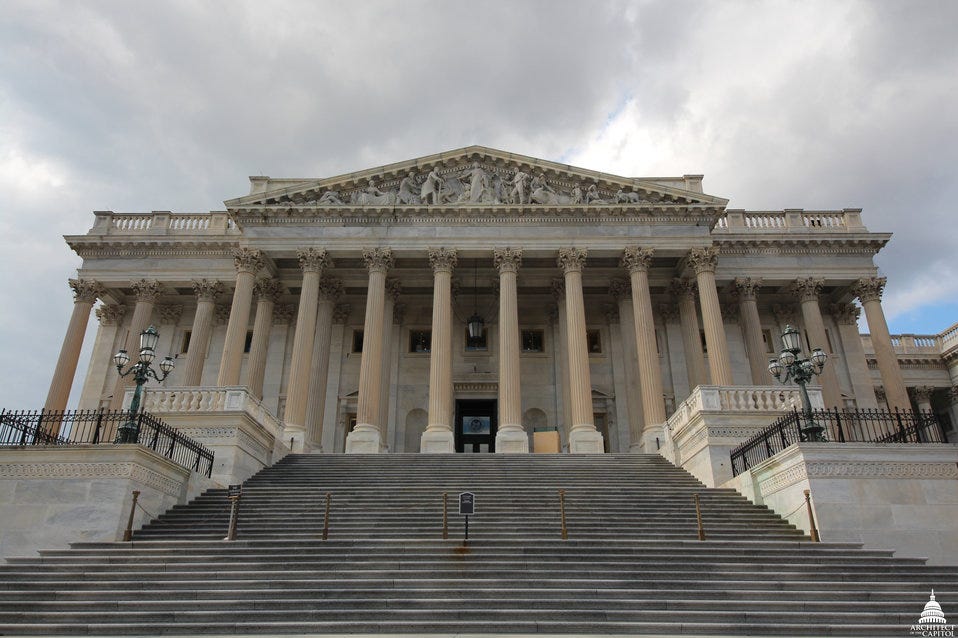
Congress had already approved the money.
On September 25, President Trump asked Congress to repudiate the $810 million appropriation Congress had made for the departments of Commerce, Education, Health and Human Services, Homeland Security, Housing and Urban Development, Justice, and international assistance programs. The White House simultaneously withheld the money from being obligated.
Money appropriated by Congress can be rescinded by the President; however, Trump made the request five days before the end of the federal fiscal year.
The type of action is called a pocket rescission. The executive branch assumes that if Congress does not take action to deny the president’s request, the money will automatically no longer be appropriated.
Congress never has to vote yes.
The money can disappear anyway.
How rescission is supposed to work
Under the Constitution, Congress decides how federal funds are allocated. Congress decides if and how the public’s money is spent.
The president also has a role. The Impoundment Control Act of 1974 states that a president has the right to send a special message to Congress if they believe Congress allocated public funds for unwarranted expenditures.
Once the President sends that special message, the funds can be withheld, but only temporarily.
If, after a period of time, Congress does not approve canceling the funds, it must spend them.
That structure is important, the President proposes.
Congress decides.
Then there is the calendar
The September 25 request involved 11 appropriation accounts that were scheduled to expire at the end of the fiscal year on September 30.
Under the normal rescission process, Congress would have had 45 days of continuous session to consider the president’s proposal.
But according to the Government Accountability Office, that consideration period would not have ended before November 9.
The money was scheduled to expire weeks earlier.
By withholding the funds until September 30, the administration did not need Congress to approve the proposed cancellation before the money reached its expiration date.
That is the pocket in “pocket rescission.”
The power comes from the timing.
GAO says the law does not allow it
Two days before the fiscal year ended, the Government Accountability Office issued its legal conclusion.
GAO is an independent legislative-branch agency responsible under the Impoundment Control Act for reviewing presidential rescission requests and monitoring executive compliance with the law.
Its conclusion was direct.
The law does not allow the president to withhold money through its expiration date simply because a rescission request is pending.
GAO wrote:
“The President may not force the expiration of budget authority Congress has already enacted and did not rescind.”
GAO said withholding appropriated funds until they expire would undermine both Congress’s constitutional power over spending and the process Congress created for presidential rescission requests.
This is not a new interpretation.
GAO reached the same conclusion in a 2018 decision, finding that money proposed for rescission must be made available for what it called “prudent obligation” before it expires if Congress has not approved the cancellation.
The White House sees the authority differently
The Trump administration disagrees with that analysis.
In its release about the September rescission package, the White House said the President was using Impoundment Control Act authority for the pocket rescission.
The administration has said the programs are inconsistent with its policies, or are wasteful. The largest proposed rescission is $567 million of Health and Human Services funding for services to refugees, asylees and other noncitizens. Other proposals affect educational, housing, law enforcement, and international programs.
People can disagree on the merits of those programs.
Congress can eliminate or change programs. Congress can also decide the funding level of programs. The president can ask for rescission of funds, but Congress always has the final say.
The dispute here is about who gets to make the final decision.
Congress created this safeguard for a reason
This conflict has deep roots, dating back more than 50 years.
During his presidency, Richard Nixon asserted broad powers to refuse to spend money Congress had appropriated for programs he opposed.
In 1974, Congress passed the Impoundment Control Act to address this.
The Act established a basic rule that if a president wants to permanently cancel (or ‘impound’) appropriated money, Congress has to agree to it. If Congress doesn’t agree to the cancellation, the executive branch can’t keep the money impounded.
That wasn’t just a budgeting procedure.
That was a guardrail between those two branches of the government.
Congress has the power to spend, and the President can propose changes, but cannot make them on his own.
A pocket rescission tests that guardrail to see whether it can be accomplished by using the procedure to cancel appropriations, along with provisions of the act that state an order rescinding an appropriation of funds would expire automatically on a specific date.
The fight has now moved to court
California and six other states filed suit on September 30 challenging the administration’s withholding of the $810 million.
Their lawsuit argues that allowing the executive branch to cancel appropriated money this way violates Congress’s constitutional authority over federal spending and the separation of powers.
The administration has defended the rescissions as an appropriate use of presidential authority. The legal dispute is now unresolved in federal court.
That distinction is important.
GAO has concluded that the Impoundment Control Act does not authorize pocket rescissions. The administration disagrees. A federal court will now be asked to address the dispute.
What to watch
$810 million is a lot of money.
But the precedent it sets matters more.
What happens if this becomes the standard way of controlling spending? The administration wouldn’t need Congress to repeal a program or eliminate its funding. The administration could simply decide not to spend the money and submit a rescission proposal to “recover” it.
Congress can refuse to approve the cancellation.
But that refusal might not matter in the long term.
What we should watch is not whether the president and Congress agree about spending. This happens all the time.
Watch what happens to the decision-making power.
Congress appropriates the money. This time, Congress didn’t appropriate this $810,000,000. But the executive branch used rescission to prevent the money from being spent before the process expired.
How can checks and balances weaken and lose their value without being formally changed?
The law still exists. Congress can still appropriate money. The rescission process still exists.
But if the executive branch can obtain the same result without Congress’s consent, the guardrail matters less each time it works.
Sources
U.S. Government Accountability Office, Sept. 29, 2026
Impoundment Control Act of 1974: Review of the President’s Special Message of September 25, 2026
GAO decision B-338788
The White House, Sept. 25, 2026
September Rescission Package
Presidential special message proposing $810 million in rescissions
The White House, Sept. 25, 2026
President Trump Takes Historic Action to Eliminate Wasteful and Harmful Spending
White House explanation of the pocket rescission
U.S. Government Accountability Office
Impoundment Control Act
GAO overview of rescissions and impoundment law
U.S. Government Accountability Office, Dec. 10, 2018
Impoundment Control Act: Withholding of Funds through Their Date of Expiration
GAO’s earlier pocket-rescission decision
Congressional Research Service, Feb. 25, 2025
The Impoundment Control Act of 1974: Background and Congressional Consideration of Rescissions
CRS report on the history and operation of the law
Reuters, Oct. 1, 2026
California, six other states sue Trump administration over federal funds
Reuters report on the pending lawsuit