
On a recorded roll call this week, the United States House of Representatives passed H.R. 22, the Safeguard American Voter Eligibility Act, known as the SAVE Act. The bill text posted on Congress.gov would amend the National Voter Registration Act of 1993 to require documentary proof of United States citizenship before a person can be registered to vote in a federal election. It also establishes criminal penalties for election officials who register an applicant for federal voting without first obtaining and retaining that documentation.
The vote advances a proposal that has circulated in prior sessions of Congress. This time, it cleared the House and now moves to the Senate. The bill text and roll call are publicly available through Congress.gov and the Clerk of the House.
What the bill changes is specific. The NVRA currently governs how states must offer voter registration opportunities, including at motor vehicle offices and public assistance agencies. The SAVE Act would add a federal requirement layered on top of those existing processes. It would apply to registration for federal elections, meaning elections for President, U.S. Senate, and U.S. House.
For Kentucky, the question is operational: how would this new federal requirement interact with the Commonwealth’s current voter registration system, which is administered by the Kentucky State Board of Elections under the supervision of the Secretary of State and implemented by county clerks in all 120 counties.
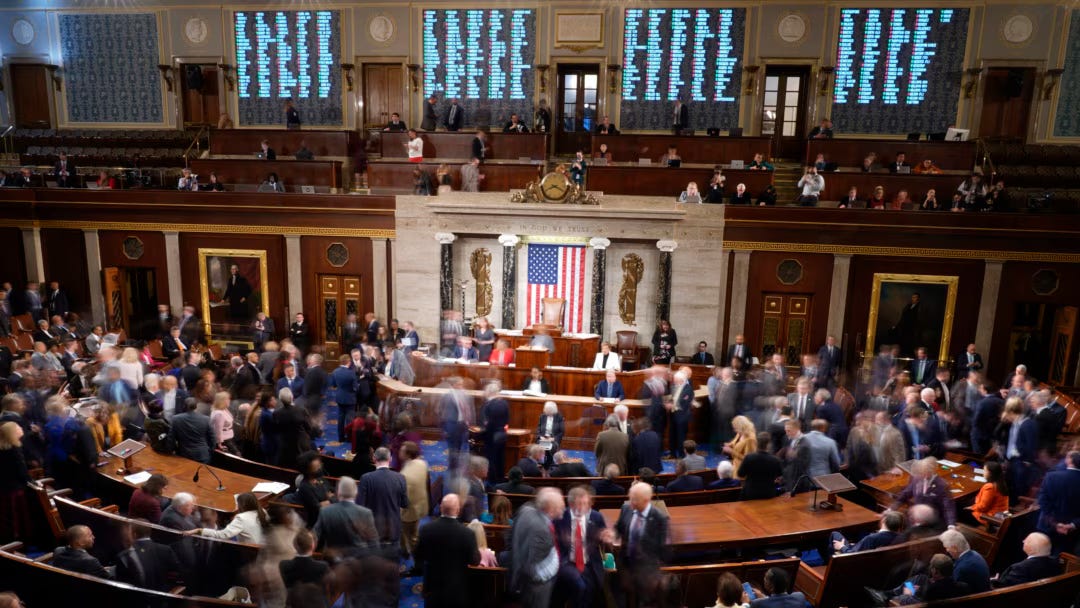
House Roll Call on the SAVE Act
The House vote followed committee consideration and floor debate. The final passage vote is recorded in the Congressional Record and on the Clerk’s website, identifying each member’s position. The bill text, as engrossed and sent to the Senate, specifies amendments to 52 U.S.C. § 20501 et seq., the codified section of the NVRA.
Under the proposal, states would be prohibited from registering an individual to vote in a federal election unless the applicant presents documentary proof of citizenship. The bill defines acceptable documentation to include items such as a U.S. passport or a birth certificate accompanied by a government-issued photo identification. The measure also directs states to maintain copies of the documentation provided.
The legislation creates a new federal offense for an election official who “knowingly registers” an applicant for federal voting without the required proof. The bill text sets out potential fines and imprisonment terms. That provision shifts legal exposure directly onto state and local officials who process registration forms.
The House has authority to pass such legislation under the Elections Clause of the U.S. Constitution, which grants Congress power to regulate the “Times, Places and Manner” of federal elections. Whether the Senate will take up the bill, amend it, or decline to act remains an open procedural question.
Amendment to the National Voter Registration Act
The NVRA, enacted in 1993, established uniform federal standards for voter registration in federal elections. It requires states to provide mail-in registration forms, to offer registration at motor vehicle agencies, and to maintain accurate voter rolls. Kentucky complies with the NVRA through its online portal, mail-in forms, and in-person registration at county clerk offices and certain state agencies.
The SAVE Act would alter that compliance structure by adding a documentation mandate. Under current Kentucky practice, a registrant affirms U.S. citizenship under penalty of perjury when completing the registration form. The federal form includes a checkbox affirming citizenship status. States rely on that sworn statement, along with database checks, to determine eligibility.
If enacted, the new federal statute would require Kentucky election officials to collect documentary proof before completing a federal registration. The bill’s language directs that the documentation must be presented in person. It would limit the use of purely online registration for federal purposes unless a system is created to transmit acceptable documentation securely.
That change would affect the Commonwealth’s online voter registration system maintained by the Secretary of State and the State Board of Elections. The current portal allows eligible Kentuckians to register or update their registration electronically, relying on data from the Transportation Cabinet and digital signature verification. The SAVE Act would require a new step.
Criminal Liability for Election Officials
One section of the bill specifies criminal penalties for election officials who register applicants without first obtaining documentary proof of citizenship. The text refers to “knowingly” registering a person for federal voting without the required documentation.
In Kentucky, voter registration processing is carried out at the county level. County clerks in Jefferson County, Fayette County, Oldham County, and the other 117 counties receive applications, verify information, and enter registrants into the statewide voter registration system. The system is overseen by the State Board of Elections.
Under the proposed federal amendment, these local officials would bear personal legal risk if they failed to follow the documentation requirement precisely. That includes situations in which an applicant appears eligible but does not produce the specified documentation.
Election administrators already operate under a mix of state and federal law. Kentucky statutes in KRS Chapter 116 govern voter eligibility, registration procedures, and removal from the rolls. Federal law overlays those provisions for federal elections. The SAVE Act would insert an additional compliance layer tied specifically to proof of citizenship and backed by federal criminal enforcement.
Kentucky’s Current Registration Process
Kentucky law requires that a voter be a U.S. citizen, at least 18 years old on or before Election Day, and a resident of the precinct for at least 28 days before the election. Applicants attest to these qualifications under penalty of perjury. False registration statements are subject to criminal penalties under state law.
The Commonwealth participates in interstate data-sharing efforts such as the Electronic Registration Information Center in prior years and conducts periodic list maintenance in accordance with federal law. The State Board of Elections issues guidance to county clerks on processing applications, verifying addresses, and handling incomplete forms.
At present, a Kentuckian can register to vote online if they possess a Kentucky driver’s license or state-issued ID. The system pulls data from the Kentucky Transportation Cabinet database. Alternatively, a resident can submit a paper form by mail or in person.

If the SAVE Act becomes law, Kentucky would need to revise these processes for federal elections. The Commonwealth might be required to bifurcate registration procedures, distinguishing between federal and state elections unless it adopts the federal standard across the board. That administrative decision would fall to state officials, guided by legal counsel and federal rulemaking if the bill authorizes implementing regulations.
Interaction With Federal Election Authority
Congress’s authority under the Elections Clause extends to federal elections. States retain authority over state and local elections. In practice, states administer a unified voter registration system covering all contests on the ballot.
If a federal documentation mandate applies only to federal elections, Kentucky would face a choice. It could apply the proof-of-citizenship requirement to all voter registration to maintain a single list. Or it could maintain separate eligibility flags within the statewide voter database, identifying registrants who have met the federal documentation threshold.
Either approach would require programming changes to the statewide voter registration system and updated training for county clerks and staff. Budget allocations for those changes would be determined through the state budget process, likely involving the General Assembly and the Governor’s office.
The Kentucky General Assembly may need to amend KRS Chapter 116 to align state statutes with the new federal requirement. The Secretary of State of Kentucky would issue administrative guidance, and the State Board of Elections would adopt revised forms and instructions.
Compliance Costs and Administrative Steps
The bill text does not include a dedicated federal funding stream for state implementation. Absent appropriations, states would absorb the cost of updating systems, training staff, and handling increased in-person traffic for documentation review.
Kentucky’s 120 county clerk offices would likely experience higher foot traffic if applicants are required to present documentation in person. Rural counties with limited staffing could face scheduling pressure during peak registration periods.
The State Board of Elections would need to revise the statewide voter registration form and online portal. It would also need to establish document retention procedures consistent with federal privacy and recordkeeping laws.
If Congress or the U.S. Department of Justice issues implementing regulations or guidance, Kentucky officials would need to review and incorporate those directives. Any discrepancy between federal requirements and existing state law would be resolved through statutory amendment or litigation.
Senate Procedure and Next Steps
The SAVE Act now sits before the United States Senate. The Senate may refer the bill to committee, bring it directly to the floor, amend it, or decline to advance it. If the Senate passes a different version, the House and Senate would reconcile differences through a conference committee.
If both chambers approve identical text, the bill would be sent to the President for signature or veto. Upon enactment, the statute would specify an effective date. States would then begin compliance planning.
Kentucky election officials typically prepare for statutory changes months in advance of major election cycles. If the bill advances in the Senate, the State Board of Elections and the Secretary of State’s office would likely begin internal review of system changes and cost estimates.
Until Senate action occurs, the existing Kentucky voter registration process remains in effect.
Suggested Actions for Readers
Readers who want to understand how this proposal would operate in Kentucky can review the bill text on Congress.gov and compare it to current Kentucky statutes in KRS Chapter 116. Contacting the offices of Kentucky’s U.S. Senators to ask about their position on the SAVE Act will provide clarity on how they intend to proceed.
Those interested in local administration can attend meetings of their county board of elections or review minutes from the Kentucky State Board of Elections, which are posted online. These forums often include discussion of federal legislative developments that affect state procedures.
Further Reading
• H.R. 22 – SAVE Act (119th Congress) — Bill All Info & Actions (official text, status, actions on Congress.gov)
https://www.congress.gov/bill/119th-congress/house-bill/22/all-info
• Text – H.R. 22, Safeguard American Voter Eligibility Act (full legislative text showing NVRA amendments)
https://www.congress.gov/bill/119th-congress/house-bill/22/text
• Summary – H.R. 22 on Congress.gov (official legislative summary of requirements)
https://www.congress.gov/bill/119th-congress/house-bill/22
• Kentucky Online Voter Registration (Commonwealth’s official portal)
https://vrsws.sos.ky.gov/ovrweb/
• Kentucky Voter Registration Requirements & Deadlines (State Board of Elections)
https://elect.ky.gov/Voters/Pages/Registration.aspx
• Kentucky Revised Statutes § 116.155 – Voter Registration Forms & Info Required (Justia)
https://law.justia.com/codes/kentucky/chapter-116/section-116-155/
• Kentucky Voter Information Center (check registration status, polling place)
https://vrsws.sos.ky.gov/vic/
• NVRA Instructions for Kentucky (Election Assistance Commission)
https://www.eac.gov/nvra-instructions-kentucky-english
• Register to Vote in Kentucky (Vote.org overview of Kentucky rules)
https://www.vote.org/register-to-vote/kentucky/