
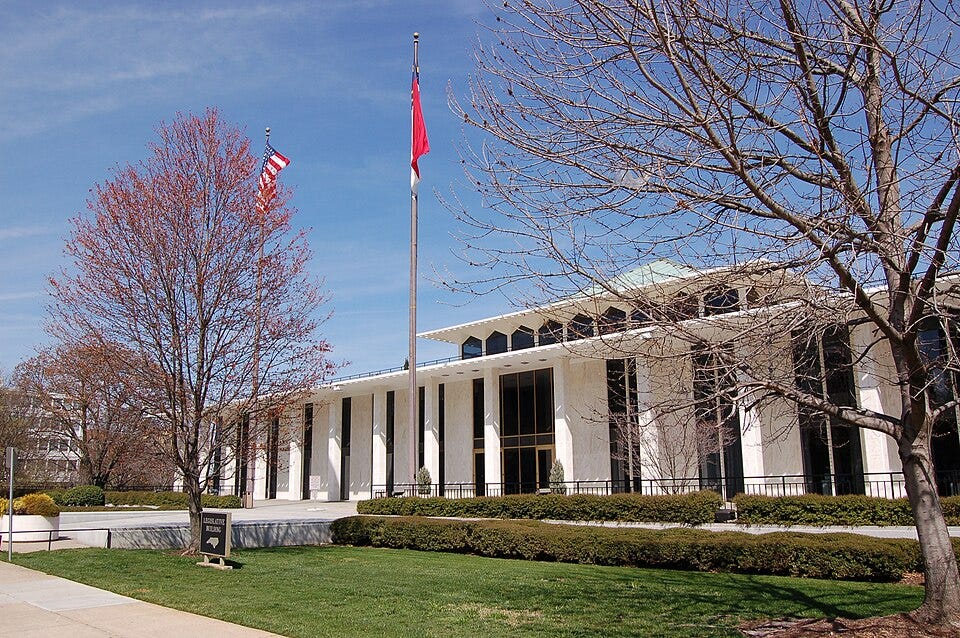
North Carolina legislators studied how racial minorities voted in the 2013 election. They analyzed which racial minorities used early voting.
They examined which racial minorities registered to vote on Election Day and which used other voting methods.
After their analysis, the legislators changed voting methods largely used by racial minorities.
They reduced the length of the early voting period.
They prohibited same-day registration and voting.
They changed procedures for counting provisional ballots.
They required voters to present government-issued photo IDs.
In 2016, a federal appeals court ruled that the changes to North Carolina’s voting procedures were enacted to discriminate against racial minorities, and especially against African Americans. It is important to note the 2016 federal appeals court decision because it shows how the people charged with operating the government of a representative democracy also have the power to restrict the rules of that same democracy. It shows the power North Carolina legislators have to change the voting procedures and processes to discriminate against racial minorities.
American democracy has moved backward. It has moved backward when legislators have changed the rules to restrict voting in discriminatory ways.
It has moved backward when legislators have changed the rules to restrict voting in a way that disenfranchises racial minorities.
The power to change the rules
Elections reflect the public interest, but state officials set key election rules long before the polls open.
Every state has regulations governing voter registration, setting election dates, locating voting places, delineating legislative boundaries, and establishing procedures for canvassing votes.
They have legitimate and necessary interests in formulating regulations that facilitate a smooth, fair, and honest election and maintain accurate, current voter lists.
Issues arise when regulations are formulated to alter the competitive process in a way that harms citizen control and responsibility in government.
Adjusting legislative districts is one example. Conducting a census every ten years obligates a state to adjust its legislative districts to reflect changes in the state’s population.
Often, legislative district boundaries are adjusted to group voters of a particular political party to dilute the voting strength of opponents.
By strategically grouping or diluting opponents’ voters, legislative mapmakers can influence elections by deciding which voters control legislative branches. Grouping voters in a particular district, known as “packing,” or diluting voters in multiple districts, known as “cracking,” both deny opponents the opportunity to win legislative seats.
One consequence of extreme gerrymandering is that a political party can win a high percentage of legislative seats, despite a low statewide vote.
Although a discrepancy between the statewide vote and Legislative seat totals does not imply unconstitutional gerrymandering, circumstances exist in which the Legislature draws district maps to deliberately increase partisan advantage to the point that the balance of legislative representation does not accurately reflect the statewide electorate.
Changes to voting procedures and laws that alter when, how, and where citizens cast votes impact voters’ choices and control.
Therefore, the purposes, effects, and outcomes of changes to voting procedures and laws warrant consideration.
What changed after the 2010 elections
In 2010, the Republican Party gained many state legislative seats and several governorships.
The status quo changed dramatically and suddenly as the Republican Party gained control of state government and the redistricting process.
In some cases, these changes affected election rules and how legislators were represented.
Political scientist Jacob Grumbach studied this phenomenon and published his findings in the American Political Science Review in 2017.
He titled the work Laboratories of Democratic Backsliding.
Grumbach developed the State Democracy Index to statistically evaluate the health of democracy across the U.S. From 2000 to 2018, he evaluated democratic processes and election-related procedures and policies to identify improvements and regressions in state democracy.
Other researchers have focused on different state policies and activities, whereas Grumbach analyzed changes in the state Republican Party’s control of state government.
From 2010 to 2016, Republican control of state government was consistently correlated with negative changes in the Democracy Index.
Most of these changes resulted from Republican efforts to alter election laws and procedures. Since 2010, several Republican-controlled state legislatures engaged in partisan competition to adopt restrictive election procedures and laws.
Grumbach also evaluated changes in voter demographics and partisan alignment, as well as overall political competition within states. These factors, on their own, had a relatively small impact on the changes in the state Democracy Index.
In most cases, Republican control of state governments accounted for the largest variability in changes in the state Democracy Index.
Republican control of state governments from 2010 to 2016 allowed state legislatures to significantly diminish democratic accountability in several ways.
North Carolina clearly illustrates this phenomenon.
North Carolina: From expanded participation to new restrictions
In the years before 2010, North Carolina implemented laws that increased opportunities for citizens to participate in the election process.
Early voting spanned 17 days, and same-day registration during early voting was permitted. If a voter cast his/her/their ballot at the wrong precinct, as long as it was cast in the correct county, the ballot was counted. Numerous state laws enacted in 2005 and amended in 2007 helped to expand the voter base and increase participation.
The laws allowed 16- and 17-year-olds to pre-register to vote. The laws automatically registered voters when individuals turned 18.
These legislative efforts all expired on December 31, 2010.
During the 2010 elections, North Carolina Republicans gained control of both chambers of the North Carolina legislature.
The following year, the first of many restrictive voter laws was passed. Though a democratic governor vetoed the law, it established strict voter identification requirements.
After a Republican governor was elected in 2012, North Carolina’s election laws quickly evolved to reflect greater restrictions and barriers to voting.
The loss of federal oversight (Shelby County v. Holder) shifted State legislatures’ abilities to quickly amend election laws. Consequently, in 2013, a new North Carolina election law, North Carolina House Bill 589, was passed.
The court ruled in favor of Shelby County.
As a result, section 4 of the Voting Rights Act and the associated preclearance section (section 5) were rendered inapplicable to covered jurisdictions.
North Carolina state legislators had a previously proposed bill to enact strict voter ID requirements.
With the preclearance provision no longer in effect, the legislators could enact voter ID requirements without restriction.
In addition, the legislators enacted other restrictions regarding voting and election procedures.
Many of the restrictions limited the duration of the early voting period.
Other restrictions prohibited voting on registration day and out-of-precinct voting.
The restrictions also eliminated preregistration for minors and required voter ID.
Governor McCrory signed the legislation on August 12, 2013. The restrictions drew immediate legal challenges.
What the court found
The legislature’s records demonstrated the most pertinent evidence.
North Carolina’s legislature enacted the restrictions after determining, based on state legislature requests, the racial composition of voters using distinct election methods.
North Carolina’s records showed that Black voters used the restricted practices more.
As noted earlier, Black voters used early voting more than White voters. Black voters also used Same Day Registration and certain provisional voting methods more frequently.
Restrictive provisions also required specific forms of ID and other permitted IDs more commonly held by Black voters.
North Carolina asserted that the restricted and otherwise modified voting methods and requirements were enacted to reduce voter fraud and enhance election integrity.
The court also upheld the challenged restrictions to enhance public confidence in the election process.
The restrictions enacted by the North Carolina legislature, according to the Fourth Circuit Court of Appeals, succeeded in limiting the election rights of Black voters.
The plaintiffs in North Carolina State Conference of the NAACP v. McCrory and other related cases presented evidence that the state’s revisions to its voting laws were enacted to intentionally discriminate against voters of color, and Black voters in particular.
The Court didn't conclude that all voter ID laws are discriminatory.
The Court considered evidence specific to North Carolina.
The evidence showed that the legislators imposed restrictions on voting that would disproportionately affect Black voters.
A federal court of appeals reached this conclusion about the legislators’ intent.
The Court’s interventions to protect voting rights demonstrate that a backsliding trend in democratic practices can be addressed.
Following the Court's ruling in Shelby County, acts protected by the Voting Rights Act could no longer be pre-cleared by the Courts. This meant that, to protect voters from discriminatory legislation, citizens could no longer have their voting rights protected through pre-clearance.
Instead, this could only be accomplished through post-clearance, that is, after discriminatory voting laws are enforced.
Changing representation through district boundaries
North Carolina also made other changes in 2010.
After the census, North Carolina Republicans drew new congressional districts.
The new districts led to another round of lawsuits.
In 2017, the U.S. Supreme Court ruled in Cooper v. Harris, and agreed that two of North Carolina’s congressional districts unconstitutionally used race as the main factor in their definition.
Unlike the challenges to North Carolina’s voting laws, which were decided in 2016, the Cooper case did not consider race as an unconstitutional consideration of voting.
The case did show that the North Carolina legislature drew the districts to limit the representation of racial minorities.
The U.S. Supreme Court did not allow challenges to the North Carolina districts on the grounds of partisan gerrymandering. The Supreme Court did allow state court challenges to partisan gerrymandering.
In 2019, the U.S. Supreme Court considered challenges to congressional maps from North Carolina and Maryland in Rucho v. Common Cause.
The Supreme Court did not allow challenges to partisan gerrymandering in federal court.
One part of the judgment was that racial and ethnic gerrymandering would still allow challenges.
The judgment did allow state legislatures to control partisan redistricting. The U.S. Supreme Court also did not allow challenges to partisan gerrymandering in the Wisconsin case, even though plaintiffs claimed that the maps restricted their right to vote in violation of the U.S. Constitution.
Wisconsin: When the votes and the seats told different stories
In 2011, with complete control of Wisconsin’s state government, the Republican Party redesigned the state’s legislative districts.
They passed the new districts through the state legislature and gained final approval from the governor.
The next election proved problematic for the state’s Republicans.
In that election, the state’s Republican Assembly candidates only received about 48.6% of the statewide vote. However, Republicans won 60% of the Assembly seats.
As a result, Republicans controlled about 61% of the Assembly, despite not controlling a majority of the statewide Assembly vote.
In 2018, the U.S. Supreme Court noted these numbers in its ruling in Gill v. Whitford.
State legislative elections do not turn on statewide election results. Consequently, statewide election results by themselves do not prove legislative election maps violate the U.S. Constitution.
Wisconsin holds 99 separate elections for its Assembly (the state’s lower legislative house).
During the 2018 elections, Democratic voters challenged Wisconsin’s election maps.
The case was filed in a state court but was ultimately heard by the U.S. Supreme Court. In 2018, the Court ruled that the plaintiffs lacked standing to bring their claims.
The Court neither ruled on the merits of the case nor decided whether Wisconsin’s statewide partisan imbalance violated the U.S. Constitution. In 2019, the U.S. Supreme Court ruled that the Federal courts could not consider cases involving partisan gerrymandering.
Consequently, the courts have not determined the merits of the plaintiffs’ claim that Wisconsin’s state legislative maps, challenged in federal court, violated the U.S. Constitution because of partisan gerrymandering.
Years later, Wisconsin’s state courts addressed a separate constitutional problem.
In 2023, the Wisconsin Supreme Court ruled in Clarke v. Wisconsin Elections Commission that Wisconsin’s state legislative maps, which were challenged in the state courts, violated the Wisconsin Constitution because of partisan gerrymandering.
In February 2024, Wisconsin’s Republican-controlled legislature surprised many by approving new legislative district maps proposed by the state’s Democratic Governor Tony Evers. Evers later signed the maps into law.
What happened in Wisconsin in 2024 illustrates not only how control of legislative districting by political parties affects the outcome of legislative elections, but also how far either party will go to remove districting maps that adversely affect their interests.
Wisconsin legislators, while controlling districting, approved legislative district maps that benefitted their party and ensured a large Republican legislative majority. A court decision further limited representation by ruling Wisconsin’s legislative districting maps unconstitutional.
Federal courts did not finally decide the case regarding partisan gerrymandering, but Wisconsin’s state courts decided cases involving other constitutional limitations.
Similar conflicts occurred in Alabama over the political representation of the state’s African American voters.
Alabama: When district boundaries diluted Black voting strength
Following the 2020 Census, Alabama’s Black population was estimated to be roughly 27 percent of the state’s total population.
Because of this, and because Alabama has seven Congressional seats, one might expect Alabama’s new Congressional map to include more than one seat where the Black population can elect its preferred candidate.
However, Alabama’s new map, passed by the Alabama Legislature in November 2021, contains only one seat in which the Black population can elect the candidate of their choice.
Several counties in Alabama make up the Alabama Black Belt, and like the rest of Alabama, Black Belt counties are large and span many square miles.
Because of how Alabama’s new Congressional map is drawn, Black voters in the Black Belt are divided among many different districts, and the largest concentration of Black voters in the state is packed into Alabama’s Seventh Congressional District.
Because of this, Black voters and several Black voter rights organizations filed a lawsuit against the state of Alabama and several Alabama officials in an effort to stop the new Alabama Congressional map.
Black voters and Black voter rights organizations argued that Alabama’s new map violated the Voting Rights Act of 1965 by limiting Black voters’ opportunity to elect the candidate of their choice. The court determined that Black voters of Alabama had the right to a map that allowed them the opportunity to elect at least two Black Representatives. Alabama is appealing this decision.
Allen v. Milligan, decided by the U.S. Supreme Court in June 2023, concerns Alabama’s 2021 redistricting plan and is noteworthy for two reasons.
First, it affirmed a lower court’s determination based on the standards established in the Voting Rights Act (VRA).
Second, it upheld a preliminary decision issued by a federal district court under Section 2 of the VRA.
Although Alabama defended its redistricting plan as consistent with traditional principles of legislative drafting, the Supreme Court declined to revise the lower courts’ opinions.
In July 2023, the Alabama Legislature enacted a new redistricting plan.
This plan also did not create a second congressional district as required by the federal courts.
Two of the three federal judges hearing the case appointed a special master.
The master developed a new plan to implement the requirements of the lower federal courts.
This plan transformed Alabama’s second congressional district.
African Americans made up 48.75% of the voting-age population in this district.
In addition, in the November 2024 election, Alabama voters elected Democrat Shomari Figures to represent them in the U.S. Congress.
He received 158,041 votes, and his Republican opponent, Caroleene Dobson, received 131,414 votes.
Alabama also elected its second Black U.S. Congressperson, Terri Sewell.
Alabama’s new congressional districts created the first opportunity for Alabama voters to elect both of their U.S. Congresspersons as African-American.
In 2025, a federal court ruled that Alabama’s 2023 map unlawfully weakened the Black vote and discriminated against Black voters.
In 2026, the U.S. Supreme Court’s ruling in Callais altered the way courts evaluate vote dilution claims. The Court reconsidered the Alabama case. The Court also vacated the prior Alabama orders and stayed further action.
As of now, the court cases determine the boundaries of vote dilution claims.
In 2023, the Alabama legislature passed maps for Alabama’s congressional districts.
According to the courts’ interpretation of the Voting Rights Act, and based on the 2023 ruling, the maps did not ensure Black voters the opportunity for adequate representation.
In response to the courts’ intervention, the state used different district boundaries for the 2024 elections.
The election changed Alabama’s congressional delegation. The state’s ongoing cases show how a state’s electoral representation can rapidly and substantially change through court cases and interpretations of the Constitution and laws governing representation.
Why this matters in Kentucky
Following the 2020 census, Kentucky’s Democratic governor and Republican-controlled state legislature each controlled a different branch of government.
As a result, the state’s district boundaries became contentious.
The state legislature adopted new district maps in January 2022. The state’s Democratic governor, Andy Beshear, vetoed the maps.
The state legislature enacted the maps over the governor’s veto. Lawyers for the Democratic Party and some Democratic state senators challenged the legislative district maps. The plaintiffs asserted that the district maps constituted unconstitutional and illegal partisan gerrymandering.
On December 14, 2023, the Kentucky Supreme Court decided Graham v. Adams.
The court held that legislative maps adopted by the state’s general assembly constituted an appropriate limit on judicial review. Thus, the Kentucky Supreme Court upheld the legislative district maps.
The outcomes in the Kentucky case should not be equated with the outcomes in Wisconsin, North Carolina, or Alabama.
Unlike in Wisconsin, North Carolina, and Alabama, the Court did not find intent-based racial discrimination by state legislators.
The four states faced different legal obstacles and achieved different results, but all raised the same basic question about election processes.
How much latitude should state legislatures have when drawing election district boundaries?
The Kentucky Constitution provides that elections be “free and equal.” It is expressly provided that Kentucky courts may determine the constitutionality of legislation, including redistricting statutes.
The Kentucky Supreme Court upheld the long-established principle that legislatures have broad discretion to exercise political judgment in adopting election statutes.
The Court’s rulings have placed responsibility and discretion for determining the composition of representative assemblies in the political branch of government, while charging the courts with ascertaining whether the political branch has overreached its constitutional limits.
Many Kentuckians are thoroughly concerned with the principles at issue because the election district boundaries determine who shares representation with others in Frankfort and who represents them in Washington.
District boundaries also affect how citizens’ votes and political support translate into representation.
The answers to those questions shape the government’s responsibility and accountability to the people long before elections.
What actually caused the deterioration?
North Carolina, Wisconsin, and Alabama illustrate how states used their control over election and representation processes.
In North Carolina, Republican legislators acted quickly to impose restrictions on voting after receiving racial data showing which voters relied on them to vote. A federal appellate court ruling found that the restrictions were enacted to discriminate against voters.
Wisconsin Republican legislators manipulated election laws to assure their dominance in Wisconsin. The legislative boundary lines enacted by the Wisconsin Legislature in 2011 resulted in a situation where, in 2012, the Republican Party’s candidate for Governor won less than 50 percent of the vote, and yet the Republican Party won a large margin of the seats representing Wisconsin in the lower house of the Wisconsin Legislature.
In Alabama, Republican legislators maintained the boundaries of Alabama’s Congressional districts. The manipulation of election boundaries diluted the votes of the African American community and removed their opportunity to be represented.
The 2024 elections were the first in which representatives were elected based on court-approved boundaries.
While the partisan composition of the Republican-controlled Alabama Legislature remained unchanged, legal challenges to the court-ordered boundaries of Alabama’s congressional districts revealed differing views on judicial restraint and constitutional interpretation.
The 2013 decisions issued by the U.S. Supreme Court in Shelby County and Rucho altered how election laws, voting rights, and partisan gerrymandering would be interpreted in the future.
Grumbach connects these legislative actions to more extensive deterioration of democracy at the state level during Republican administrations.
Her data show that not all restrictions had the same impact, and not all states demonstrably worsened.
The effects of voter ID laws are researched and debated.
Some studies suggest that ID laws have little to no impact on voter turnout.
While voter ID laws and other restrictions may have different impacts, a court need not consider the full range of data to evaluate the negative consequences of a restriction.
Cases from North Carolina, Wisconsin, and Alabama demonstrate the negative effects of election laws and voting restrictions on the right to political representation. Restrictive election laws and rules are explicitly made by politicians.
Election laws therefore affect political parties’ and candidates’ ability and opportunity to compete for voter support.
Democracy weakened while its institutions continued functioning
There are important lessons to be learned from these case studies.
For one, the reduction of democracies did not happen only to nations that outright abolished elections. Many other countries continued to hold elections. Legislatures continued to pass laws. Governors signed laws. Courts ruled on the constitutionality of laws.
Courts largely determined changes to the rules and processes of elections and representation.
Some changes were upheld, while others were invalidated. Others remain neither valid nor invalid because of ongoing litigation. Just because elections and other branches of government exist and function in a particular country does not necessarily mean that country is a functioning democracy.
A government can and will use its power to alter the rules, processes, and conditions of elections if it determines that those rules do not support its desired outcome.
For example, North Carolina’s legislature altered election laws in a way that a court of law determined was unconstitutional and discriminatory.
Legislative districting in Wisconsin left a severe imbalance between the statewide vote and the number of legislative seats won.
In Alabama, the creation and maintenance of racial and partisan gerrymandered congressional districts benefitted one party at the expense of the other, barring African Americans from the opportunity to elect candidates of their choice.
Challenging districting plans in court to alleviate gerrymandering, one of the more viable options, has not been successful in Alabama.
Recent U.S. Supreme Court decisions shifted the legal standard required to strike down partisan gerrymandered districts.
This uncharted legal territory barred lower courts from granting relief to African Americans seeking fairer congressional district maps.
Eroding democracy is not always the result of an overt effort to subvert the electoral process.
Genuine competition among political parties to capture control of the government is not antagonistic to the health of democracy.
Composite cases studied in this series demonstrate that strain on democratic government occurs when those in power manipulate the rules of democratic competition.
This series documents two distinct, but interrelated, efforts: (1) legislative action directed at undermining election results and (2) actions to revise the electoral rules.
The following article in the series describes President Trump and his allies’ efforts to overturn the results of the 2020 Presidential Election.
Next in the series: Part Two, The Attempt to Overturn the 2020 Election.
Sources and documentation
This article draws on original court decisions, published political science research, and official election records. Principal sources include:
State-level democratic backsliding
North Carolina
Wisconsin
Wisconsin Supreme Court, Clarke v. Wisconsin Elections Commission (2023)
Wisconsin legislative redistricting history, Loyola Law School
Alabama
Kentucky
Additional voting-law research