
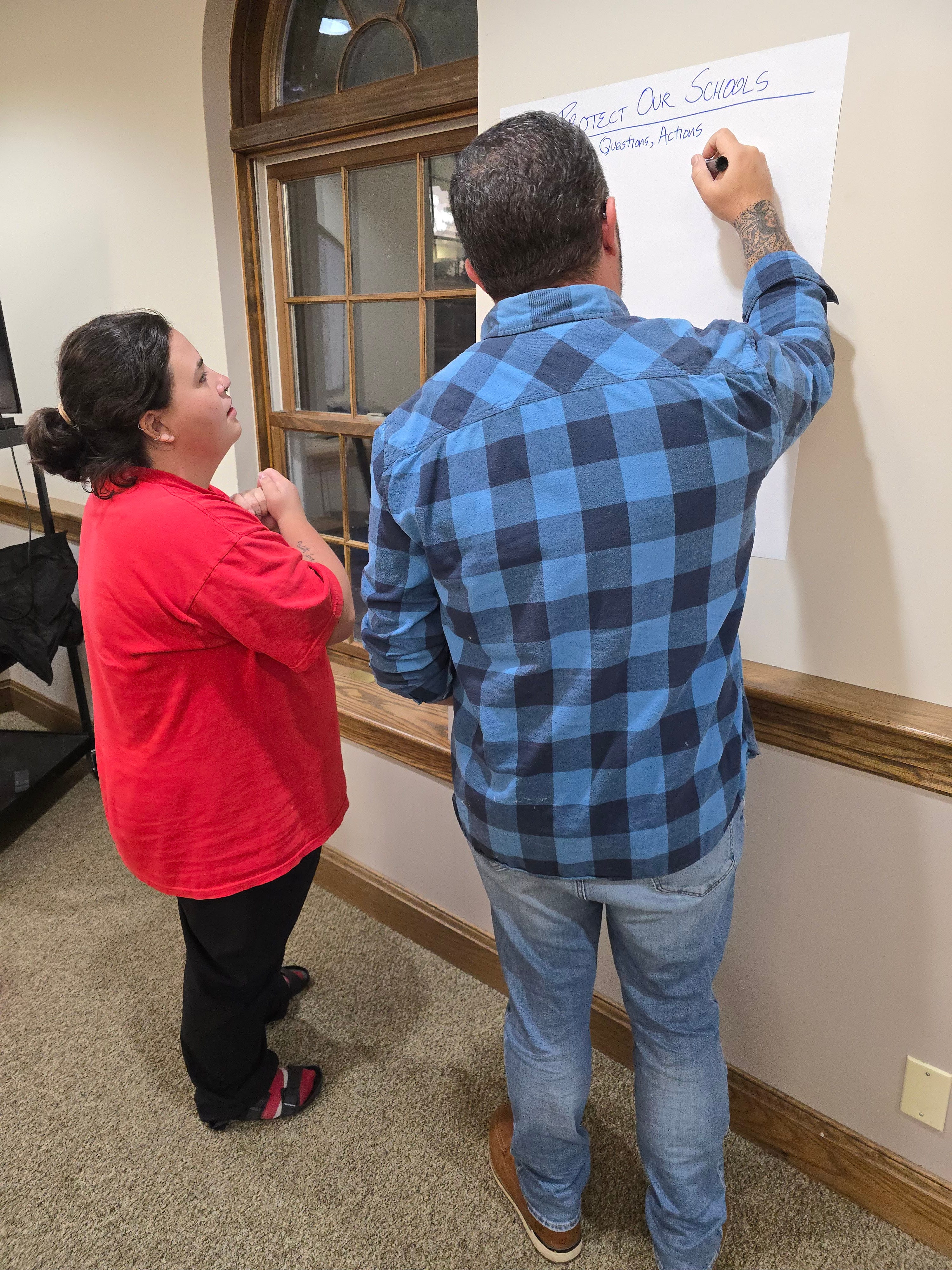
Last night’s leadership meeting carried a strange mix of determination and fatigue. Nobody who joined the call was ready to give up. People were still engaged, still thinking strategically, still talking through projects, next steps, and local concerns. But there was also a heaviness beneath the conversation that felt different from simple burnout. It felt more like people trying to understand how long they can continue operating at this level of emotional intensity while the larger political climate continues to darken around them.
The conversation moved through the kinds of topics that now feel routine in organizing spaces across Kentucky. ICE detention and transfers are happening locally. There is a fear that local democratic and governmental systems are becoming increasingly opaque, unaccountable, and difficult for ordinary people to influence. Another example of repeated difficulty obtaining records. People talked through logistics, messaging, outreach, events, responsibilities, and priorities. The work itself still mattered to everyone on the call. That was never really in question.
What surfaced instead was the growing difficulty of measuring whether all this effort is changing the larger direction of events.
At one point, someone asked, “Are we actually changing anything?”
The call did not become silent in a dramatic way. Nobody stopped the meeting. Nobody delivered an inspirational answer. The question settled over the conversation because everyone recognized it immediately. It was the kind of question that appears after months of effort when people begin measuring the size of the work against the visible outcomes they can point to.
This morning, that question was still on my mind when I opened my laptop.
Before the coffee had even fully kicked in, there were already four new topics waiting to be written about. Four more examples of democratic strain, institutional pressure, extremist rhetoric, policy escalation, or systems being pushed in directions that would have felt unthinkable to many people only a few years ago. Four more stories requiring research, context, explanation, sourcing, and public attention.
And if I am honest, my first reaction was not motivation.
It was tiredness.
Not the kind that comes from one bad night of sleep, but the deeper kind that comes from living in a prolonged state of civic vigilance. The kind where every day begins with scanning for what happened overnight, what escalated, what changed, what new pressure point emerged, what institution is under strain now, and what communities may be affected next.
I think many organizers, writers, activists, educators, volunteers, and ordinary politically engaged people are carrying some version of that same exhaustion right now. The emotional demands of this period are enormous. There is a constant feeling that attention must remain high because the consequences of looking away feel dangerous. At the same time, human beings are not built to sustain a permanent state of emotional alarm.
That tension may be one of the defining realities of this political moment.
The threats feel urgent. The pace feels relentless. But the work increasingly requires something slower and steadier than urgency alone can provide.
Over the past few months, I have started thinking about this period as “the long middle.”
The long middle begins after people recognize that something is genuinely wrong, but before any clear resolution is in sight. It is the stretch where the initial shock has already happened, the adrenaline has started to wear off, and yet the systems producing the danger are still advancing, adapting, normalizing, and embedding more deeply into public life.
Most people imagine political change through dramatic moments. Elections. Court rulings. Major protests. Scandals. Historic speeches. Visible turning points. But most democratic erosion does not happen that way. It happens through accumulation. Through repetition. Through administrative decisions that can look routine on paper, while shifting power in practice. Through normalization. Through citizens gradually losing faith that collective action can still alter the direction of events.
Resisting that kind of system requires a different understanding of what organizing actually looks like over time.
Reacting to a crisis can mobilize people for a while, but it cannot carry a movement indefinitely.
There is a natural emotional cycle that forms around outrage. Something shocking happens, attention surges, people mobilize, statements are issued, meetings are held, social media fills with urgency, and communities respond as best they can. But when every week produces another crisis, another escalation, another institutional breakdown, movements can become trapped in a permanent reactive posture where all energy goes toward responding and very little remains for building.
That organizing eventually becomes unsustainable because it asks people to live continuously at emotional extremes.
And here in Kentucky, the work increasingly resembles patient civic labor more than dramatic national political theater. It is the same small group of people rotating between school board meetings, fiscal court meetings, and community events because there are not enough people to cover everything. It is volunteers teaching themselves how jail contracts, school policies, election procedures, and public records law function because local institutions receive too little public scrutiny. It is small grassroots groups carrying responsibilities that would strain organizations with far larger staffs and budgets.
That can create a dangerous mismatch between expectation and reality. Many people understandably want visible wins. They want proof that the effort is accomplishing something concrete. They want moments where the larger tide visibly shifts direction. Without those moments, exhaustion can start turning into discouragement.
Early organizing success often looks different from what people expect.
In the beginning stages, success may look like more people understanding how power actually operates inside their own communities. It can show up when institutional behavior becomes visible rather than hidden, when public officials are forced to answer questions they previously ignored, and when isolated citizens begin to find each other and build relationships strong enough to support long-term work rather than temporary outrage.
Those developments rarely produce the emotional satisfaction people associate with victory. They are smaller than that. More gradual. But they matter because they create civic durability, and durability is what democratic movements eventually depend upon.
At some point, every movement faces the reality that emotional intensity alone will not carry people all the way through. Outrage can open people’s eyes. Fear can mobilize action. Anger can force attention onto issues that were previously ignored. But none of those emotions is stable enough to sustain years of disciplined organizing.
Something steadier has to emerge in their place.
That does not mean becoming numb or detached. It means accepting that long-term organizing requires rhythms that human beings can actually live with for long periods. It requires shared responsibility instead of a handful of exhausted people carrying everything. It requires relationships strong enough to survive political disappointment. It requires local trust, practical goals, patience, boundaries, and the ability to continue doing meaningful work even when the larger outcome still feels uncertain.
I suspect that is where many people in organizing spaces across Kentucky are finding themselves now. The question is no longer whether the pressures on democratic institutions are real. Most people in these circles already believe they are. The harder question is how to build forms of civic engagement that can survive the long middle without collapsing.
Authoritarian movements often gain more from exhausting those who resist than from persuading everyone.
Their advantage grows when citizens become convinced that nothing they do matters, when outrage burns hot and disappears quickly, when communities fragment, when people withdraw, and when democratic participation begins to feel emotionally unsustainable.
The question “Are we actually changing anything?” is understandable because people naturally want evidence that their efforts matter. But large political and civic shifts often take shape long before they become publicly obvious. By the time a major change becomes visible, years of organizing, relationship-building, public pressure, education, documentation, and institutional scrutiny have usually already taken place underneath it.
The long middle asks something different of us.
It asks us to stop measuring the work only by the moments that feel like victory. It asks us to notice the smaller signs of civic muscle returning: the neighbor who starts paying attention, the meeting that draws new faces, the public question an official can no longer ignore, the document that gets saved before it disappears, the person who moves from despair into participation.
The next right action is not to ask ourselves whether we can fix everything this week.
It may be better to ask a more useful question.
What can I help make stronger?
That can be as concrete as attending one local meeting this month, inviting one tired person to coffee instead of asking them to carry more, or learning how one local system works. It can also be a phone call, a public comment, a clear explanation shared with neighbors, a records request, or a small act that helps one organization become less dependent on the same exhausted handful of people.
But tired people are not weak. They are often people who have been paying attention for a long time. Tired people need rhythms, roles, rest, and community if they are going to stay in the work.
The long middle asks people to build a different kind of stamina.
Not the rush that comes from responding to the latest crisis, and not the emotional lift that comes from an immediate win. It asks for something steadier: enough people choosing work they can actually sustain, returning to it again and again, and trusting that small, useful acts can accumulate into civic strength over time.
In a time when authoritarian politics feeds on isolation and despair, staying connected to useful work becomes more than a coping strategy. It becomes a way of refusing the story that nothing can be done. That does not mean pretending the work is easy or that the outcome is guaranteed. It means choosing, again and again, to remain connected to people, places, and responsibilities that can still be strengthened.
That may be the better question to carry forward from last night’s meeting. Not only “Are we actually changing anything?” but also “What am I willing to keep showing up for?”