
On Tuesday, October 27, the United States military attacked a small boat in the eastern Pacific Ocean, killing five people aboard.
U.S. Southern Command announced that the vessel was traveling along a known drug-trafficking route. It said intelligence confirmed the boat was involved in trafficking and described those killed as “narco-terrorists.”
The military released a short video showing the vessel being destroyed. It did not identify the people aboard, disclose what the boat was carrying, or release the intelligence used to justify the attack.
That does not mean the intelligence was false. It means the public has no way to evaluate the government’s claims about the five people it killed.
The attack was the latest in a military campaign that began in September 2025. Since then, American forces have carried out more than 70 strikes against suspected drug-trafficking vessels in the Caribbean and eastern Pacific, killing at least 240 people.
The administration says it is protecting Americans from illegal drugs and the thousands of deaths associated with addiction. President Trump has described the United States as being in an armed conflict with Latin American drug cartels.
The question is whether that gives the military authority to kill people suspected of trafficking drugs.
The difference between an arrest and an airstrike
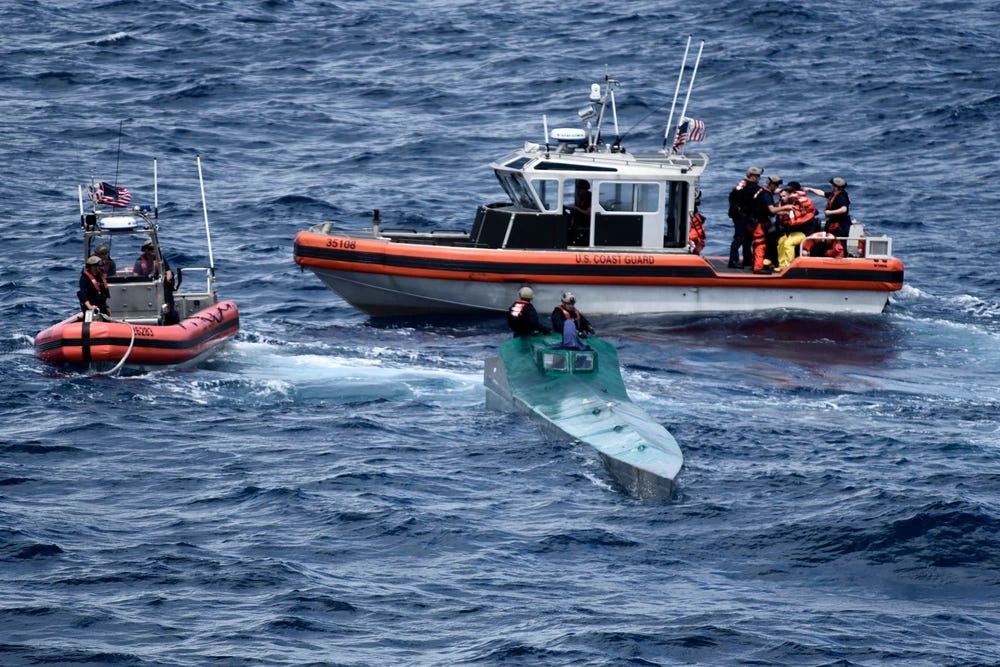
The United States has spent decades intercepting suspected drug smugglers at sea. Those operations have frequently involved Coast Guard personnel working with the Navy to stop vessels, seize drugs, and take suspects into custody.
In July 2025, for example, the Coast Guard and Navy intercepted a high-speed boat in the eastern Pacific. After warning shots failed to stop it, a military helicopter used disabling fire. The crew recovered approximately 3,439 pounds of cocaine and arrested two suspected smugglers.
Both survived to face legal consequences for their alleged actions.
We do not know whether the vessel attacked Tuesday could have been stopped in the same way. Circumstances differ, and maritime interdictions can be dangerous.
But a suspected criminal is not automatically a battlefield target.
The administration’s legal argument depends on treating its campaign against drug cartels as an armed conflict. Under the laws of war, military forces may attack legitimate military targets under defined conditions.
Legal scholars and human-rights organizations challenge that interpretation. They argue that criminal trafficking, even by a group designated as a terrorist organization, does not automatically make its members lawful military targets.
The administration maintains that its operations are legal and necessary to defend the United States. It has not made its full legal reasoning public.
That disagreement goes to the heart of the government’s authority. If the president can designate suspected criminals as wartime enemies and order lethal strikes against them, the ordinary safeguards associated with arrest, evidence, and prosecution may no longer apply.
What Congress and the courts have actually done
Meaningful efforts have challenged the strikes.
In December 2025, the House considered a resolution directing the removal of American forces from unauthorized hostilities against designated terrorist organizations in the Western Hemisphere.
It failed, 210 to 216.
That was a real opportunity for Congress to challenge the administration’s use of military force. The House did not approve the measure, and the military campaign continued.
Civil-liberties organizations have also taken the case to court.
The American Civil Liberties Union and the Center for Constitutional Rights sued to obtain a Justice Department legal memorandum that the administration has relied upon to justify its boat-strike campaign.
On September 30, U.S. District Judge Paul Engelmayer rejected two of the government’s arguments for withholding the memorandum. He ordered the administration to submit it for private judicial review and provide information about who had received access to it.
The administration subsequently challenged the requirement to identify those individuals. On October 8, the judge temporarily paused that part of his order while considering the government’s objections. The requirement to submit the legal memorandum for judicial review remained in place.
This is meaningful judicial scrutiny, but its limits matter.
The judge has ordered scrutiny of the legal rationale. He has not ordered the strikes to stop.
The lawsuit concerns public access to the legal memorandum, not a judicial determination of whether the military may conduct the strikes. The document has not been released publicly, and the underlying legal dispute remains unresolved.
The Pentagon’s inspector general has also initiated an evaluation of whether military personnel followed established targeting procedures. That review may establish whether the military complied with its own procedures, but it is not intended to determine whether the strikes themselves were lawful.
These are different forms of accountability, with different powers and limitations. None has yet produced a demonstrated change in the military’s use of lethal force against suspected traffickers.
A Kentucky congressman is preparing another challenge
Representative Thomas Massie, a Republican from Kentucky, is preparing to force a House vote on impeaching Defense Secretary Pete Hegseth.
Massie announced eight proposed articles of impeachment in September. One accuses Hegseth of replacing maritime law enforcement with unauthorized lethal military operations against suspected drug traffickers.
The allegations are serious. They include unlawful killings, failure to protect survivors, and misuse of military authority. They remain allegations, not established judicial findings.
On October 26, Massie told Roll Call that he intends to pursue a vote during the first week of the House’s post-election session, which begins the week of November 9.
That gives the Kentucky congressman a specific opportunity to challenge the Pentagon’s leadership.
It does not guarantee that the House will debate or approve the charges.
Massie plans to use a House procedure that can bring an impeachment question before the chamber. But members may choose to table the resolution instead of proceeding with the charges. Even if the House votes to impeach Hegseth, the Senate would need a two-thirds vote to convict and remove him.
A vote on impeachment would not, by itself, end the strikes.
There is another complication. Massie’s resolution includes allegations involving military operations in Iran, Venezuela, and Yemen, as well as the drug-boat campaign. Lawmakers considering his proposal will be voting on a broader case against Hegseth rather than a separate measure devoted exclusively to the boat strikes.
Nevertheless, the proposed vote could require members of Congress to take a public position on whether the defense secretary should face formal accountability for the military’s conduct.
What happens next
For Kentucky readers, the most immediate opportunity is the approaching House decision.
One practical step is to ask your current U.S. representative whether they will support allowing Massie’s impeachment resolution to proceed rather than tabling it, and to explain their position on its allegations concerning the boat strikes.
The official House directory, linked below, provides contact information for every representative.
That request will not stop a military operation on its own. But it concerns a specific decision Congress may soon make, and one representatives can be asked to account for publicly.
Meanwhile, the court must determine whether the administration can continue withholding the legal memorandum that governs its use of lethal force. Congress retains its powers over military authorization, funding, investigations, and impeachment.
The military has continued its campaign while these questions remain unsettled.
Five more people were killed on October 27. The administration says they were drug traffickers. The public has not seen the evidence, and no court has yet ruled on the legality of this strike.
When the House returns in November, members will have another opportunity to decide whether to challenge the defense secretary’s conduct.
What remains to be seen is whether that decision produces anything more than another debate while the strikes continue.
Sources
U.S. Southern Command, original video and military statement, October 27, 2026
Associated Press, October 27, 2026: U.S. military strike kills five aboard alleged drug boat
Just Security, updated October 27, 2026: Timeline of Boat Strikes and Related Actions
DVIDS, July 18, 2025: Coast Guard and USS Sampson conduct eastern Pacific interdiction
U.S. House Clerk, December 17, 2025: Roll Call 345 on H. Con. Res. 61
Federal district court, September 30, 2026: ACLU v. Department of Justice, Opinion and Order
Federal district court, October 8, 2026: Order temporarily staying one disclosure requirement
Associated Press, May 2026: Pentagon inspector general announces targeting review
Representative Thomas Massie, September 15, 2026: Proposed impeachment articles
Roll Call, October 26, 2026: Massie plans impeachment vote during lame-duck session